What “Partnership-Led Growth Mindset” Actually Means
Definition and intent: A partnership-led growth mindset is the habit of seeing growth opportunities as “co-created” with other organizations rather than “won” alone. It combines two disciplines: (1) a growth mindset about learning and iteration, and (2) a partnership lens that asks, “Who already has the assets, access, or credibility that would multiply this outcome?” Instead of treating partnerships as a last-mile distribution trick, you treat them as a strategic way to design better offers, reach customers faster, reduce risk, and unlock capabilities you don’t have in-house.
How it differs from a sales or marketing mindset: A sales mindset focuses on closing deals with customers; a marketing mindset focuses on generating demand; a partnership-led growth mindset focuses on building repeatable growth loops with other entities—platforms, communities, suppliers, integrators, complementary products, and even competitors—where both sides win and the customer experience improves. The key is not “more introductions,” but “more compounding.”
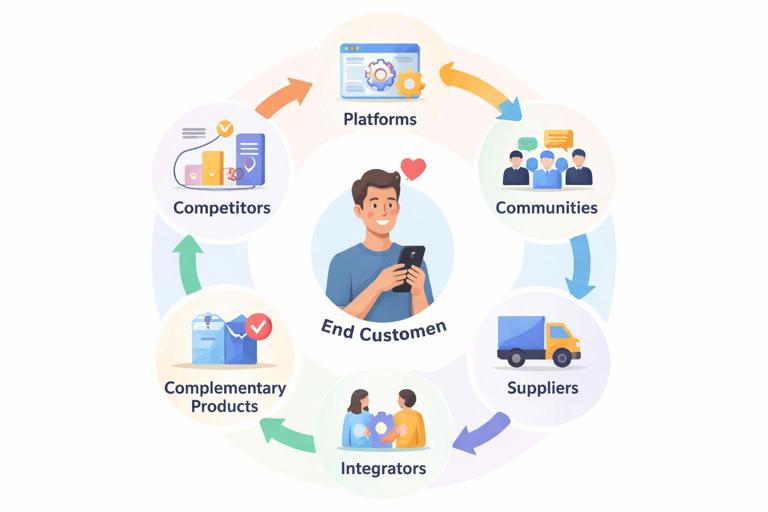
Core belief: Your company’s growth ceiling is often determined by your “adjacency map”—the set of partners that can connect you to customers, data, workflows, trust, and distribution. The mindset is to continuously expand and refine that map while staying selective about which opportunities to pursue.
Why Opportunity Selection Matters More Than “More Partnerships”
Partnerships are not free: Every partnership consumes attention, legal review, product work, training, co-marketing time, and relationship management. If you pursue too many low-leverage opportunities, you create “partnership debt”: half-built integrations, stale co-marketing pages, confused positioning, and internal skepticism about partnerships as a channel.
Opportunity selection is a growth skill: The best partnership teams are not the ones that say “yes” to everything; they are the ones that can quickly identify which opportunities have (a) strategic fit, (b) a clear path to value, and (c) a realistic execution plan. Selection is where you protect focus and maximize learning per unit of effort.
- Listen to the audio with the screen off.
- Earn a certificate upon completion.
- Over 5000 courses for you to explore!

Download the app
Compounding vs. one-off wins: A partnership-led growth mindset prioritizes opportunities that can compound: repeatable referrals, embedded distribution, shared workflows, or recurring co-selling motions. One-off sponsorships or “logo swaps” can be useful, but they rarely compound unless they are part of a broader loop.
The Partnership-Led Growth Loop: A Simple Mental Model
Loop components: Think in loops rather than linear campaigns. A partnership-led growth loop typically includes: (1) partner discovers you, (2) partner understands value and trust is built, (3) partner activates a motion (referral, bundling, integration, marketplace listing, co-selling), (4) customer gets value quickly, (5) results are measurable and shared, (6) partner is rewarded and repeats, (7) more partners join because the program is credible.
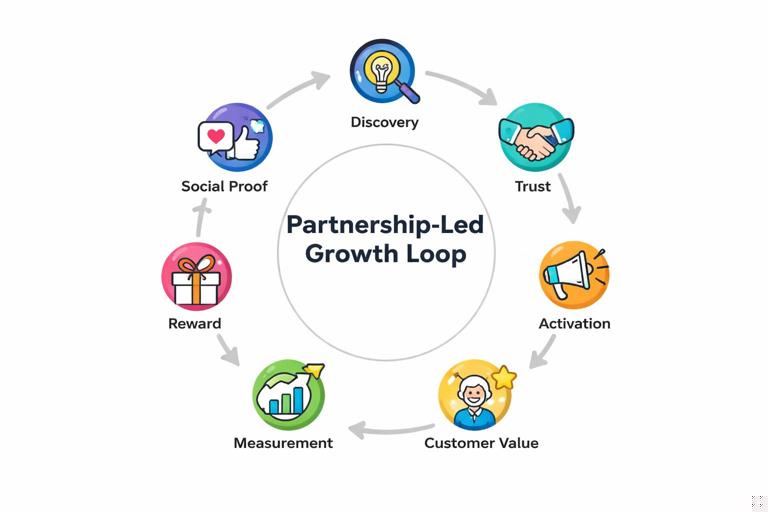
Example: A B2B analytics tool partners with a niche implementation agency. The agency uses the tool in every client engagement, gets a margin or referral fee, and publishes case studies. Each successful client becomes proof that attracts more clients to the agency and more inbound interest to the tool. The loop compounds because the agency’s business model naturally repeats the motion.
Opportunity Types: Know What You’re Actually Selecting
Common partnership opportunity categories: Opportunity selection improves when you name the type of partnership you’re evaluating. Different types have different timelines, risks, and success metrics.
- Distribution partners: Someone who can put you in front of customers (resellers, affiliates, communities, marketplaces).
- Capability partners: Someone who adds missing expertise (implementation, compliance, localization, support).
- Product adjacency partners: Complementary products that create a better combined workflow (integration, bundling, embedded features).
- Credibility partners: Brands or institutions that increase trust (certifications, endorsements, co-branded research).
- Supply or access partners: Data providers, manufacturers, logistics, or platforms that unlock inputs you need.
Practical implication: If you treat every opportunity as “a partnership,” you will compare apples to oranges. A marketplace listing might be a 2-week effort with uncertain upside; an integration might be a 3-month effort with long-term compounding. Naming the type helps you set the right bar.
Step-by-Step: A Practical Framework for Selecting Partnership Opportunities
Step 1: Start with a “Growth Constraint” (Not a Partner List)
Identify the bottleneck: Opportunity selection begins with your current constraint. Examples: low trust in a regulated market, long sales cycles, lack of implementation capacity, weak retention due to missing workflow integration, or limited reach into a specific segment.
Write a constraint statement: Use a simple template: “We are not growing because ______.” Then add: “A partner could help by ______.” For example: “We are not growing in mid-market healthcare because prospects don’t trust a new vendor. A partner could help by lending credibility and providing implementation expertise.”
Step 2: Define the “Partner Value Hypothesis” in One Sentence
Make it testable: A partner value hypothesis is a clear claim about how the partnership will create measurable value for both sides. Template: “If we partner with [partner type], then [customer segment] will [behavior], because [mechanism], resulting in [metric].”
Example: “If we partner with payroll integrators, then HR managers will adopt our benefits tool faster because setup becomes one-click, resulting in a 20% higher conversion rate from demo to paid.”
Step 3: Score Opportunities with a Lightweight “Partnership Fit Score”
Use a consistent rubric: Create a simple 1–5 scoring system across criteria. Keep it lightweight so it gets used. Here is a practical rubric you can implement immediately:
- Strategic alignment: Does this partner serve the same customer segment and support your positioning?
- Mutual value clarity: Can you explain the win for them without forcing it?
- Activation path: Is there a clear first motion (referral, integration, bundle, co-sell) that can start within 30–60 days?
- Execution cost: How much product, legal, and operational work is required?
- Compounding potential: Will the motion repeat naturally, or is it a one-time push?
- Control and dependency risk: Could they change terms, compete, or gatekeep access?
- Measurement feasibility: Can you track outcomes with reasonable accuracy?
Decision rule: Decide in advance what “good” looks like. For example: pursue only opportunities scoring 24+ out of 35, and require at least 4/5 on “activation path” and “mutual value clarity.” This prevents you from chasing shiny logos that won’t move the needle.
Step 4: Choose a “Minimum Viable Partnership” (MVP) Test
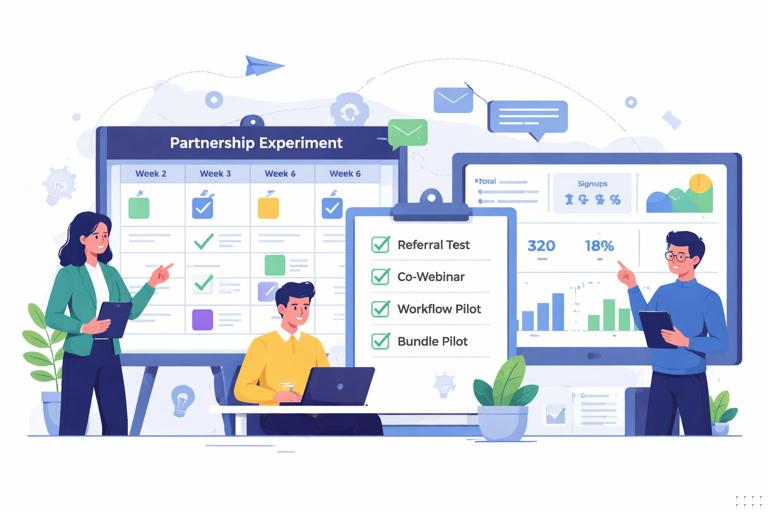
Design a small experiment: Instead of negotiating a complex long-term arrangement, define a test that validates the hypothesis. MVP tests should be time-boxed (2–6 weeks) and produce a measurable signal.
- Referral test: Partner sends 3–10 warm intros to qualified prospects; you track conversion and sales cycle impact.
- Co-webinar test: One event to measure registration-to-meeting conversion and audience fit.
- Workflow pilot: A manual “concierge integration” where you simulate the integration with human effort to validate demand before building.
- Bundle pilot: Offer a limited-time combined package to 5–20 customers; measure attach rate and churn impact.
Define success thresholds: Example: “If we get at least 5 qualified meetings and close 1 deal within 60 days, we proceed to a deeper motion.” Thresholds turn partnership selection into a learning system rather than a debate.
Step 5: Map the “Activation Owner” and Internal Readiness
Assign ownership: Partnerships fail when “everyone” owns them. For each opportunity, assign a single activation owner responsible for the first motion and outcomes. This might be a partnerships manager, a sales lead, or a product lead depending on the type.
Check readiness: Ask: Do we have the assets to activate? Examples include a partner pitch deck, a landing page, a demo environment, a training doc, a referral tracking method, and a clear support path. If you can’t activate quickly, you’re not selecting an opportunity—you’re selecting a future project.
Step 6: Decide the “Next Deeper Commitment” Before You Start
Pre-commit to the ladder: Define what happens if the MVP test works. Examples: move from referral test to quarterly co-selling cadence; move from concierge integration to API build; move from one co-webinar to a 3-event series; move from bundle pilot to a formal SKU and enablement.
Also define exit criteria: If the test fails, decide whether you iterate (change segment, offer, or motion) or stop. This keeps your pipeline clean and protects your team’s credibility.
Practical Examples of Opportunity Selection in Different Contexts
Example 1: Early-Stage SaaS Choosing Between a Big Logo and a Small Specialist
Scenario: A startup offering customer support automation has two options: (A) pursue a partnership with a major CRM platform that requires a long integration and marketplace approval, or (B) partner with a boutique customer success agency that can start referring clients immediately.
Selection logic: Using the fit score, the big platform scores high on compounding potential but low on activation path and execution cost. The boutique agency scores high on activation path and mutual value clarity. The startup chooses the agency first to generate case studies and revenue, then uses that proof to approach the platform later with stronger leverage and clearer integration requirements.
Example 2: Consumer Brand Selecting Retail Partnerships Without Losing Margin
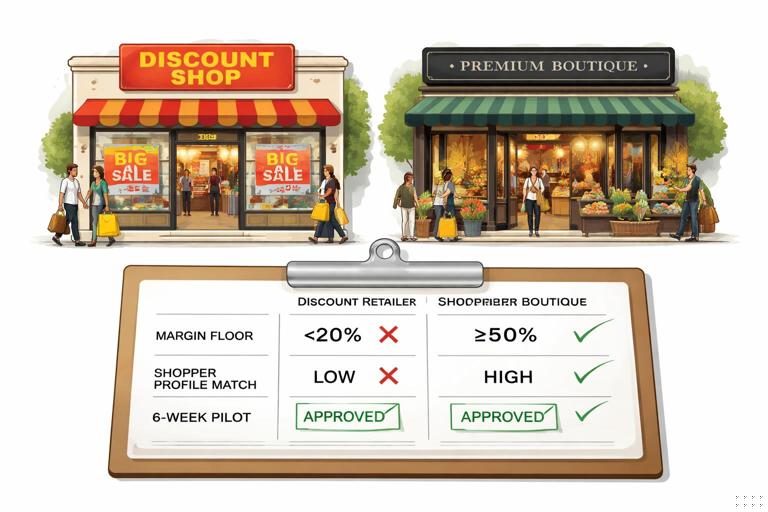
Scenario: A premium food brand is approached by multiple retailers. Some offer large volume but demand deep discounts and promotional spend; others are smaller but align with the brand’s positioning and have loyal audiences.
Selection logic: The brand defines its constraint as “awareness among high-intent buyers without eroding premium perception.” It selects retailers where the shopper profile matches, the merchandising supports premium placement, and the partnership includes storytelling (sampling events, featured placements) rather than constant discounting. The MVP test is a 6-week regional pilot with a clear reorder threshold and margin floor.
Example 3: Services Firm Selecting Capability Partners to Scale Delivery
Scenario: A cybersecurity consultancy is growing but can’t deliver projects fast enough. It considers partnering with freelance networks, training academies, and complementary consultancies.
Selection logic: The constraint is delivery capacity and consistent quality. The firm selects a training academy partnership where graduates can be certified into the firm’s delivery playbook. The MVP test is onboarding a cohort of 10 trainees into supervised projects with quality metrics and client satisfaction targets. This creates a compounding talent pipeline rather than ad-hoc staffing.
Mindset Shifts That Improve Partner Opportunity Judgment
Shift 1: From “Who’s impressive?” to “Who has repeated access?”
Practical filter: Prefer partners who repeatedly encounter your ideal customer at the right moment. For example, an accounting firm sees businesses during financial system changes; a logistics provider sees e-commerce brands during scaling pains. Repeated access beats brand prestige when you need consistent pipeline.
Shift 2: From “Can they send leads?” to “Can we create a default workflow?”
Workflow thinking: The strongest partnerships become the default choice inside a workflow: “When X happens, we use Y.” For example, “When a company implements HRIS, they also implement benefits enrollment.” Selecting partners who can embed you into a workflow increases compounding and reduces reliance on constant promotion.
Shift 3: From “Let’s negotiate terms” to “Let’s validate behavior”
Behavior first: Before you debate revenue share percentages, validate that the partner will actually activate. A small test where they introduce you to real customers is more informative than a polished partnership deck. Opportunity selection improves when you prioritize evidence over promises.
Shift 4: From “We need more partners” to “We need a partner portfolio”
Portfolio logic: Think like an investor: diversify by partner type and risk. You might have a few high-upside platform bets, several reliable channel partners, and a set of capability partners that protect delivery quality. Opportunity selection becomes easier when you know what your portfolio is missing.
Tools You Can Implement Immediately
A One-Page Opportunity Brief (Template)
Use this before any serious pursuit:
Partner Opportunity Brief (1 page) 1) Partner type: 2) Target customer segment overlap: 3) Growth constraint addressed: 4) Partner value hypothesis (one sentence): 5) First activation motion (within 30–60 days): 6) MVP test design (time-boxed): 7) Success metrics + thresholds: 8) Internal owner + required resources: 9) Risks (dependency, brand, legal, operational): 10) Next deeper commitment if successful:Why it works: It forces clarity, makes trade-offs visible, and creates a record of assumptions you can revisit after the test.
A Simple Scoring Sheet (Example)
Copy and adapt:
Partnership Fit Score (1–5 each) Strategic alignment: __ Mutual value clarity: __ Activation path: __ Execution cost (reverse score): __ Compounding potential: __ Dependency risk (reverse score): __ Measurement feasibility: __ Total: __ / 35 Decision: Pursue / Park / DeclineTip: “Reverse score” means lower cost or lower risk gets a higher score, keeping totals intuitive.
Common Traps in Opportunity Selection (and How to Avoid Them)
Trap 1: The “Big Logo” Bias
What happens: Teams chase a well-known brand because it feels validating. The deal drags, internal resources get consumed, and activation never materializes.
Countermeasure: Require a near-term activation path and an MVP test. If the partner cannot commit to a small test, treat it as a long-term relationship-building effort, not a growth initiative.
Trap 2: Confusing “Interest” with “Ability to Execute”
What happens: A partner says they are excited, but they lack incentives, bandwidth, or a clear owner.
Countermeasure: In your selection process, ask: “Who is the activation owner on your side, and what is their success metric?” If they can’t answer, you’re selecting a conversation, not an opportunity.
Trap 3: Overbuilding Before Proof
What happens: You invest in integrations, collateral, and complex agreements before validating demand.
Countermeasure: Use concierge pilots and manual processes to validate behavior first. Build only after you see repeated pull from real customers.
Trap 4: Partnering Outside Your Positioning
What happens: You pursue partners with different customer expectations, leading to mismatched messaging and poor conversion.
Countermeasure: Include “positioning fit” in your score and test with a small audience before scaling. If the partner’s customers need a different promise than you can credibly deliver, decline.
How to Build a Personal Habit of Partnership Opportunity Scanning
Create a Weekly “Adjacency Review”
Routine: Once a week, list 5 entities that touch your customer before, during, or after they use your product: tools, agencies, communities, educators, compliance bodies, distributors, or influencers. For each, write one sentence: “They could help us because ______.” This builds your adjacency map over time.
Keep a “Signals Log” for Partner Readiness
Signals to track: inbound mentions from partners, customers asking for integrations, repeated co-usage patterns, partners already recommending alternatives, or partners publishing content about the problem you solve. Opportunity selection becomes easier when you follow signals rather than forcing partnerships into existence.
Use “Customer Journey Anchors” to Find High-Leverage Partners
Anchor moments: Identify moments when customers are most open to adopting something new: onboarding, switching systems, compliance deadlines, hiring bursts, fundraising, entering new markets. Partners who own these moments are often the highest leverage. For example, if customers adopt your tool during onboarding, then onboarding consultants and implementation agencies are natural targets.