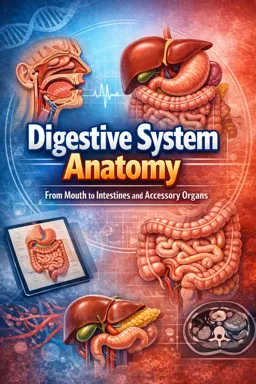
Oral Cavity Boundaries and Subdivisions
The oral cavity is the entry chamber where digestion begins through mechanical breakdown (mastication), lubrication, and formation of a swallowable bolus. Anatomically, it is defined by clear boundaries that you should be able to trace on a skull, a sagittal section, or an oral exam.
Boundaries to identify
- Anterior: lips (orbicularis oris) and oral fissure.
- Lateral: cheeks (buccinator) and the dental arches.
- Superior (roof): hard palate anteriorly and soft palate posteriorly.
- Inferior (floor): mylohyoid and geniohyoid muscles covered by mucosa; tongue occupies most of the space.
- Posterior: the oropharyngeal isthmus (also called the fauces), the gateway to the oropharynx.
Subdivisions: vestibule vs oral cavity proper
Think of the oral cavity as two connected spaces separated by the teeth and gingiva.
- Oral vestibule: the slit-like space between lips/cheeks and the teeth/gingiva. This is where food can temporarily collect and where you can feel the openings of some salivary ducts near the upper molars.
- Oral cavity proper: the space inside the dental arches, containing the tongue and opening posteriorly to the oropharynx through the fauces.
Practical identification tip: If you retract the cheek laterally, you are looking into the vestibule. When you close your teeth together and place food on the tongue, you are using the oral cavity proper.
Module 1: Dentition and Occlusion Basics (Mechanical Breakdown)
Teeth are specialized tools for cutting, tearing, and grinding food into smaller particles, increasing surface area for enzymatic action and making a cohesive bolus possible.
Tooth classes and functional roles
- Incisors: sharp edges for cutting and shearing.
- Canines: pointed cusps for tearing and gripping.
- Premolars: transitional grinding; typically two cusps.
- Molars: broad occlusal surfaces for crushing and grinding.
Key external tooth anatomy (what to label)
- Crown: visible portion above the gingiva, covered by enamel.
- Neck (cervix): junction near the gingival margin.
- Root: anchored in the alveolar bone by the periodontal ligament.
Occlusion: how teeth meet to process food
Occlusion refers to the contact relationship between maxillary and mandibular teeth. Efficient mastication depends on stable contacts that allow grinding without excessive lateral stress.
- Listen to the audio with the screen off.
- Earn a certificate upon completion.
- Over 5000 courses for you to explore!

Download the app
- Centric occlusion (maximum intercuspation): the position where upper and lower teeth fit together most fully; commonly used during chewing strokes.
- Chewing cycle (functional overview): opening phase (food repositioning), closing phase (tooth-food contact), and power stroke (grinding on molars/premolars).
Practical step-by-step: what happens to a bite of food
- Incision: incisors cut a piece from the food.
- Positioning: tongue and cheeks move the piece onto the occlusal tables of premolars/molars (usually one side at a time).
- Grinding: molars crush and grind while saliva moistens particles.
- Collection: tongue gathers the moistened particles into a cohesive bolus on its dorsum.
Cheek and lip support: keeping food on the teeth
The buccinator presses the cheek against the teeth, preventing food from accumulating in the vestibule during chewing. The lips help seal the anterior oral cavity, especially important for retaining liquids.
Module 2: Tongue Anatomy for Bolus Formation (Muscles and Papillae)
The tongue is a muscular hydrostat: it changes shape and position to manipulate food, mix it with saliva, and form a bolus that can be propelled posteriorly.
Surface landmarks students should recognize
- Apex: tip of the tongue.
- Body: anterior two-thirds (oral part).
- Root: posterior one-third (pharyngeal part), facing the oropharynx.
- Sulcus terminalis: V-shaped groove separating body and root.
- Foramen cecum: small pit at the apex of the sulcus terminalis (a landmark, not a duct opening).
- Lingual frenulum: midline fold tethering the ventral tongue to the floor of mouth.
Intrinsic vs extrinsic muscles (function-focused)
Muscles are best learned by what they do during chewing and swallowing.
- Intrinsic muscles (within the tongue): change shape (curl, flatten, narrow, elongate). These are crucial for molding the bolus and creating a central groove for liquids.
- Extrinsic muscles (attach to surrounding bones/structures): move the tongue’s position.
| Extrinsic muscle | Main action in digestion | What to look for on sagittal anatomy |
|---|---|---|
| Genioglossus | Protrudes and depresses central tongue; helps keep airway open while positioning bolus | Fan-shaped muscle from mandibular symphysis to tongue |
| Hyoglossus | Depresses tongue sides; helps create space for bolus control | Vertical sheet from hyoid to lateral tongue |
| Styloglossus | Retracts and elevates tongue; draws bolus posteriorly | Posterolateral pull toward styloid region |
| Palatoglossus | Elevates posterior tongue; narrows the fauces during bolus transfer | Forms the palatoglossal arch (anterior pillar) |
Papillae: anatomical features relevant to bolus handling
Papillae increase friction and help manipulate food; some also house taste buds, which influence salivary reflexes and chewing patterns.
- Filiform papillae: most numerous; keratinized; provide friction for moving and gripping food (no taste buds).
- Fungiform papillae: scattered, especially near the tip; contribute to taste and oral sensory feedback.
- Circumvallate papillae: large papillae arranged just anterior to the sulcus terminalis; associated with taste buds and glandular secretions that help cleanse trenches.
- Foliate papillae: lateral folds (more prominent in some individuals); contribute to taste and texture sensing.
Practical link to digestion: Texture and taste detection modulate chewing force and salivary flow; the tongue’s frictional surface helps gather scattered particles into a single cohesive bolus.
Floor of mouth structures that guide saliva and bolus
- Mylohyoid: forms the muscular diaphragm of the floor; elevates during early swallowing to help push the bolus posteriorly.
- Sublingual folds: mucosal ridges created by the sublingual glands; important landmarks for duct openings.
- Sublingual caruncles: small papillae on either side of the frenulum; key duct opening sites (see salivary module).
Module 3: Hard and Soft Palate (Separating Oral and Nasal Cavities)
The palate forms the roof of the mouth and creates a functional separation between the oral cavity (food pathway) and nasal cavity (air pathway). This separation is dynamic: rigid anteriorly and mobile posteriorly.
Hard palate: rigid platform for chewing
- Composition: palatine processes of the maxilla (anterior) and horizontal plates of the palatine bones (posterior).
- Function in digestion: provides a firm surface against which the tongue compresses food during bolus formation; supports efficient mastication.
- Landmarks: palatine rugae (transverse ridges) help grip food; incisive papilla is an anterior midline landmark.
Soft palate: mobile valve during swallowing
The soft palate is a muscular flap that changes position to regulate communication between the nasopharynx and oropharynx.
- Uvula: midline projection; a visible landmark of the soft palate’s posterior edge.
- Palatoglossal arch (anterior pillar): mucosal fold over palatoglossus; forms the anterior boundary of the fauces.
- Palatopharyngeal arch (posterior pillar): mucosal fold over palatopharyngeus; contributes to guiding the bolus into the pharynx.
Functional sequence: During the swallow, the soft palate elevates to help seal off the nasopharynx while the tongue propels the bolus posteriorly through the fauces.
Accessory-Organ Preview: Major Salivary Glands, Duct Openings, and Nearby Landmarks
Saliva lubricates, begins chemical digestion, buffers oral pH, and helps form a cohesive bolus. The major salivary glands deliver saliva into specific oral locations via ducts that have consistent surface landmarks.
Map of glands and duct openings (what to find in the mouth)
| Gland | Main duct | Oral opening landmark | Nearby structures students should note |
|---|---|---|---|
| Parotid | Parotid duct (Stensen) | Parotid papilla in the vestibule opposite the upper 2nd maxillary molar | Crosses masseter, turns medially through buccinator; close relationship to facial nerve branches within parotid region (nerve is not in the duct but is a key regional landmark) |
| Submandibular | Submandibular duct (Wharton) | Sublingual caruncle beside the lingual frenulum | Duct runs forward in floor of mouth; closely related to the lingual nerve in this region (important neurovascular landmark for orientation) |
| Sublingual | Multiple small ducts (Rivinus) and sometimes a major sublingual duct (Bartholin) | Along the sublingual fold; may contribute to opening at sublingual caruncle | Lies under mucosa of floor of mouth; forms visible sublingual fold ridge |
How to locate duct openings during an oral exam (step-by-step)
- Parotid duct: retract the cheek laterally; look for a small papilla opposite the upper second molar; gentle pressure over the parotid region may express saliva.
- Submandibular duct: lift the tongue; identify the lingual frenulum; find the paired sublingual caruncles at its base; the duct openings are on these papillae.
- Sublingual ducts: trace the sublingual fold posterior-to-anterior along the floor of mouth; multiple tiny openings may be present along the ridge.
Why duct location matters for digestion
- Targeted lubrication: saliva enters where food is manipulated (floor of mouth and vestibule), improving bolus cohesion.
- Chewing efficiency: well-lubricated particles aggregate rather than scatter, reducing chewing time and aiding safe swallowing.
Bolus Movement to the Oropharynx: Stepwise Anatomy (Sagittal Section Emphasis)
Bolus transport from the oral cavity to the oropharynx is often described in phases. Here the focus is on the anatomical pathway and the structures you should be able to point out on a mid-sagittal image.
Key sagittal landmarks to identify before describing motion
- Hard palate (anterior roof) and soft palate with uvula (posterior roof).
- Dorsum of tongue (body) and tongue root approaching the oropharynx.
- Fauces (oropharyngeal isthmus): space between the palatoglossal arches.
- Floor of mouth: mylohyoid under the tongue.
- Oropharynx: posterior to the oral cavity proper, inferior to the soft palate.
Step-by-step: from formed bolus to entry into the oropharynx
- Bolus formation (oral cavity proper): the tongue’s intrinsic muscles shape the bolus; the dorsum of the tongue and hard palate act as opposing surfaces to compress and consolidate food.
- Bolus positioning: the tongue tip and lateral margins help seal against the teeth/gingiva, while the cheeks (buccinator) prevent lateral escape into the vestibule.
- Anterior-to-posterior tongue propulsion: the tongue elevates sequentially against the hard palate, pushing the bolus posteriorly along the midline toward the fauces.
- Fauces narrowing and guidance: the palatoglossal arches (over palatoglossus) help form a controlled gateway; the posterior tongue elevates and retracts to direct the bolus through the oropharyngeal isthmus.
- Soft palate elevation (valve action): the soft palate elevates to separate the nasopharyngeal space from the bolus pathway, keeping the bolus directed toward the oropharynx.
- Entry into the oropharynx: the bolus passes behind the oral cavity proper into the oropharynx; on sagittal view, this is the transition posterior to the tongue root and inferior to the elevated soft palate.
Practical study cue: On a sagittal section, trace a continuous path from the dorsum of the tongue to the fauces, then into the oropharynx, and note how the soft palate forms the superior boundary of that passage during swallowing.