What “Win-Win” Actually Means in Partnership Negotiations
In strategic alliances, “win-win” is not a vague promise to be nice. It is a deal structure where both parties can point to specific, measurable outcomes they will receive, and where the agreement is resilient under real-world stress: missed forecasts, changing priorities, personnel turnover, and competitive pressure. A win-win deal has three properties: (1) each side’s upside is clear and tied to actions they control, (2) the risks are allocated to the party best able to manage them, and (3) the incentives align so that the fastest path to one party’s success also advances the other party’s success.
Win-win is also dynamic. Partnerships evolve: what is fair at launch may be unfair at scale. A strong negotiation therefore designs “fairness over time” using review points, tiered economics, and adjustment mechanisms. Instead of arguing about who deserves more today, you negotiate how the deal adapts as performance changes.
Preparation: Define Your Negotiation Architecture Before You Talk Numbers
Set your “deal thesis” in one sentence
A deal thesis is your internal statement of what must be true for the partnership to be worth the effort. It is not a pitch; it is a filter for decisions. Example: “We will trade margin for distribution only if we can verify partner-driven pipeline and protect our brand positioning.” This thesis prevents you from conceding on critical terms just to close.
Separate positions from interests
Positions are what someone asks for (“We need 30% revenue share”). Interests are why they ask (“We need to cover sales compensation and justify prioritization”). Negotiation gets stuck when both sides trade positions. It moves when you uncover interests and create options that satisfy them differently. For example, if the partner’s interest is sales compensation, you might offer a higher first-year share that steps down after onboarding costs are recovered, or a spiff tied to verified activations.
Map the negotiation into three buckets
Before the first negotiation call, list terms in three buckets: (1) must-haves (deal breakers), (2) tradables (you can flex if compensated), and (3) giveaways (low cost to you, high value to them). This prevents accidental concessions. A “giveaway” might be co-marketing assets or enablement sessions that cost little but signal commitment.
- Listen to the audio with the screen off.
- Earn a certificate upon completion.
- Over 5000 courses for you to explore!

Download the app
Build your BATNA and your walk-away criteria
Your BATNA (best alternative to a negotiated agreement) is your plan if the deal fails. In partnerships, BATNAs often include alternative partners, direct channels, or a smaller pilot with a different scope. Define walk-away criteria in writing: for example, “We will not grant exclusivity without minimum performance commitments and audit rights.” If you do not define this early, you will negotiate against your own anxiety.
Core Negotiation Tactics That Preserve Trust While Increasing Leverage
Anchor with structure, not with a random number
Anchoring is powerful, but in partnerships it can backfire if it feels arbitrary. A better approach is to anchor with a structure: “We typically use a tiered model based on verified outcomes, with a review at 90 days.” This sets expectations that economics are conditional and performance-based, which is easier to defend than a single aggressive percentage.
Use the “issue-by-issue” method to avoid hidden tradeoffs
Many partnership deals fail because parties negotiate in bundles (“We’ll accept your revenue share if you accept our exclusivity”). Bundling hides value and creates resentment. Instead, negotiate issue-by-issue, writing down each term and its rationale. Then, once the list is visible, you can trade consciously: “If we extend payment terms, we need stronger reporting and a shorter termination notice.”
Ask calibrated questions to surface constraints
Calibrated questions are open-ended questions that invite problem-solving rather than defensiveness. Examples: “How does your team get compensated on partner-sourced revenue?” “What would make this easy to prioritize internally?” “What would you need to see in the first 60 days to feel confident?” These questions reveal the internal mechanics driving their demands, which gives you options for creative structuring.
Use conditional language to avoid premature concessions
Replace “Yes” with “If.” Conditional language keeps you collaborative while protecting your leverage. Example: “If we agree to a higher share in the first quarter, then we’d need a clear activation commitment and weekly reporting.” This frames concessions as trades, not gifts.
Control tempo with written summaries
After each negotiation meeting, send a short written summary of what was agreed, what is open, and what each side will propose next. This reduces misunderstandings and prevents “term drift,” where previously agreed points get reopened. It also creates a record that speeds legal review later.
Step-by-Step: Structuring a Win-Win Deal (From Terms to Mechanisms)
Step 1: Define the unit of value and the unit of risk
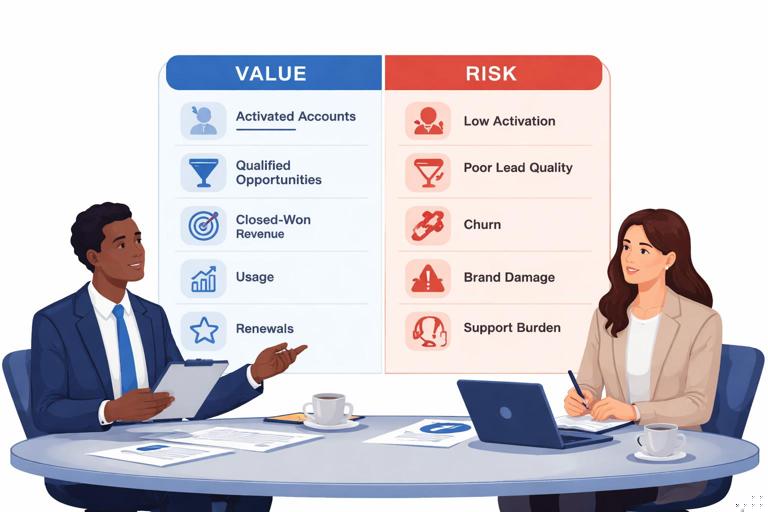
Partnership economics should be tied to a unit of value that both sides can observe and verify. Examples include: activated accounts, qualified opportunities accepted by sales, closed-won revenue, usage thresholds, or renewals. The unit of risk is what can go wrong: low activation, poor lead quality, high churn, brand damage, or support burden. Start by naming both explicitly, because your deal terms should reward the value unit and protect against the risk unit.
Step 2: Choose an economic model that matches behavior
Different models incentivize different behaviors. A referral fee may incentivize volume but not quality. A revenue share may incentivize deeper involvement but can create disputes about attribution. A fixed fee may simplify operations but can reduce motivation. Select the model based on what you need the partner to do consistently. If you need them to invest in enablement and ongoing promotion, a tiered revenue share with performance thresholds may fit. If you need quick introductions, a per-activation bounty with quality gates may fit.
Step 3: Add performance gates and quality controls
Win-win deals protect both sides from wasting effort. Add gates such as: minimum qualification criteria, acceptance windows, disqualification reasons, and a “cure period” to fix issues. Example: “Leads must include company size, use case, and decision-maker contact. We will accept or reject within five business days. Rejected leads will include a reason code.” This prevents arguments later and helps the partner improve.
Step 4: Allocate responsibilities with a RACI-style term
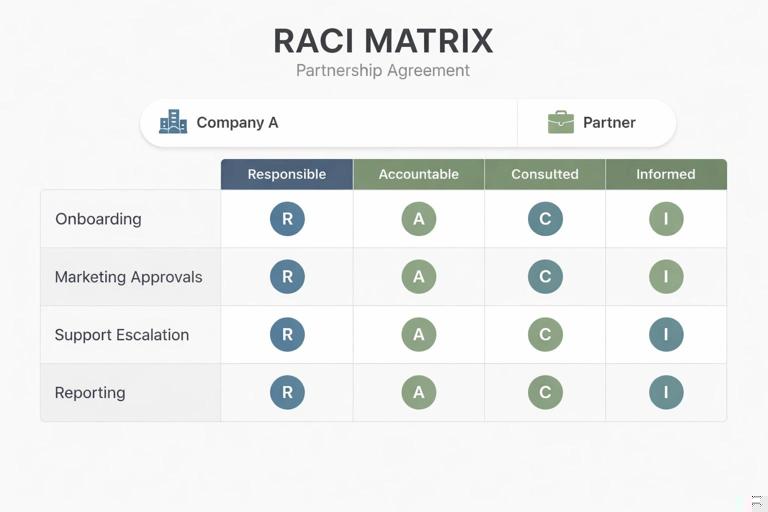
Many partnership conflicts are operational, not economic. Include a simple responsibility matrix in the agreement or an attached exhibit: who is Responsible, Accountable, Consulted, and Informed for onboarding, marketing approvals, customer support escalation, and reporting. A clear RACI reduces the “we thought you were doing that” failure mode.
Step 5: Design review points and adjustment mechanisms
Instead of trying to predict the future, build checkpoints. Common mechanisms include: 30/60/90-day reviews, quarterly business reviews, and annual renegotiation windows. Tie these to specific triggers: “If partner-sourced revenue exceeds X, the revenue share steps down/up,” or “If support tickets exceed Y per account, we revisit enablement requirements.” This makes the deal adaptable without feeling unstable.
Step 6: Add protective clauses that feel fair
Protective clauses are not “gotchas” when they are mutual and clearly explained. Examples: confidentiality, data handling, brand guidelines, non-solicitation of employees, and limitations on public announcements. The key is to explain the operational reason: “We need brand approval to prevent inconsistent claims,” or “We need data handling terms to comply with customer requirements.” Fairness comes from reciprocity and clarity.
Common Deal Terms and How to Negotiate Them Without Losing the Relationship
Revenue share vs. referral fee
When negotiating revenue share, clarify: gross vs. net revenue, discounts, refunds, chargebacks, and renewal treatment. A frequent win-win approach is to pay higher on the first term (to reward acquisition effort) and lower on renewals (to reflect reduced incremental work), or to pay renewals only if the partner remains engaged in success activities. For referral fees, define the “qualified referral” precisely and include an acceptance process to avoid disputes.
Exclusivity
Exclusivity is often requested as a shortcut to priority. It can be win-win only when it is conditional. Negotiate exclusivity with (1) a narrow scope (specific segment, geography, or use case), (2) time limits, and (3) performance commitments with automatic reversion if unmet. Example: “Exclusive for mid-market healthcare in the UK for six months, contingent on X verified activations; otherwise it becomes non-exclusive.”
Territory and segment definitions
Ambiguous territory definitions create channel conflict. Define segments using objective criteria (employee count, industry codes, geography, product line). Add a conflict-resolution rule: “If both parties claim the same account, priority goes to the party that registered it first with evidence of activity within the last 30 days.” The goal is not to “win” conflicts but to prevent them.
Deal registration and protection windows
Deal registration protects partner effort and encourages investment. To keep it fair, require proof of meaningful activity and set expiration windows. Example: “Registration is valid for 90 days and can be renewed once with evidence of progress.” This prevents account squatting while still rewarding real work.
Payment terms and cash flow
Partners may push for faster payments; you may need to manage cash flow and refund risk. A win-win compromise is staged payments: partial payment on activation and the remainder after a retention milestone, or payment after invoice collection. If you accept faster payments, trade for stronger verification, lower rates, or caps on disputed amounts.
Marketing and brand approvals
Marketing terms often become bottlenecks. Negotiate a clear approval process: what needs approval, who approves, and how long it takes. Example: “We respond to asset approval requests within five business days; if no response, the asset is deemed approved, provided it follows the brand guide.” This protects your brand and keeps the partner moving.
Data sharing and reporting
Data is both value and risk. Define what data is shared, how often, and for what purpose. Use the principle of minimum necessary data: share what is needed to operate the partnership, not everything you have. If the partner requests deeper access, trade it for commitments: “We can provide cohort retention reports if you provide campaign source data and agree to joint optimization sessions.”
Advanced Win-Win Structuring: Incentives, Tiers, and Risk Sharing
Tiered incentives that reward the right behavior
Tiers can reward volume, quality, or strategic focus. A common structure is: base rate for standard performance, higher rate for hitting activation thresholds, and a bonus for strategic segments. To keep tiers win-win, make thresholds achievable but meaningful, and ensure the partner can influence outcomes. If the threshold depends on your internal sales cycle, the partner may view it as unfair; in that case, use earlier indicators like accepted opportunities or activated accounts.
Shared investment with clear ownership
Some alliances require joint spending: events, integrations, or dedicated headcount. Negotiate shared investment by defining ownership of deliverables and what happens if the partnership ends. Example: “We co-fund an event 50/50; leads are shared equally; creative assets can be reused by both parties; if terminated, neither party can claim the other’s trademarks.” Clarity prevents later conflict.
Risk reversals and guarantees
Risk reversals can unlock agreement when trust is still forming. Examples: a limited performance guarantee, a pilot credit, or a cancellation window. The win-win principle is to cap exposure and tie the guarantee to controllable factors. Example: “If activation is below X due to our onboarding delays, we extend the partner’s protection window by 30 days.” This signals accountability without writing a blank check.
Most-favored-nation (MFN) clauses
MFNs can create long-term constraints. If a partner requests MFN, narrow it: limit it to a specific segment, time period, or economic term, and exclude custom enterprise deals. Alternatively, offer transparency instead of MFN: “We will review economics annually and adjust based on performance tiers.” This maintains flexibility while addressing fairness concerns.
Handling Hardball Tactics Without Escalation
When they use pressure deadlines
If the partner says, “We need this signed by Friday,” respond by separating urgency from importance: “We can move quickly if we align on the open terms today. Which two terms are truly blocking?” Then propose a short-term letter of intent or a limited-scope addendum that allows progress while legal details finalize. This keeps momentum without accepting unfavorable terms under pressure.
When they demand unilateral terms
Unilateral terms (one-sided termination, one-sided indemnity, one-sided exclusivity) are common asks. Counter by proposing symmetry: “We can accept that if it’s mutual,” or by offering a narrower version: “We can do that for a specific segment and with a cure period.” The goal is to reframe from power to principles: reciprocity, scope limits, and accountability.
When they say “This is non-negotiable”
“Non-negotiable” often means “hard to change internally.” Use calibrated questions: “What constraint makes it non-negotiable?” “Who needs to be comfortable with an exception?” “If we keep that term, what can you adjust elsewhere to balance risk?” This turns a dead end into a trade discussion.
Practical Negotiation Scripts You Can Use
Script: Trading economics for commitments
“If we increase the first-term share to help you justify prioritization, then we’ll need a written activation plan, named owners on your side, and weekly reporting for the first 60 days. Does that work, and what would you need from us to execute?”
Script: Responding to exclusivity requests
“We can consider exclusivity if it’s narrow and performance-based. What segment do you want exclusivity in, what minimum outcomes can you commit to, and what should happen automatically if those outcomes aren’t met?”
Script: Handling a high anchor
“I understand why you’re asking for that. To make the economics sustainable, we usually tie higher rates to verified outcomes and step-downs after onboarding costs are recovered. Can we look at a tiered model with a 90-day review?”
Script: Clarifying attribution disputes early
“To avoid friction later, let’s define what counts as partner-sourced versus partner-influenced, and how we’ll handle cases where both teams touched the account. What evidence can we both agree on?”
Negotiation Hygiene: Making the Deal Easy to Execute
Keep the contract short and push details into exhibits
Long contracts slow partnerships. A practical approach is a master agreement with core legal protections, plus exhibits for economics, operating process, and brand guidelines. Exhibits can be updated more easily as the partnership evolves, which supports win-win adaptation without constant renegotiation.
Define escalation paths
Operational issues will happen. Include an escalation ladder: working-level owners first, then managers, then executives, with response times. Example: “If an issue is unresolved after five business days, it escalates to the partnership leads; after ten, to executive sponsors.” This prevents small issues from poisoning the relationship.
Use plain language definitions
Many disputes come from ambiguous definitions: “qualified lead,” “net revenue,” “active customer,” “launch date.” Add a definitions section in plain language and include examples. Example: “Net revenue excludes taxes and refunds but includes setup fees; discounts reduce net revenue.” Clarity is a negotiation tactic because it reduces future renegotiation under stress.