What “Negotiating Without Losing Alignment” Really Means
In a troubled project recovery, negotiation is not a one-time meeting where you “get approval” for a new plan. It is a structured alignment process where you convert competing needs into explicit tradeoffs that everyone can live with and execute. The goal is not to win; the goal is to create a stable agreement that holds under pressure.
“Alignment” in this context means four things are simultaneously true: (1) stakeholders share the same definition of the outcome (what value will be delivered), (2) the delivery team has a feasible path (how it will be delivered), (3) constraints are explicit (what cannot change), and (4) decision rights are clear (who can change what, and how fast). When any of these are missing, scope, resources, and dates become moving targets and the recovery plan collapses.
Negotiating scope, resources, and dates is therefore a controlled exercise in constraint management. You are not negotiating three independent variables; you are negotiating a system. Changing one variable changes the others, and pretending otherwise is how projects re-enter distress.
The Constraint Triangle, Reframed for Recovery
Most teams know the “scope–time–cost” triangle, but in recovery work you need a more operational framing: Commitments (what you promise), Capacity (what you can actually do), and Calendar (when it must be done). Quality and risk are not optional corners; they are guardrails that determine whether the negotiated plan is real.
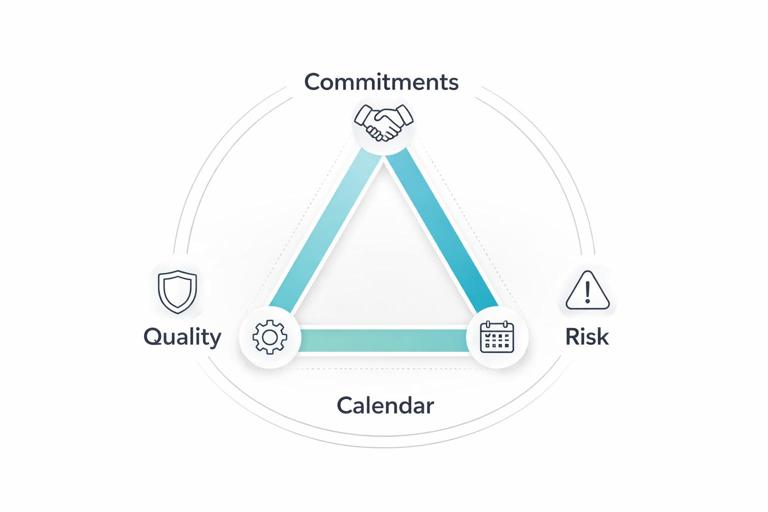
- Commitments (Scope): Not a feature list, but a set of outcomes and acceptance criteria. In negotiation, scope must be decomposed into negotiable units (must-have, should-have, could-have) with clear “done” definitions.
- Capacity (Resources): Not headcount on an org chart, but available, skilled hours after accounting for onboarding, meetings, support load, and dependencies.
- Calendar (Dates): Not a single end date, but a sequence of decision points, milestones, and release windows that can be validated.
- Guardrails (Quality/Risk): Non-negotiables such as regulatory compliance, safety, security, performance thresholds, or operational readiness. These define what “cannot be traded away” even when dates are tight.
When alignment is lost, stakeholders often negotiate as if one corner can change without affecting the others. Your job is to make the coupling explicit and to provide options that preserve guardrails.
- Listen to the audio with the screen off.
- Earn a certificate upon completion.
- Over 5000 courses for you to explore!

Download the app
Prepare: Enter Negotiation With Options, Not Opinions
Negotiations fail when the recovery lead arrives with a single preferred plan and tries to “sell” it. In distressed projects, stakeholders have different incentives and risk tolerances; a single plan forces them into yes/no positions. Instead, arrive with a small set of coherent options, each with clear implications.
Step 1: Translate the ask into outcomes and constraints
Before discussing scope or dates, restate what the business is trying to achieve in outcome language. Then capture constraints as explicit statements.
- Outcome examples: “Reduce customer onboarding time from 10 days to 2 days,” “Enable invoicing in EUR for EU customers,” “Meet audit requirement X by Q2.”
- Constraint examples: “Must pass external audit by May 15,” “Cannot increase vendor spend,” “Must maintain 99.9% uptime,” “No customer-facing downtime.”
This prevents the negotiation from devolving into feature-by-feature bargaining without a shared purpose.
Step 2: Build a negotiable scope inventory
Convert the backlog or requirements into a list of negotiable units that are understandable to non-technical stakeholders. Each unit should include: value statement, dependency notes, acceptance criteria, and an effort range.
Use categories that support negotiation:
- Minimum Viable Outcome (MVO): the smallest set that achieves the outcome and is usable in production.
- Risk reducers: work that reduces delivery or operational risk (e.g., automated tests, monitoring, data migration rehearsal).
- Enhancements: valuable but deferrable items.
- Nice-to-haves: items that can be dropped with minimal impact.
In recovery, “risk reducers” must be visible. Otherwise, they get traded away to protect dates, and the project fails later in production.
Step 3: Quantify capacity honestly
Resource negotiation is often distorted by optimistic assumptions. Present capacity as a weekly throughput range, not as “we have 8 people.” Include:
- Allocation reality (e.g., “Team is 70% allocated due to support rotation”).
- Skill constraints (e.g., “Only two engineers can modify the billing engine”).
- Ramp-up time for new staff (e.g., “New contractor productive after 3–4 weeks”).
- Non-project load (meetings, incidents, compliance tasks).
When you show capacity as a range, you create room for risk-aware negotiation rather than false precision.
Step 4: Create 2–4 integrated options
Each option should be internally consistent: scope set, staffing model, timeline, and risk profile. Avoid presenting more than four; too many options create analysis paralysis.
Example option set for a product launch:
- Option A (Date fixed): Keep launch date; reduce scope to MVO; add operational hardening; accept limited regions.
- Option B (Scope fixed): Deliver full scope; move date; keep team stable; reduce burnout risk.
- Option C (Resource increase): Keep scope and date; add specialized contractors; accept onboarding cost and integration risk.
- Option D (Phased release): Deliver MVO by date; deliver enhancements in two follow-on releases; requires stakeholder agreement on phased value.
Each option must include what you will not do, not just what you will do. That is what makes the tradeoff real.
Run the Negotiation: A Step-by-Step Facilitation Script
The negotiation meeting should be facilitated like a decision workshop, not a status meeting. Your role is to keep the group anchored to outcomes, constraints, and tradeoffs.
Step 1: Open with shared objectives and decision needed
State the decision in one sentence and confirm the decision-makers are present.
Example: “Today we need to decide which recovery option we will commit to for the next 6 weeks: fixed date with reduced scope, moved date with full scope, or phased release. We will leave with a signed-off scope boundary, staffing commitment, and milestone dates.”
Step 2: Confirm non-negotiables (guardrails)
Ask stakeholders to explicitly confirm what cannot be compromised. Capture it visibly.
- Compliance/security thresholds
- Operational readiness requirements
- Customer commitments that cannot be broken
- Budget ceilings
This step prevents later “surprise constraints” that invalidate the agreement.
Step 3: Present options with the same template
Use a consistent structure so stakeholders compare apples to apples:
- Scope included / excluded
- Resources required (by role, not just count)
- Dates and milestones
- Key risks and mitigations
- Decision points (where you can adjust)
Do not debate details yet; ensure everyone understands each option first.
Step 4: Force explicit tradeoff language
When stakeholders ask for “everything by the original date,” translate it into tradeoffs and ask them to choose.
Useful prompts:
- “If the date is fixed, which outcomes can be deferred?”
- “If scope is fixed, which date is acceptable?”
- “If we add resources, which risks are you willing to accept (onboarding time, integration defects, cost)?”
- “Which is worse: missing the date, or shipping with reduced capability?”
Make tradeoffs explicit in the meeting notes. Ambiguity is misalignment.
Step 5: Negotiate scope using “outcome slices”
Scope negotiation works best when you slice by outcome, not by component. An “outcome slice” is a thin end-to-end capability that delivers measurable value.
Example (customer onboarding improvement):
- Slice 1 (MVO): digital form + basic validation + manual review queue + audit log.
- Slice 2: automated identity verification integration.
- Slice 3: self-serve document upload + status notifications.
- Slice 4: analytics dashboard + optimization rules.
In negotiation, you can commit to Slice 1 by a fixed date and schedule Slices 2–4 based on capacity. This preserves alignment because stakeholders see value delivered, not just “partial components.”
Step 6: Negotiate resources by role and bottleneck
Resource negotiation fails when it is framed as generic headcount. Frame it around bottlenecks and critical skills.
Example: “Adding two frontend engineers does not move the date because the bottleneck is database migration and only one engineer has that expertise. The fastest lever is adding a migration specialist and freeing the current expert from support duties.”
Offer resource tradeoffs that are actionable:
- Reduce non-project work (support rotation, internal initiatives)
- Secure specific roles (QA automation, data engineer, security reviewer)
- Time-box external help with clear deliverables
- Improve decision latency (faster approvals, fewer committees)
Also negotiate “resource stability.” In recovery, churn (switching people in/out) is a hidden cost that destroys throughput.
Step 7: Negotiate dates using milestones and decision points
Instead of a single end date, negotiate a sequence:
- Milestone 1: MVO ready for internal users
- Milestone 2: limited pilot release
- Milestone 3: general availability
- Decision point: go/no-go based on predefined criteria
This structure preserves alignment because stakeholders can see how progress will be validated and where adjustments can be made without re-litigating the entire plan.
Step 8: Close with a “commitment contract” summary
End the meeting by reading back the agreement in plain language: what will be delivered, by when, with what resources, and what is explicitly out of scope. Ask each decision-maker to confirm.
Capture it as a short written artifact shared immediately after the meeting.
Practical Tools and Templates You Can Use Immediately
Option comparison table (one page)
Option: ______________________ (A/B/C/D) Owner: __________ Date: __________ Guardrails: _____________ Outcome: ______________________ Scope included (top 5): 1) ______ 2) ______ 3) ______ 4) ______ 5) ______ Scope excluded / deferred: 1) ______ 2) ______ 3) ______ Resources required (by role): - Backend: __ FTE - Frontend: __ FTE - QA/Automation: __ FTE - Data: __ FTE - Product/BA: __ FTE - Ops/SRE: __ FTE Timeline: - Milestone 1: ____ - Milestone 2: ____ - Milestone 3: ____ Key risks (top 3) + mitigation: 1) ______ / ______ 2) ______ / ______ 3) ______ / ______ Decision points + criteria: - Date: ____ Criteria: ______This forces completeness and makes it harder for stakeholders to cherry-pick the best parts of each option.
Scope boundary statement (anti-scope-creep)
We will deliver: ________________________________ by __________. We will not deliver: ___________________________ in this recovery window. Any request that changes the above requires: (1) tradeoff proposal, (2) impact review within __ days, (3) approval by __________.This is not bureaucracy; it is alignment protection.
Resource commitment checklist
- Named individuals (not just roles) assigned for the recovery window
- Allocation percentage confirmed by functional managers
- Support/on-call impact addressed (coverage plan)
- Access and environment needs resolved (tools, permissions)
- External dependencies have owners and response SLAs
Without these, “approved resources” are often imaginary.
Handling Common Negotiation Traps (and What to Say Instead)
Trap 1: “Just add more people”
Adding people can help, but only if it addresses the bottleneck and the onboarding cost is acceptable.
Response pattern:
- State the bottleneck: “The critical path is data migration and integration testing.”
- Explain why generic headcount won’t help: “More frontend capacity won’t shorten that path.”
- Offer a targeted ask: “We need one migration specialist for 4 weeks and to remove the current expert from support.”
Trap 2: “We can’t move the date” (but also won’t reduce scope)
This is a constraint conflict. Your job is to make the conflict visible and force a choice.
Response pattern:
- Confirm the constraint: “Understood, date is fixed due to the campaign.”
- Present the feasible set: “Then we must choose an MVO scope that fits capacity and guardrails.”
- Offer outcome slices: “Here are the slices; which one is the minimum acceptable for the campaign?”
Trap 3: “We’ll accept lower quality”
In recovery, “lower quality” often means hidden rework, incidents, and reputational damage. If quality is negotiable, negotiate it as explicit, measurable thresholds, not as a vague permission to cut corners.
Response pattern:
- Translate quality into measurable criteria: “Are we changing performance from 2s to 5s? Are we reducing test coverage? Are we skipping security review?”
- Explain downstream cost: “That increases incident risk and will consume the same team next month.”
- Offer safer alternatives: “We can reduce scope while keeping operational readiness intact.”
Trap 4: “Let’s keep it flexible”
Flexibility without rules is misalignment. You can allow change, but only through a defined mechanism.
Response pattern:
- Agree on controlled flexibility: “We can keep a 10% capacity buffer for unknowns.”
- Define change rules: “Any new request must come with a tradeoff: what gets removed or what date moves.”
Example Scenario: Negotiating a Recovery Release for a Billing System
Situation: A billing modernization project is in recovery. Sales needs EU invoicing by April 30 for renewals. Finance requires audit controls. Engineering reports the integration with the legacy ledger is unstable. The current plan claims full functionality by April 30, but capacity and risk make it unrealistic.

Step-by-step negotiation approach
1) Define outcome and guardrails: Outcome: “Generate compliant EU invoices for renewals.” Guardrails: “Audit trail required; no incorrect invoices; security review mandatory.”
2) Create outcome slices:
- Slice A (MVO): EU invoice generation for renewals only, limited currencies, manual exception handling, full audit log.
- Slice B: Automated tax calculation integration.
- Slice C: Self-serve credit notes and adjustments.
- Slice D: Full ledger reconciliation automation.
3) Build options:
- Option A (Fixed April 30): Deliver Slice A only; defer B–D; add a dedicated QA automation engineer; include monitoring and rollback plan.
- Option B (Move date to June 15): Deliver Slices A–C; keep team stable; reduce operational risk.
- Option C (Add resources): Attempt Slices A–C by April 30 by adding two contractors; accept onboarding and defect risk; require daily decision access from Finance.
4) Facilitate tradeoff decision: Sales confirms April 30 is critical for renewals, but accepts renewals-only scope if invoices are compliant. Finance insists audit controls are non-negotiable. Engineering confirms ledger automation is the bottleneck and cannot be safely accelerated by adding generic headcount.
5) Close the commitment: Agree on Option A with explicit exclusions (no automated reconciliation by April 30). Resources: one QA automation engineer reassigned full-time; Finance provides a named reviewer with 24-hour turnaround. Dates: internal pilot April 10, limited release April 20, renewals-ready April 30.
This preserves alignment because each stakeholder’s core need is met (renewals, compliance, feasibility), and the tradeoffs are explicit and documented.
Maintaining Alignment After the Negotiation (So It Holds)
Negotiation is fragile if it is not reinforced through operational routines. Alignment holds when the agreement is continuously reflected in day-to-day decisions.
Use “tradeoff language” in every change discussion
When a new request appears, respond with a standard question: “What are we trading for this?” If stakeholders cannot name the tradeoff, the request is not ready.
Protect the scope boundary with a lightweight change gate
Define a small group (often the recovery lead, product owner, and a key business sponsor) that can approve changes quickly, but only with explicit impact statements on scope/resources/dates.
Track alignment signals
Misalignment often reappears as behaviors: stakeholders bypassing the agreed process, teams receiving conflicting priorities, or “urgent” additions that ignore capacity. Treat these as alignment incidents and address them immediately by restating the agreement and the tradeoff rules.
Keep options alive with decision points
Even after choosing an option, maintain a contingency option tied to a decision point (e.g., “If integration stability is not achieved by Milestone 1, we switch to a manual fallback process for the first release”). This prevents panic renegotiations and keeps stakeholders aligned under uncertainty.