What “Mutual Value Validation” Really Means
Mutual value validation is the disciplined process of proving—using evidence, not optimism—that a partnership creates measurable value for both parties, and that the value is achievable with realistic effort, timelines, and constraints. It sits between “this partner looks like a fit” and “we should sign a deal.” The goal is to reduce two common failure modes: (1) one-sided partnerships where only one party benefits, and (2) partnerships that look good on paper but collapse during execution because assumptions about demand, adoption, or operational capacity were wrong.
In practice, mutual value validation answers four questions: What value will the end customer receive? What value will each partner receive? What must be true for that value to materialize? How will we measure and verify it quickly? A partnership is “validated” when both sides can point to a small set of leading indicators (early signals) and lagging indicators (business outcomes) that demonstrate progress toward the promised value.
Partner Value Proposition Design: A Two-Sided Value Proposition
A partner value proposition (PVP) is a clear, testable statement of why a partner should work with you, what outcomes they will get, and what it will cost them (in time, risk, resources, and opportunity cost). Unlike a customer value proposition, a PVP must work in two directions: it must be compelling to the partner organization and also translate into a better offer for the shared end customer.
Think of the PVP as three stacked propositions: (1) the end-customer proposition (why customers adopt the combined solution), (2) the partner proposition (why the partner’s business improves), and (3) the joint execution proposition (why the partnership is feasible to deliver). Many alliances fail because teams only craft (1) and (2) and ignore (3): operational reality, enablement, sales motion, support load, compliance, and incentives.
Core Components of a Strong Partner Value Proposition
- Target segment and use case: The specific customer profile and scenario where the partnership wins.
- Partner outcome: Revenue, retention, expansion, cost reduction, risk reduction, differentiation, or strategic positioning the partner gets.
- Your outcome: Distribution, credibility, product capability, data access, reduced CAC, faster sales cycles, or improved retention you get.
- Customer outcome: Time saved, fewer tools, lower total cost, reduced risk, better performance, or new capability.
- Proof and credibility: Case studies, benchmarks, pilot results, references, or product evidence.
- Activation path: The simplest path from “agreement” to “first customer value” (often the missing piece).
- Costs and trade-offs: Integration effort, training, support, margin impact, sales time, and any exclusivity constraints.
Value Is Not a Feature: Translating Capabilities into Outcomes
Partnership discussions often start with features (“we integrate with X,” “we can co-market,” “we have an API”), but validation requires outcome language. Outcomes are measurable changes in business performance. A useful technique is to translate every capability into an outcome statement with a metric and a timeframe.
- Listen to the audio with the screen off.
- Earn a certificate upon completion.
- Over 5000 courses for you to explore!

Download the app
Capability-to-Outcome Translation Template
Capability: What we can do together (feature, channel, integration, bundle) Outcome: What changes for the customer/partner (metric + timeframe) Mechanism: Why it changes (behavioral or operational driver) Evidence: How we will prove it (data source + test design)Example: “We integrate with your CRM” becomes “Sales reps reduce manual data entry by 30% within 60 days, increasing follow-up speed and improving conversion rate by 5–10%.” The mechanism is reduced admin time; the evidence is time-on-task measurement and pipeline conversion analysis.
Mutual Value Map: Seeing Both Sides at Once
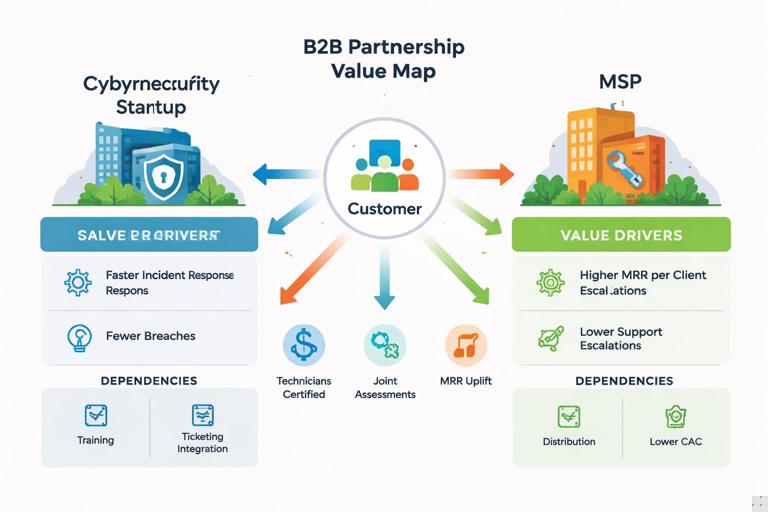
A mutual value map is a simple artifact that forces clarity. It lists value drivers for each party and the customer, then connects them to measurable indicators. It also surfaces conflicts early (for example, one partner wants premium pricing while the other needs aggressive discounting to move volume).
Mutual Value Map Structure
- Customer value drivers: What the customer gains and what pain is removed.
- Partner A value drivers: Revenue, retention, differentiation, efficiency, risk reduction.
- Partner B value drivers: Same categories, but from your perspective.
- Dependencies: Integration, enablement, data sharing, compliance, sales motion alignment.
- Metrics: Leading and lagging indicators for each driver.
Practical example: A cybersecurity startup partners with a managed service provider (MSP). Customer value: faster incident response and fewer breaches. MSP value: higher monthly recurring revenue per client and reduced support escalations. Startup value: distribution and lower CAC. Dependencies: training MSP technicians, integrating alerting into MSP ticketing, and defining SLAs. Metrics: number of MSP technicians certified (leading), number of joint assessments delivered (leading), MRR uplift per client (lagging), churn reduction (lagging).
Step-by-Step: Mutual Value Validation Process
The process below is designed to validate value quickly without requiring a full partnership rollout. It emphasizes small tests, explicit assumptions, and measurable signals.
Step 1: Define the “Joint Use Case” in One Sentence
Write a single sentence that includes the target customer, the trigger event, and the promised outcome. This prevents vague partnerships that try to serve everyone.
Template: “For customer segment who experience trigger, we jointly deliver outcome by mechanism.”
Example: “For mid-market e-commerce brands facing rising chargebacks, we jointly reduce chargeback losses by 20% in 90 days by combining fraud scoring with automated dispute workflows.”
Step 2: List Assumptions as “Must Be True” Statements
Partnerships fail when assumptions remain implicit. Convert them into “must be true” statements and rank them by risk and uncertainty.
- Customers will trust a combined offer from both brands.
- The partner’s sales team will pitch the joint use case.
- Integration can be completed in under four weeks.
- Support load will not exceed a defined threshold.
- Pricing and margin structure will be acceptable to both parties.
Then identify the top 3–5 assumptions that are both high impact and uncertain. Those become your validation targets.
Step 3: Design a Minimum Viable Partnership (MVP) Test
A minimum viable partnership is the smallest collaboration that can produce evidence of value. It is not necessarily a product integration; it can be a referral loop, a co-hosted webinar with a clear conversion goal, or a joint assessment offer. The key is that it produces measurable outcomes tied to your assumptions.
MVP test examples:
- Co-sell pilot: 10 accounts, shared pipeline review weekly, one joint demo script.
- Referral pilot: Partner sends 20 warm intros using a standardized email; you track conversion and time-to-first-meeting.
- Co-marketing pilot: One webinar + one follow-up sequence; measure registrants-to-qualified-leads and partner-sourced pipeline.
- Service bundle pilot: Partner includes your product in a fixed-fee package for 3 customers; measure attach rate and retention.
Step 4: Define Metrics That Prove Value for Both Parties
Choose a small set of metrics per party. Avoid vanity metrics (impressions, “interest”) unless they directly correlate with pipeline or adoption. Use a mix of leading and lagging indicators so you can learn quickly.
Metrics Menu (Pick 2–3 per party)
- Customer metrics: time-to-value, adoption rate, reduction in errors/incidents, NPS for the joint workflow, cost savings, revenue uplift.
- Partner metrics: attach rate, average contract value uplift, churn reduction, services margin, sales cycle time, win rate in competitive deals.
- Your metrics: partner-sourced pipeline, CAC reduction, activation rate, expansion rate, retention, product usage depth.
Example: For a SaaS + agency partnership, leading indicators might be “number of joint proposals sent” and “demo-to-proposal conversion.” Lagging indicators might be “closed-won revenue” and “90-day retention.”
Step 5: Align Incentives and Remove Friction Before Testing
Even a small pilot fails if incentives conflict. Before running the MVP test, align on: who gets credit for the deal, how commissions work (if relevant), what happens if a customer already exists in one CRM, and how quickly each side must respond to leads. Also remove friction by providing partner-ready assets: a one-page pitch, qualification checklist, email templates, and a short demo script.
A practical way to do this is to create a “partner activation kit” that fits on one page plus a shared folder. If it takes more than 15 minutes for a partner rep to understand what to do next, adoption will be low.
Step 6: Run the Pilot with a Weekly Learning Cadence
Set a fixed pilot window (for example, 30–60 days) and a weekly checkpoint. Each checkpoint should answer: What did we do? What happened? What did we learn? What will we change next week? This turns the partnership into an experiment rather than a hope-based initiative.
Track not only outcomes but also operational signals: response times, number of handoffs, integration issues, and support tickets. Many partnerships “work” commercially but fail operationally; you want to detect that early.
Step 7: Decide Using Pre-Agreed Thresholds
Before the pilot starts, agree on success thresholds. For example: at least 5 qualified opportunities created, at least 2 closed-won within 90 days, attach rate above 20%, or time-to-first-value under 14 days. If thresholds are met, you scale. If not, you either iterate (change the use case, assets, or motion) or stop.
Designing the Partner Value Proposition: A Practical Workshop Format
You can design a PVP in a 60–90 minute working session with the right stakeholders. The key is to produce a draft that is specific enough to test immediately.
Workshop Step 1: Choose One Segment and One Use Case
Force focus. If you attempt to cover multiple segments, your messaging becomes generic and your pilot becomes hard to interpret. Pick the segment where both parties already have credibility and access.
Workshop Step 2: Draft the “Partner Promise” and “Customer Promise”
Write two promises: one to the partner and one to the customer. Each promise should include an outcome and a timeframe.
- Partner promise example: “Increase services revenue per client by 15% in 6 months by bundling our automation into your managed offering.”
- Customer promise example: “Reduce monthly reporting time from 8 hours to 2 hours within 30 days using automated dashboards and templates.”
Workshop Step 3: Identify the “Reason to Believe”
List the proof points you already have and the proof points you need. If you lack proof, design a pilot that generates it. Proof can be product analytics, case studies, third-party benchmarks, or a small set of reference customers willing to speak.
Workshop Step 4: Specify the Activation Path (First 30 Days)
Activation is where partnerships die. Define the first 30 days in concrete steps: who does what, in what order, and what the customer experiences. Include enablement steps (training, certification, demo access) and operational steps (support routing, escalation paths).
Example activation path:
- Day 1–3: Partner rep identifies candidate account using a qualification checklist.
- Day 4–7: Joint discovery call using a shared agenda and note template.
- Day 8–14: Joint demo + proposal with a pre-built ROI calculator.
- Day 15–30: Implementation kickoff; customer reaches first measurable outcome (time saved, error reduction, or adoption milestone).
Workshop Step 5: Define Commercial and Operational “Give-Get”
Document what each side gives and gets. This includes not only revenue share or referral fees, but also non-monetary commitments: marketing slots, sales engineer time, roadmap commitments, data sharing, and support responsibilities.
We give: enablement, demo environment, priority support, co-branded assets We get: access to partner pipeline, inclusion in partner package, joint webinars, case study participationCommon Validation Pitfalls (and How to Avoid Them)
Pitfall 1: Validating Interest Instead of Value
A partner saying “this is interesting” is not validation. Validation requires behavior: sending intros, scheduling joint calls, committing marketing inventory, or allocating technical resources. Design tests that require real effort, because effort is a proxy for perceived value.
Pitfall 2: Overbuilding Before Proving Demand
Teams often start with deep integrations. Instead, validate demand with a lighter motion first (referrals, joint assessments, co-selling scripts). If you cannot generate qualified opportunities without an integration, the integration may not fix the underlying value proposition.
Pitfall 3: Ignoring the Partner’s Internal Customer
In many partnerships, the “buyer” is not the end customer; it is an internal stakeholder at the partner: a channel manager, head of sales, product lead, or services director. Your PVP must address their incentives: quota attainment, margin, churn, differentiation, or operational simplicity. If you only speak to the end-customer value, the partnership may stall internally.
Pitfall 4: Misaligned Sales Motions
If one party sells transactional deals and the other sells enterprise, the joint motion may be mismatched. Validation should include testing the sales process: qualification, demo, procurement, and implementation. A good PVP includes a “best-fit motion” statement such as “works best in renewals,” “works best in new implementations,” or “works best as an add-on after month 3.”
Example: Building a Partner Value Proposition for a B2B SaaS + Accounting Firm Alliance
Joint Use Case
For growing professional services firms preparing for monthly close, we jointly reduce close time by 30% within 60 days by combining automated expense capture with accountant-led process optimization.

Mutual Value Map
- Customer value: faster close, fewer errors, better cash visibility.
- Accounting firm value: higher advisory revenue, stronger retention, standardized delivery.
- SaaS value: distribution into the firm’s client base, higher activation, lower churn.
Assumptions to Validate
- Clients will adopt the tool when recommended by their accountant.
- The firm can deliver onboarding in under 2 hours per client.
- The firm can package the offer at a margin that makes sense.
MVP Test
Run a 45-day pilot with 5 clients: the firm offers a fixed-fee “Close Acceleration Sprint” that includes the SaaS subscription plus two advisory sessions. Measure close-time reduction, onboarding time, and willingness to renew the package.
Metrics
- Customer: days-to-close, error rate, satisfaction with the new workflow.
- Firm: advisory revenue per client, hours delivered, renewal intent.
- SaaS: activation within 14 days, weekly active usage, churn risk signals.
Artifacts to Produce (So Validation Becomes Repeatable)
To scale partnerships, you need repeatable artifacts. These are lightweight documents that make value explicit and execution easy.
- One-page Partner Value Proposition: segment, use case, promises, proof, activation path, metrics.
- Qualification checklist: 5–8 questions that determine if an account is a fit for the joint use case.
- Joint pitch script: a short narrative that explains the combined outcome and next steps.
- ROI calculator: simple inputs and outputs tied to the customer’s economics.
- Pilot scorecard: weekly tracking of leading/lagging indicators and operational friction.
When these artifacts exist, mutual value validation becomes a system: you can run multiple pilots, compare results, and refine your PVP based on evidence rather than opinions.