What This Chapter Trains: Mini-Writing for Real Life
Mini-writing tasks are short, repeatable writing drills that mirror what you actually type in Korean: a quick text to a friend, a DM to a coworker, or a few lines in a diary. The goal is not “perfect essays.” The goal is speed, clarity, and appropriate tone in small spaces. Because Korean writing is highly sensitive to relationship and context, mini-writing is also where you practice choosing the right level of politeness, softening requests, and sounding natural without overexplaining.
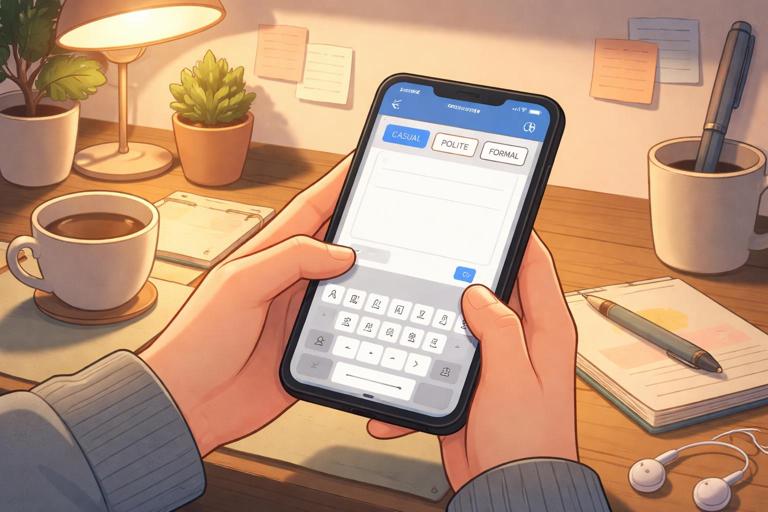
In this chapter, you will learn a practical system to produce short Korean messages reliably. You will also get templates, step-by-step workflows, and mini-tasks you can repeat daily. The focus is on output: composing and editing your own messages.
The Core Concept: One Intent, One Message
Most real-life messages have one main intent. If you keep that intent clear, your Korean becomes simpler and more natural. Common intents include: asking, confirming, updating, apologizing, thanking, inviting, declining, and checking in. Mini-writing trains you to express one intent in 1–4 lines.
Intent + Context + Softener
A reliable formula for short Korean writing is:
- Intent: What do you want the other person to do/know?
- Context: Only the minimum needed (time, place, reason).
- Softener: A polite cushion (especially for requests, declines, and corrections).
Compare the difference:
- Listen to the audio with the screen off.
- Earn a certificate upon completion.
- Over 5000 courses for you to explore!

Download the app
- Too blunt: 지금 보내 주세요. (Send it now.)
- Better: 가능하시면 지금 보내 주실 수 있을까요? (If possible, could you send it now?)
Mini-writing tasks help you automate these choices so you don’t freeze when typing.
Choose the Right Register: 반말, 해요체, 합니다체
Before you write, decide the relationship. This is the biggest “hidden” step in Korean writing.
- 반말 (casual): close friends, same-age friends, younger people you are close with. Often used in DMs and texts between friends.
- 해요체 (polite everyday): most safe default for acquaintances, coworkers, service situations, and people you don’t know well.
- 합니다체 (formal): announcements, official emails, formal workplace contexts, customer-facing messages.
Mini-writing practice should include rewriting the same message in two registers. That builds flexibility and prevents “tone accidents.”
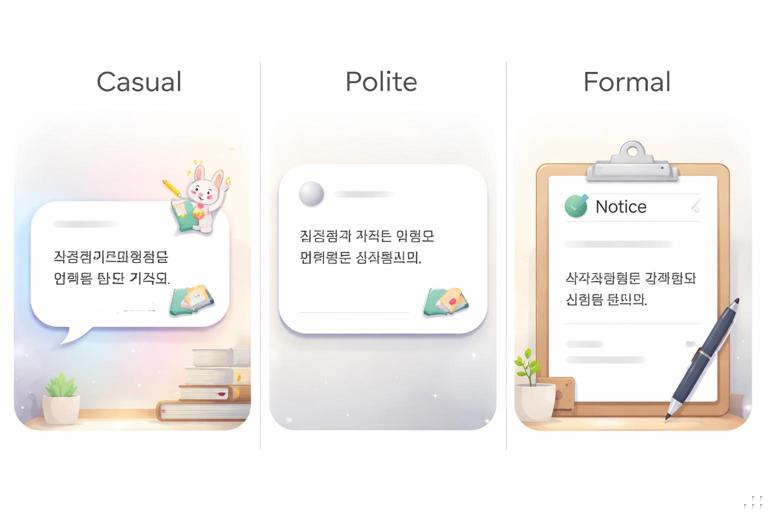
Register swap example (same intent: “I’ll be 10 minutes late”)
- 반말: 나 10분 정도 늦을 것 같아. 먼저 들어가 있어.
- 해요체: 10분 정도 늦을 것 같아요. 먼저 들어가 계세요.
- 합니다체: 10분 정도 지연될 예정입니다. 먼저 입장해 주시면 감사하겠습니다.
Step-by-Step Workflow for Any Short Message
Step 1: Write in “Message Blocks” (1–3 sentences)
Instead of thinking “I need to write Korean,” think “I need 2 blocks.” Typical blocks:
- Block A (main point): request / update / question
- Block B (detail): time / location / file / reason
- Optional Block C (softener): thanks / apology / closing
Example: asking for a file (해요체)
- Block A: 자료 파일 혹시 보내 주실 수 있을까요?
- Block B: 오늘 회의 전에 확인하려고요.
- Block C: 감사합니다!
Step 2: Pick One “Softener” Pattern
Short messages sound natural when you add one small softener. Choose one:
- 혹시 (by any chance): 혹시 지금 괜찮으세요?
- 가능하시면 (if possible): 가능하시면 오늘 중으로 부탁드려요.
- ~주실 수 있을까요? (could you…?): 확인해 주실 수 있을까요?
- ~해 주시면 감사하겠습니다 (I’d appreciate it if…): 회신해 주시면 감사하겠습니다.
Mini-task idea: write the same request three times, each time using a different softener.
Step 3: Check for “Korean Brevity”
In many everyday contexts, Korean messages are shorter than English because context is assumed. After drafting, remove extra explanations. Keep only what the other person needs to act.
- Too long: 제가 지금 밖에 나와 있는데요, 혹시 가능하시다면…
- Cleaner: 지금 밖이라서요. 가능하시면…
Step 4: Add a Natural Ending
Endings signal tone. Pick one that matches the situation:
- Friendly: 고마워요! / 고마워!
- Neutral polite: 감사합니다. / 부탁드릴게요.
- Work polite: 확인 부탁드립니다. / 회신 부탁드립니다.
Mini-Writing Tasks for Texts (친구/가족)
Texts are fast, casual, and often incomplete. Your practice should focus on: short questions, quick updates, and emotional tone (warmth, teasing, checking in).
Task Set A: Micro-Updates (1 sentence)
Write 5 one-sentence updates. Keep each under 20 characters if possible (excluding spaces). Examples (반말):
- 나 지금 출발했어.
- 오늘 좀 늦을 듯.
- 집 도착!
- 배고파… 뭐 먹지?
- 지금 통화 가능?
Rewrite the same five in 해요체 to practice safe politeness:
- 지금 출발했어요.
- 오늘 좀 늦을 것 같아요.
- 집에 도착했어요!
- 배고파요… 뭐 먹을까요?
- 지금 통화 가능하세요?
Task Set B: “Two-Line” Plans
Write a plan in two lines: (1) suggestion, (2) time/place. Example (반말):
- 오늘 저녁에 영화 볼래?
- 7시에 역 앞 어때?
Variation drills (change only one element):
- Activity swap: 영화 → 산책 / 카페 / 전시
- Time swap: 7시 → 6시 반 / 8시 / 내일 점심
- Place swap: 역 앞 → 우리 동네 / 회사 근처 / 집 앞
Task Set C: Soft Declines (without sounding cold)
Declining is a high-value skill. Practice a “soft no” with: (1) empathy, (2) reason (short), (3) alternative or future. Examples (해요체):
- 아, 오늘은 좀 어려울 것 같아요. 내일은 괜찮아요!
- 미안해요, 오늘은 일정이 있어요. 다음 주에 어때요?
- 지금은 힘들 것 같아요. 끝나고 연락드릴게요.
Mini-task: write 6 declines, each with a different reason category: work, family, health, already promised, travel, need rest.
Mini-Writing Tasks for DMs (친구/지인/업무 경계)
DMs often sit between casual and polite. You may be friendly but still need respect. DMs also often include: introductions, context reminders, and small requests.
Task Set D: DM “Context Reminder” Openers
Practice opening lines that remind the person who you are or what you’re referring to. Keep it short and natural (해요체):
- 안녕하세요! 지난번에 행사에서 인사드렸던 ○○입니다.
- 안녕하세요, ○○님. 어제 말씀하신 건 관련해서 연락드렸어요.
- 안녕하세요! 혹시 지난주에 공유해 주신 자료 관련해서 질문이 있어요.
Mini-task: write 5 openers for different contexts: met at a meetup, friend of a friend, bought something from them, coworker from another team, teacher/coach.
Task Set E: DM Requests with “Low Pressure” Tone
DM requests should feel easy to answer. Use softeners and give an easy out.
- 혹시 시간 되실 때 ○○에 대해 한 가지만 여쭤봐도 될까요?
- 가능하시면 ○○ 링크 한 번만 보내 주실 수 있을까요?
- 바쁘시면 나중에 편하실 때 답 주셔도 괜찮아요.
Step-by-step drill:
- Write the request in one sentence.
- Add 혹시 or 가능하시면.
- Add an “easy out” line: 바쁘시면 나중에…
Task Set F: DM Follow-Ups (no awkwardness)
Following up is common and can feel uncomfortable. Korean has polite, light follow-up phrases.
- 혹시 제가 보낸 메시지 확인하셨을까요?
- 바쁘실 텐데, 확인 가능하실 때 부탁드릴게요.
- 일정 괜찮으시면 답 주시면 감사하겠습니다.
Mini-task: write 3 follow-ups with different tones: very gentle, neutral, more urgent (but still polite).
Mini-Writing Tasks for Short Diary Entries (짧은 기록)
Diary writing is private, so it’s ideal for building fluency without pressure. The key is consistency: 3–6 lines daily. Diary entries also help you practice describing feelings, small events, and reflections—exactly the language you need for real conversations.
Choose Your Diary Style: “Report” vs “Reflection”
- Report style: what happened (facts). Great for beginners.
- Reflection style: what it meant / how you felt. Great for intermediate learners.
You can mix both in a short entry: 2 lines report + 2 lines reflection.
Task Set G: 4-Line Diary Template
Use this structure:
- Line 1: 오늘은… (topic)
- Line 2: 그래서/근데… (turn)
- Line 3: 기분/생각 (feeling/thought)
- Line 4: 내일/다음에는… (small plan)
Example (해요체, simple and natural):
- 오늘은 일이 좀 많았어요.
- 그래도 점심에 친구랑 잠깐 통화해서 좋았어요.
- 요즘은 작은 게 더 고맙게 느껴져요.
- 내일은 일 끝나고 산책을 꼭 할 거예요.
Mini-task: write 7 entries using the same template, changing only the topic (work, study, health, food, weather, family, hobby).
Task Set H: “Emotion + Reason” Pairs
Diary entries become more expressive when you pair emotion with a reason. Practice 10 pairs:
- 기뻤다/기뻤어요 + because: ~해서
- 아쉬웠다/아쉬웠어요 + because: ~라서
- 뿌듯했다/뿌듯했어요 + because: ~해서
- 답답했다/답답했어요 + because: ~때문에
Examples:
- 오늘은 운동을 해서 뿌듯했어요.
- 비가 와서 약속이 취소돼서 아쉬웠어요.
- 할 일이 많은데 집중이 안 돼서 답답했어요.
Task Set I: “One Scene” Diary (mini-fiction style, but personal)
Pick one tiny scene (elevator, convenience store, bus stop) and write 5 lines describing only what you saw/did. Keep it concrete. This trains you to write vivid Korean without needing advanced vocabulary.
- 편의점에 들렀다.
- 따뜻한 커피를 하나 샀다.
- 계산할 때 직원이 “봉투 필요하세요?”라고 물었다.
- 나는 괜찮다고 했다.
- 밖에 나오니까 바람이 차가웠다.
Mini-task: write 3 “one scene” entries per week.
Editing Skills: Make Your Mini-Writing Sound Natural
Writing fast is good, but editing is where you improve. Use a short checklist after you draft.
Checklist 1: Politeness and Relationship
- Is the ending consistent (해요체 vs 반말)?
- Did you accidentally mix styles (e.g., “고마워요” + “했어”)?
- Is your request softened enough for the relationship?
Checklist 2: Remove “English-shaped” Phrases
When translating directly, you may add unnecessary subjects or long introductions. In Korean, you can often omit “I” and “you” and keep the core.
- Less natural: 저는 당신이 보낸 메시지를 받았습니다.
- More natural: 메시지 잘 받았어요.
Checklist 3: Make It Actionable
Especially for DMs and work-ish texts, the reader should know what to do next.
- Add a clear question: “가능하세요?” “언제 괜찮으세요?”
- Add a time window if needed: “오늘 중으로” “이번 주 안에”
Practical “Daily Routine” Mini-Writing Plan (10–15 minutes)
Consistency beats intensity. Here is a repeatable routine you can do daily.
Routine A (Text-focused day)
- 2 minutes: write 5 micro-updates (Task Set A)
- 5 minutes: write 2 two-line plans (Task Set B)
- 5 minutes: rewrite one message in a different register (반말 ↔ 해요체)
Routine B (DM-focused day)
- 3 minutes: write 3 context-reminder openers (Task Set D)
- 7 minutes: write 2 requests + add easy-out lines (Task Set E)
- 3 minutes: write 1 follow-up (Task Set F)
Routine C (Diary-focused day)
- 10 minutes: write one 4-line diary entry (Task Set G)
- 3 minutes: add 2 emotion+reason pairs (Task Set H)
Reusable Message Templates (Fill-in-the-Blank)
Templates help you write quickly without sounding robotic. The key is to customize one detail (time, reason, context) so it feels personal.
Template 1: Quick Check-In (해요체)
Use when you haven’t talked in a while.
요즘 잘 지내세요? 갑자기 생각나서 연락드렸어요. 시간 되실 때 근황 들려주세요.Template 2: Simple Request (해요체)
혹시 가능하시면 [항목] 좀 [동사]해 주실 수 있을까요? [이유/기한]이라서요. 감사합니다.Example fill:
혹시 가능하시면 회의 자료 좀 공유해 주실 수 있을까요? 오늘 오후에 확인해야 해서요. 감사합니다.Template 3: Apology + Update (해요체)
죄송해요, 제가 [문제] 때문에 조금 늦을 것 같아요. [도착 예상/대안]로 할게요.Example fill:
죄송해요, 길이 막혀서 조금 늦을 것 같아요. 10분 뒤에 도착할게요.Template 4: Friendly Invite (반말)
이번 주에 [활동] 할래? [요일/시간] 어때?Template 5: Soft Decline + Alternative (해요체)
아, 그날은 [이유] 때문에 어려울 것 같아요. 대신 [대안/다른 날짜]는 괜찮아요.Mini-Challenges: Turn One Situation into Multiple Messages
To build flexibility, take one situation and write 3 versions: text to a friend, DM to an acquaintance, and diary entry. This trains tone control and helps you reuse vocabulary across contexts.
Situation 1: You forgot to reply and it’s been two days
- Text (friend, 반말): 야 미안, 답장 깜빡했어. 지금 봤다!
- DM (acquaintance, 해요체): 답장이 늦어서 죄송해요. 지금 확인했습니다.
- Diary (reflection): 답장을 미루다가 이틀이 지나버렸다. 작은 일도 바로바로 해야 마음이 편하다.
Situation 2: You need to reschedule
- Text (friend): 오늘 말고 내일로 바꿀 수 있어?
- DM (polite): 혹시 일정 변경 가능하실까요? 오늘은 조금 어려울 것 같아요.
- Diary: 계획이 틀어져서 약속을 옮겼다. 미리 말해서 다행이었다.
Situation 3: You want to thank someone for help
- Text (friend): 아까 진짜 고마웠어. 덕분에 살았다.
- DM (polite): 오늘 도와주셔서 정말 감사합니다. 덕분에 잘 마무리했어요.
- Diary: 누군가 도와주면 하루가 달라진다. 나도 다음엔 먼저 손을 내밀고 싶다.
Common Mini-Writing Pitfalls (and Quick Fixes)
Pitfall 1: Overusing “저는/제가”
Fix: remove the subject unless it’s needed for contrast or clarity.
- Before: 제가 지금 집에 가고 있어요.
- After: 지금 집에 가는 중이에요.
Pitfall 2: Sounding too demanding in requests
Fix: add one softener + one gratitude line.
- Before: 오늘까지 보내 주세요.
- After: 가능하시면 오늘까지 보내 주실 수 있을까요? 감사합니다.
Pitfall 3: Mixing casual and polite endings
Fix: pick one register and keep it throughout the message.
- Mixed: 지금 가요. 조금 늦을 것 같아.
- Consistent (해요체): 지금 가요. 조금 늦을 것 같아요.
Pitfall 4: Writing diary entries like formal reports
Fix: choose a diary voice and stick to it. If you want a natural diary feel, use simple past tense and feelings.
- Formal-ish: 금일 업무를 수행하였으며…
- Diary: 오늘 일하느라 정신없었다.
Practice Bank: Prompts You Can Reuse Anytime
Text prompts (반말/해요체 둘 다 연습)
- Ask what someone is doing right now.
- Suggest food and decide a place.
- Say you arrived safely.
- Ask to call for 5 minutes.
- React to good news with warmth.
DM prompts (해요체)
- Introduce yourself briefly and state why you’re messaging.
- Ask for a recommendation (restaurant/book/app) with low pressure.
- Follow up on a previous message politely.
- Request a small favor with a deadline.
- Thank someone and mention the result.
Diary prompts (3–6 lines)
- One small win today.
- One thing that annoyed you (and why).
- A short scene you noticed outside.
- Something you learned about yourself.
- What you want tomorrow to feel like.