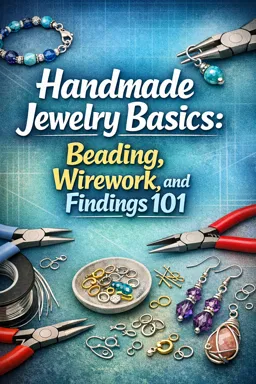
What “Findings” Are (and Why They Matter)
In jewelry making, findings are the small, pre-made components that act as the engineered connections in a design. Beads and wire provide the visual story; findings provide the mechanics: where pieces join, where movement happens, where the jewelry opens and closes, and where stress is carried.
Think of findings as the “hardware” of jewelry. A well-chosen finding makes a piece easier to wear, more durable, and more professional-looking. A poorly chosen finding can cause weak points, awkward drape, or a clasp that won’t stay shut.
How Findings Function in a Finished Piece
- Connection: linking components (jump rings, connectors).
- Closure: opening/closing the jewelry (clasps, toggles, hook-and-eye).
- Suspension: hanging elements (headpins/eyepins for dangles, ear wires).
- Retention: keeping parts from sliding off (crimps, earring backs).
- Spacing/decoration: shaping the look and transitions (spacers, bead caps).
Jump Rings: The Tiny Links That Do Big Work
A jump ring is a small metal ring used to connect components—like attaching a clasp to chain, joining a pendant to a bail, or linking a charm to a bracelet.
Open vs. Closed Jump Rings
- Open jump ring: has a cut/split so it can be opened and closed. Used for most assembly tasks.
- Closed jump ring: fully soldered or seamless (no split). Used when you need maximum security (e.g., between a clasp and a chain, or for high-stress connection points).
Gauge and Diameter (Strength + Fit)
Jump rings are described by wire thickness (gauge) and inner diameter (ID). Thicker wire generally means stronger rings; larger diameter means more room to connect multiple components.
| What you’re choosing | Why it matters | Common effect |
|---|---|---|
| Gauge (wire thickness) | Strength and resistance to pulling open | Too thin = ring can gap; thicker = sturdier but harder to fit through small loops |
| Inner diameter (ID) | How many loops/links fit inside | Too small = won’t fit; too large = looks sloppy and can change drape |
Round vs. Oval Jump Rings
- Round: general-purpose; rotates freely; common for charms and chain connections.
- Oval: can reduce twisting and help keep components facing forward; often looks cleaner in necklace/bracelet clasp areas.
Practical Step-by-Step: Opening and Closing an Open Jump Ring
The goal is to preserve the ring’s shape and create a tight closure.
- Listen to the audio with the screen off.
- Earn a certificate upon completion.
- Over 5000 courses for you to explore!

Download the app
- Grip each side of the split with two pliers (one on each side of the cut).
- Twist open sideways (like opening a door), moving one side toward you and the other away from you. Do not pull the ends apart outward into a “C” shape.
- Add components (chain end, clasp loop, connector loop, etc.).
- Twist closed by reversing the motion until the ends meet.
- Check the seam: the ends should touch or slightly “click” past each other and settle flush. If there’s a gap, the ring can snag or slip.
Clasps: Closures and What Makes Them Secure
A clasp is the finding that allows jewelry to be put on and taken off. Security comes from a combination of mechanical lock, proper sizing, and matching the clasp style to the jewelry’s weight and movement.
Lobster Clasp
A lobster clasp uses a spring-loaded lever that closes a gate. It’s widely used because it’s compact and secure.
- Security strengths: spring gate closes automatically; good for everyday wear.
- Watch-outs: very small lobsters can be hard to operate; choose a size appropriate for the wearer and the piece.
Toggle Clasp
A toggle uses a bar that passes through a ring. It’s easy to use and decorative.
- Security strengths: works well when the bracelet/necklace has enough tension to keep the bar seated.
- Watch-outs: can slip open if the ring is too large, the bar too short, or the jewelry is too loose/light. Best for medium-to-heavier designs that sit snugly.
Magnetic Clasp
Magnetic clasps close by magnetic attraction, often with a locking sleeve or alignment system.
- Security strengths: very easy to fasten; good for people with limited dexterity.
- Watch-outs: basic magnets can separate under pulling force; choose stronger styles (larger magnets, locking mechanisms) for heavier pieces.
Hook-and-Eye (or Hook-and-Loop)
This clasp uses a hook that catches into an eye/loop.
- Security strengths: simple, elegant, and can be very secure when the hook is properly shaped and the eye is sized correctly.
- Watch-outs: if the hook opening is too wide, it can unhook; if too tight, it’s hard to use.
Quick Security Checklist for Clasps
- Clasp size matches jewelry weight: heavier pieces need larger, stronger clasps and connection rings.
- Connection points are reinforced: use sturdy jump rings (or closed rings) at the clasp ends.
- Movement is considered: pieces that twist a lot benefit from oval rings or connectors that reduce torque at the clasp.
Headpins and Eyepins: Building Bead Dangles
Headpins and eyepins are straight pieces of wire used to create bead drops (dangles) and links.
- Headpin: has a “stop” at one end (flat, ball, or decorative head) so beads don’t slide off. Used for single dangles.
- Eyepin: has a loop (eye) at one end. Used to create links or connect a beaded segment to another component.
Practical Step-by-Step: Make a Simple Bead Dangle with a Headpin
- Slide on the bead(s) until they rest against the head.
- (Optional) Add a spacer or bead cap above or below the bead for a finished look.
- Trim excess wire so you have enough to form a loop above the bead (leave a small amount for wrapping if you’re doing a wrapped loop).
- Form the top loop (simple loop or wrapped loop, depending on the design’s strength needs).
- Attach the dangle to a jump ring, ear wire, connector, or chain link.
When to Choose Headpins vs. Eyepins
- Choose headpins when you want a single hanging drop with a clean bottom stop.
- Choose eyepins when you want a beaded segment that connects on both ends (like a chain made of beads).
Ear Wires and Earring Backs
Ear wires are the findings that suspend earrings from pierced ears. The right style balances comfort, security, and the weight of the earring.
Common Ear Wire Styles (Functional Notes)
- French hook (fishhook): common and lightweight; often paired with a small coil and ball. May benefit from a back/stopper for security.
- Leverback: has a hinged closure that clicks shut; very secure for dangles and heavier earrings.
- Stud post: straight post with a decorative front; requires an earring back; good for small designs or short drops.
Earring Backs (Stoppers)
- Friction back (butterfly): standard for posts; holds by tension.
- Silicone/rubber stopper: often used with hooks to prevent loss; comfortable and discreet.
- Locking backs: extra security for valuable or heavier earrings.
Crimp Beads and Crimp Tubes: Locking Beading Wire
Crimps are small metal beads or tubes that are compressed to secure beading wire to a clasp, ring, or connector. They create a permanent hold by gripping the wire.
- Crimp bead: small round crimp; compact but can be harder to crimp neatly.
- Crimp tube: short tube; often easier to compress cleanly and can be stronger due to more surface contact.
Practical Step-by-Step: Basic Crimp Connection (Conceptual Workflow)
- Thread a crimp onto the beading wire.
- Pass the wire through the clasp ring (or a closed jump ring/connector) and back through the crimp to form a loop.
- Adjust loop size: small enough to look neat, large enough to move freely without binding.
- Compress the crimp to lock the wire in place.
- Trim or tuck the tail according to your design (often hidden inside beads or covered with a crimp cover, if used).
Selection note: match crimp size to your beading wire diameter; too large can slip, too small may not fit the wire.
Bead Caps and Spacer Beads: Clean Transitions and Visual Structure
Bead Caps
Bead caps are decorative metal “cups” that sit on one or both sides of a bead.
- Purpose: frame a focal bead, cover large bead holes, add a finished edge, and create a more intentional transition.
- Selection tip: choose a cap diameter that matches the bead’s curve; too small looks pinched, too large looks like a hat.
Spacer Beads
Spacers are small beads (often metal) used between larger beads.
- Purpose: add rhythm, prevent bead-to-bead rubbing, and control spacing.
- Selection tip: use consistent spacer size for a uniform look; vary spacer shapes intentionally to create pattern.
Connectors: Multi-Loop Building Blocks
A connector is a finding with two or more loops/holes designed to join components. Examples include bar connectors, ring connectors with multiple loops, and decorative links.
- Purpose: create stations in necklaces, build bracelet centers, add symmetry, or provide multiple attachment points (e.g., for a chandelier earring).
- Strength note: connectors often become stress points—pair them with appropriately strong jump rings and clasp choices.
Selection Rules: Choosing Findings That Work Together
1) Match Metal Type and Color
- Color match: keep tones consistent (bright silver vs. antiqued silver; warm gold vs. pale gold). Mixing can be intentional, but should look deliberate.
- Metal compatibility: use the same or compatible metals to reduce mismatched wear and to keep the look cohesive (e.g., all stainless, all sterling, all gold-filled, etc.).
- Sensitivity considerations: if designing for sensitive ears/skin, select ear wires and posts in hypoallergenic options (commonly titanium, niobium, surgical stainless, or precious metals depending on the wearer).
2) Choose Gauge for Strength (Especially Jump Rings and Pins)
- High-stress areas: clasp connections, bracelet ends, heavy pendants, and multi-dangle earrings need thicker/stronger rings and pins.
- Fit check: thicker gauge must still fit through chain end loops, clasp loops, and connector holes.
- Design balance: very thick rings can overpower delicate designs; aim for strength without visual heaviness.
3) Pair Clasp Type with Jewelry Weight and Use
- Lightweight necklace: lobster or small hook-and-eye works well; toggle can work if the necklace sits with slight tension.
- Heavy necklace or chunky bracelet: larger lobster, sturdy hook-and-eye, or a strong magnetic clasp with a locking feature; reinforce with closed rings where possible.
- Bracelets (more movement, more tugging): prioritize secure clasps and strong jump rings; toggles should be sized carefully to avoid accidental release.
Mini-Lab: Identify, Purpose, and Placement Map
Use this mini-lab to train your “finding recognition” and to understand where each part sits in a finished design. Gather a small pile of mixed findings (or images of them) and complete the steps below.
Step 1: Identify Each Finding
| Finding | How to recognize it | Main purpose |
|---|---|---|
| Open jump ring | Small ring with a visible split | Connects components; can be opened/closed |
| Closed jump ring | Ring with no split (seamless/soldered) | Permanent, high-security connection |
| Lobster clasp | Teardrop/oval body with spring lever | Secure closure for bracelets/necklaces |
| Toggle clasp | Bar + ring set | Easy-to-use closure; decorative |
| Magnetic clasp | Two ends that snap together magnetically | Easy closure; choose strength by piece weight |
| Hook-and-eye | Hook piece + loop/eye piece | Simple closure; secure when properly shaped |
| Headpin | Straight wire with a flat/ball end | Creates bead dangles with a bottom stop |
| Eyepin | Straight wire with a loop at one end | Creates beaded links and connectors |
| Ear wire | Hook/leverback/post component for ear | Suspends earring from piercing |
| Earring back | Small clutch/stopper | Prevents earring loss; secures posts/hooks |
| Crimp bead/tube | Tiny bead or short tube | Locks beading wire to a loop/clasp |
| Bead cap | Small decorative “cup” | Frames bead; finishes edges |
| Spacer bead | Small bead used between larger beads | Controls spacing; adds pattern |
| Connector | Decorative link with 2+ loops/holes | Joins sections; provides attachment points |
Step 2: Describe the Purpose in One Sentence Each
Write a one-sentence purpose statement for each finding you have. Use this template:
[Finding name] is used to ________ so that ________.Example:
An open jump ring is used to connect a clasp to a chain so that the necklace can open and close.Step 3: Map Where Each Finding Sits in Finished Jewelry
Use the maps below to label where each finding typically goes. Imagine the jewelry laid flat on a table.
Bracelet Map (Typical Beaded or Chain Bracelet)
- Clasp: at one end of the bracelet.
- Jump rings (open or closed): between clasp and bracelet end loop/chain end.
- Crimp bead/tube (if using beading wire): near each end, securing the wire loop around a clasp ring or closed ring.
- Connectors: can be centered as a focal link or used as station links along the length.
- Spacer beads / bead caps: distributed in the bead pattern; bead caps often flank focal beads.
Necklace Map (Pendant or Station Necklace)
- Clasp: at the back ends of the chain/strand.
- Jump rings: attach clasp to chain ends; may also attach extender chain or tag.
- Connector: can sit at center front as a decorative link or as a multi-strand joiner.
- Closed jump ring (optional upgrade): at high-stress points like the clasp connection.
- Spacer beads / bead caps: around focal beads or as repeating accents.
Earring Map (Simple Dangle Earring)
- Ear wire: top component that goes through the ear.
- Jump ring (optional): between ear wire loop and dangle for extra movement.
- Headpin/eyepin dangle: hangs below the ear wire; headpin for a single drop, eyepin for linked segments.
- Bead caps/spacers: used on the dangle to frame and separate beads.
- Earring back/stopper: on hooks (silicone stopper) or on posts (friction/locking back) to prevent loss.
Step 4: Stress-Point Check (Quick Diagnostic)
Circle the locations on your maps where the jewelry is most likely to be pulled: clasp connections, bracelet ends, and the top loop of dangles. For each circled point, note one upgrade option:
- Use a thicker gauge jump ring.
- Switch to a closed jump ring at that connection.
- Choose a more secure clasp (e.g., lobster or leverback for earrings).
- Use a connector that distributes weight across multiple loops.