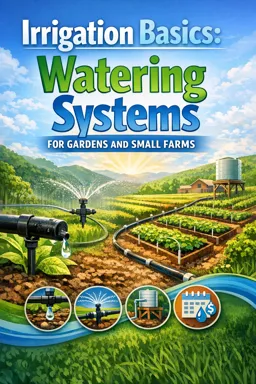
What Irrigation Is For: Consistent Moisture With Minimal Waste
Irrigation is the planned delivery of water to keep plant root zones within a target moisture range, using as little water, time, and energy as practical. The goal is not to “water a lot,” but to replace what plants use (and what evaporates) while avoiding losses from runoff, deep percolation below roots, leaks, and watering non-crop areas.
In a garden or small farm, irrigation succeeds when it delivers repeatable results: plants stay evenly moist enough for steady growth, and you can predict how long and how often to run the system without constant guesswork.
Practical goals to set before designing anything
- Moisture goal: “Keep beds evenly moist in the top 6–12 inches (15–30 cm) without puddling or dry patches.”
- Waste goal: “No runoff off beds, no standing water in paths, and no visible leaks.”
- Time goal: “I can irrigate the whole site in X minutes/day or X hours/week.”
- Reliability goal: “System still works when I’m busy or away for a weekend.”
- Crop performance goal: “Reduce blossom end rot, bolting, and uneven sizing by avoiding big moisture swings.”
Step 1: Identify Irrigated Areas and Group Crops Into Zones
Before choosing equipment, map what you will irrigate and how it should be grouped. A “zone” is an area watered by one valve (or one manual line) that runs at the same time. Good zoning is the foundation of uniform watering and simple scheduling.
A simple mapping workflow
- Draw the site outline (paper or a simple digital sketch). Include beds, rows, greenhouse/high tunnel, containers, orchard blocks, and any lawn or landscape areas you might irrigate separately.
- Mark “irrigate” vs. “don’t irrigate.” Many small farms waste water by watering paths, hedgerows, or unused corners because the system wasn’t planned around crop footprints.
- Measure each irrigated area (length × width). Record square footage (or square meters). For rows, record row length and number of rows.
- Group by similar water needs (crop type and growth stage). Put “thirsty” crops together and drought-tolerant crops together.
- Group by similar irrigation method (drip, microsprays, overhead). Mixing methods in one zone often leads to uneven results.
- Group by similar sun/wind exposure (hot, windy areas dry faster). Exposure differences can matter as much as crop differences.
Common crop groupings (examples)
| Zone grouping | Typical crops | Why it helps |
|---|---|---|
| High-demand annuals | Leafy greens, cucumbers, summer squash | Frequent, consistent moisture; sensitive to drying out |
| Moderate-demand annuals | Tomatoes, peppers, beans | Prefer deeper, less frequent watering once established |
| Low-demand / drought-tolerant | Herbs (many), some flowers, native plantings | Avoid overwatering and disease pressure |
| Perennials | Berries, orchard trees, asparagus | Different rooting depth and seasonal needs |
| Protected culture | Greenhouse/high tunnel beds | No rainfall; often needs smaller, more frequent doses |
| Containers | Pots, nursery starts | Dry quickly; often needs daily attention or automated drip |
Zone sizing: keep it manageable
Each zone should be sized so it can be watered within your water supply limits (flow and pressure) and within your time goals. If one zone is too large, you’ll compensate by running it longer, which often overwaters some areas and underwater others. Splitting a large area into two zones is often the simplest fix.
Step 2: Understand Limiting Factors (Constraints) That Shape Your Options
Every irrigation plan is a negotiation between what plants want and what your site can deliver. Identify constraints early so you don’t buy parts that can’t work together.
- Listen to the audio with the screen off.
- Earn a certificate upon completion.
- Over 5000 courses for you to explore!

Download the app
Water source: flow rate (how much water you can deliver)
Flow rate (often measured in gallons per minute or liters per minute) limits how many emitters/sprinklers you can run at once. Low flow usually pushes you toward smaller zones, longer run times, or higher-efficiency methods like drip.
- Municipal spigot: Often moderate flow, consistent, but may have restrictions or costs.
- Well: Can be excellent, but flow may be limited by pump capacity; water quality can vary.
- Storage tank/cistern: Flow depends on outlet size and head pressure; may require a pump for higher demand.
- Surface water: Requires filtration and may have seasonal variability and legal constraints.
Pressure: what your system can “push” through
Pressure determines whether sprinklers can operate correctly and whether long drip runs will deliver evenly. Pressure also changes with elevation: water pressure drops as you go uphill and increases downhill.
- Low pressure: Favors drip with pressure regulation and shorter runs; sprinklers may perform poorly.
- High pressure: Can cause misting, uneven spray, and emitter blowouts without regulation.
Practical check: If you plan to use micro-sprays or sprinklers, confirm your available pressure at the point of connection, not just at the pump or spigot.
Water quality: what can clog or damage components
Water quality affects maintenance and equipment choice. The most common issue in small systems is clogging.
- Sediment (sand/silt): Requires filtration; otherwise emitters clog quickly.
- Organic matter (algae): Common in ponds/tanks; needs filtration and sometimes periodic flushing.
- Hard water/minerals: Can scale emitters; may require acid flushing or choosing clog-resistant emitters.
- Iron bacteria: Can create slime and clogging; may require treatment and diligent filtration.
Slope and elevation: gravity, runoff risk, and uneven distribution
Slope affects both how water moves on the surface (runoff/erosion) and how pressure changes in pipes. On sloped ground, poorly planned irrigation can overwater low spots and underwater high spots.
- Steep beds: Prefer drip (slow application) to reduce runoff.
- Long runs downhill: May need pressure-compensating emitters or zone splitting.
- Gravity-fed systems: Work best with short runs, low-flow emitters, and careful elevation planning.
Budget: upfront cost vs. operating cost
Budget is not just the initial purchase. Include replacement parts, filtration, timers/valves, and your time.
- Lower upfront: Manual valves, fewer zones, simpler layouts; may cost more in labor and inconsistency.
- Higher upfront: Automation, better filtration, pressure regulation; often saves labor and reduces crop stress.
Labor and management: who will run it and how often
Even a “perfect” design fails if it’s too complicated to operate. Match complexity to your routine.
- Manual systems: Depend on consistent human attention; good for small areas or tight budgets.
- Automated systems: Reduce missed waterings; require setup, occasional troubleshooting, and protection from freezing or damage.
Access to power or gravity head
Power availability determines whether you can run a pump, controller, solenoid valves, or sensors. Gravity head (height difference between water surface and emitters) determines how much pressure you can get without a pump.
- Power at the site: Enables timers/controllers, pumps, and multi-zone automation.
- No power: Favors gravity-fed tanks, battery timers (if compatible), or manual operation.
- Gravity head: More height = more pressure; low head limits sprinkler options and zone size.
Step 3: Choose Your Efficiency Priorities (What “Good” Means for Your Site)
Efficiency is not one thing. Decide which outcomes matter most, then design around them. Most small sites can’t maximize everything at once, so choose priorities intentionally.
Priority A: Water savings
If water is scarce or expensive, prioritize minimizing evaporation and runoff.
- Design implications: Smaller zones, slower application rates, drip/micro irrigation, good filtration, and careful scheduling.
- Operational habits: Fix leaks quickly; avoid watering during hot, windy periods if using overhead.
Priority B: Uniformity (evenness across the zone)
Uniformity means plants in the same zone receive similar amounts of water. Poor uniformity shows up as dry edges, wet spots, and inconsistent crop size.
- Design implications: Keep zones with similar elevation/exposure together, limit run lengths, use pressure regulation, and avoid mixing emitter types in one zone.
- Practical check: If one bed always looks different, it may need its own zone or a different layout.
Priority C: Automation (reliability with less daily attention)
Automation is about consistency. It’s especially valuable for seedlings, containers, and protected culture where missing one day can cause major stress.
- Design implications: Multiple zones with valves, a controller/timer, and a plan for power and weather protection.
- Management implications: You’ll need a routine for seasonal startup/shutdown and occasional inspection.
Priority D: Simplicity (easy to understand, fix, and expand)
Simplicity reduces downtime. A simple system is easier to troubleshoot and less likely to be “abandoned” mid-season.
- Design implications: Fewer zone types, standardized fittings, accessible shutoffs, and clear labeling.
- Expansion-friendly: Leave room in the plan for adding a zone later rather than overloading the first build.
A quick decision tool: pick your top two
Choose the two priorities that matter most right now. Use them as tie-breakers when making decisions.
- If you choose Water savings + Uniformity: Expect more zones and more careful layout.
- If you choose Automation + Simplicity: Expect fewer “special cases,” even if it means slightly less optimized watering for a few crops.
- If you choose Water savings + Automation: Expect drip-focused systems with filtration and pressure regulation, plus timers/valves.
Guided Worksheet: Site Notes for Irrigation Planning
Use this worksheet to capture the information you’ll need to size zones and choose methods. Print it or copy into a notes app.
1) Irrigated areas and crop groupings
| Zone/Bed ID | Crop or use | Method preference (drip/overhead/micro) | Length × width | Square footage | Notes (growth stage, spacing) |
|---|---|---|---|---|---|
| Example: Bed A | Leafy greens | Drip | 4 ft × 25 ft | 100 sq ft | Shallow roots; frequent watering |
| Example: Tunnel 1 | Tomatoes | Drip | 12 ft × 48 ft | 576 sq ft | No rainfall; consistent schedule |
2) Exposure notes (affects drying rate)
| Area/Zone | Sun exposure | Wind exposure | Shade patterns | Notes |
|---|---|---|---|---|
| Example: West beds | Full sun | High (afternoon) | None | Dries fastest; consider separate zone |
| Example: North fence line | Partial sun | Low | Morning shade | May need less frequent watering |
3) Water supply and constraints checklist
- Water source(s): spigot / well / tank / pond (circle or note)
- Available flow rate: ________ (if known)
- Available pressure: ________ (if known)
- Water quality notes: clear / sandy / algae / hard water / iron staining / unknown
- Filtration present? yes / no / unknown
- Slope/elevation issues: flat / gentle slope / steep; highest point: ________ lowest point: ________
- Budget range for initial build: $________
- Labor reality: can water manually daily? yes / no; preferred watering days/times: ________
4) Power or gravity head
| Location | Power available? | Type | Distance to irrigated areas | Gravity head available? | Notes |
|---|---|---|---|---|---|
| Example: Barn | Yes | 120V outlet | 80 ft | No | Good spot for controller |
| Example: Tank stand | No | N/A | 20 ft | Yes (height: ___ ft) | Gravity-fed drip only |
5) Your efficiency priorities
Circle your top two priorities and write one sentence for each describing what success looks like.
- Water savings — Success looks like: ____________________________
- Uniformity — Success looks like: ____________________________
- Automation — Success looks like: ____________________________
- Simplicity — Success looks like: ____________________________
6) Quick zone plan (draft)
Based on your notes, list your first-pass zones. You will refine later, but this draft prevents overbuilding one zone and forgetting constraints.
Zone 1: __________________ (area/bed IDs)  Method: ________  Priority: ________  Notes: ________
Zone 2: __________________ (area/bed IDs)  Method: ________  Priority: ________  Notes: ________
Zone 3: __________________ (area/bed IDs)  Method: ________  Priority: ________  Notes: ________