What “Hook Engineering” Means in the First Second
Hook engineering is the deliberate design of the first second of a vertical short so the viewer’s brain decides “stay” before the thumb decides “swipe.” It is not just “starting strong.” It is a repeatable system that combines: (1) a clear promise (what the viewer will get), (2) an open loop (what the viewer needs resolved), and (3) immediate proof of relevance (why this matters to them right now). In mobile feeds, the first second is a micro-negotiation: the viewer gives you a tiny slice of attention, and you must repay it instantly with clarity and curiosity.
Engineering implies constraints and testing. Your hook is a designed mechanism: it has inputs (visual, audio, text, pacing), an intended output (retention past 1 second), and measurable performance (1-second view rate, 3-second hold, average view duration, rewatches). The goal is not to “trick” viewers; it is to reduce uncertainty and increase perceived value fast.
The first-second decision: what the viewer is evaluating
In the first second, viewers subconsciously ask three questions: “What is this?”, “Is it for me?”, and “Is it worth my time?” Hook engineering answers those questions with minimal cognitive load. If the viewer has to interpret your setup, decode your context, or wait for the point, you lose. Your hook should be understandable even with sound off, but stronger with sound on.
- What is this? Establish the topic category instantly (a test, a reveal, a comparison, a mistake, a transformation, a challenge).
- Is it for me? Signal audience fit (beginner vs advanced, budget vs premium, busy vs detailed, specific niche cues).
- Is it worth my time? Offer a payoff (result, shortcut, warning, surprise, satisfying resolution).
Hook Building Blocks You Can Combine
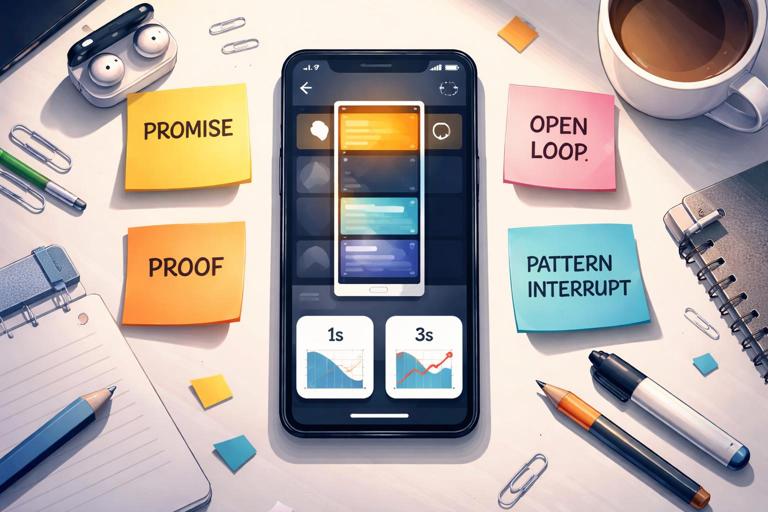
Most high-retention hooks are built from a small set of components. You can mix them, but you should be able to point to which components you used and why.
1) The Promise (explicit or implied)
The promise is the benefit or outcome the viewer expects if they keep watching. It can be explicit (“In 20 seconds, you’ll know…”) or implied (showing the end result immediately). Strong promises are specific and time-bounded.
- Listen to the audio with the screen off.
- Earn a certificate upon completion.
- Over 5000 courses for you to explore!

Download the app
- Weak: “Let’s talk about lighting.”
- Strong: “This one change makes your face look sharper in any room.”
- Even stronger: “Do this with a lamp and your phone—no ring light.”
2) The Open Loop (a question that must be answered)
An open loop creates a gap between what the viewer knows and what they want to know. The loop should be resolvable within the video’s length. If the loop is too vague (“You won’t believe what happened”), it feels like bait. If it’s too complex, it feels like homework.
- Examples: “Why does this look expensive?” “Which one is actually faster?” “What’s the mistake everyone makes?”
3) The Pattern Interrupt (a feed-stopping moment)
A pattern interrupt is anything that breaks the viewer’s scrolling rhythm: a sudden visual change, an unexpected statement, a bold action, a surprising object, a rapid before/after, or a strong sound cue. The interrupt is not the hook by itself; it is the door that gets the viewer to notice the hook.
- Examples: A timer starts at 00:20, a dramatic before/after appears instantly, a “wrong” method shown first, a quick “don’t do this” gesture, a sharp sound hit synced to the first frame.
4) Immediate Proof (show the receipt)
Proof reduces skepticism. In the first second, proof can be visual (the result on screen), social (a quick “client asked me…”), or empirical (a side-by-side test already running). Proof is especially important in crowded niches where viewers have seen many similar claims.
- Examples: Show the final shot first, show a split-screen comparison, show a graph-like overlay (simple), show the “after” reaction.
5) Specificity (numbers, constraints, and concrete nouns)
Specificity makes a hook feel real. “Better” is vague; “2 settings” is concrete. “Editing” is broad; “cutting dead air” is concrete. Constraints also help: “with no budget,” “in one take,” “in 15 seconds,” “using only your phone.”
A Practical Step-by-Step: Engineering a First-Second Hook
Use this workflow to design hooks systematically rather than improvising them on camera.
Step 1: Define the single payoff sentence
Write one sentence that describes the viewer’s reward. Keep it outcome-focused and short enough to say in one breath.
- Template: “After this, you can [do X] without [pain Y].”
- Example: “After this, you can write a hook line in 10 seconds without sounding clickbait.”
Step 2: Choose one hook type (primary) and one enhancer (secondary)
Pick a primary hook mechanism so the first second has a clear job. Then add one enhancer to strengthen it without clutter.
- Primary hook types: Result-first, mistake-first, challenge/timer, comparison, contrarian claim, curiosity question, “rule of thumb,” mini-story shock.
- Enhancers: Specific number, proof visual, authority cue (subtle), urgency constraint, clear audience callout.
Example combination: Result-first (primary) + specific number (secondary): “This 3-word opener doubled my watch time.”
Step 3: Decide what appears in frame at timecode 0.0
Timecode 0.0 is the first frame the viewer sees. Plan it like a thumbnail that moves. Ask: if the viewer only saw this frame for 0.2 seconds, would they understand the category and feel curiosity?
- Checklist: Is the main subject visible instantly? Is the action already happening? Is the “result” visible? Is there a clear contrast (before/after, A/B, wrong/right)?
Step 4: Write the first spoken line (or on-screen line) to be complete by 0.8 seconds
Many creators waste the first second with greetings, context, or filler. Instead, aim for a line that lands fast. If you speak, start mid-sentence energy-wise, as if the viewer joined late and you’re already in motion.
- Avoid: “Hey guys, today I’m going to show you…”
- Use: “Stop opening with this.” “Here’s the fastest way to…” “Watch what happens when…”
If you rely on text, keep it short enough to read instantly. One line. Big words. No stacked paragraphs.
Step 5: Add a micro-open-loop that pays off soon
Within the first second, plant a question that will be answered in the next 5–15 seconds. This prevents the hook from being only a headline and gives the viewer a reason to stay through the first beat.
- Examples: “The fix is not what you think.” “The second one wins—here’s why.” “There’s one word that kills retention.”
Step 6: Remove friction: cut anything that delays meaning
Friction is any element that forces the viewer to work: slow zooms, long establishing shots, vague phrasing, unclear visuals, delayed audio, or a hook that requires prior context. Trim the start until the first second contains meaning, not warm-up.
A practical edit rule: if you can delete the first 0.5–1.0 seconds and the video becomes better, your hook wasn’t engineered yet.
Step 7: Build a “second-second” bridge (1.0–2.0 seconds)
The first second gets attention; the second second keeps it. Plan a bridge that confirms the promise and transitions into the body without a drop in energy.
- Bridge moves: “Here’s the test.” “Look at the difference.” “Do this instead.” “Step one.”
Hook Patterns That Work (with Examples You Can Adapt)
Below are hook patterns designed specifically for the first second. Each includes a structure and multiple example lines. Adapt the nouns to your niche.
Pattern 1: Result-First Reveal
Structure: Show the end result immediately + name the benefit.
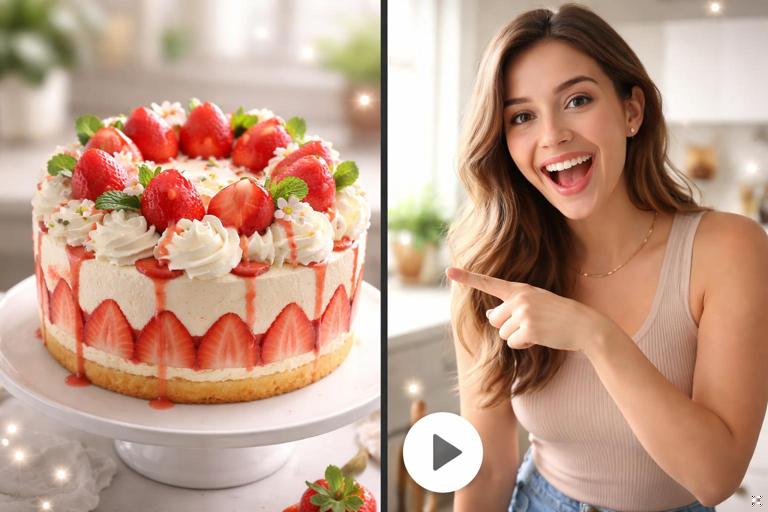
- “This is the cleanest look you can get with one light.”
- “This edit makes any clip feel faster.”
- “Here’s the hook that kept people watching to the end.”
Why it works: It answers “Is it worth it?” instantly with proof.
Pattern 2: Mistake-First (Negative Hook)
Structure: Call out a common error + imply a fix.
- “If your shorts die at 2 seconds, you’re doing this.”
- “Stop using this opener—it signals ‘skip.’”
- “This one habit makes your videos feel cheap.”
Why it works: Loss aversion and self-diagnosis create urgency.
Pattern 3: A/B Comparison in Motion
Structure: Two options shown immediately + ask which wins.
- “Left or right—which one would you watch?”
- “Same clip, two hooks. One doubles retention.”
- “I changed one word—guess which version wins.”
Why it works: The viewer becomes a participant, not a spectator.
Pattern 4: Timer / Challenge Constraint
Structure: Start a timer + define a micro-goal.
- “I have 10 seconds to make you care about this.”
- “Watch me fix this hook before the timer hits zero.”
- “In 15 seconds, you’ll have three hook options.”
Why it works: Time pressure creates momentum and a clear endpoint.
Pattern 5: Contrarian Claim (with immediate proof)
Structure: Say the opposite of common advice + show evidence.
- “Your hook shouldn’t be louder—it should be clearer.”
- “Don’t start with the question. Start with the answer.”
- “The best hooks are boring… on purpose. Watch.”
Why it works: Surprise triggers attention, proof prevents distrust.
Designing Hooks for Different Content Types
Not every short is a tutorial. Hook engineering changes depending on the content’s core engine: teaching, storytelling, review, opinion, or entertainment. The first second should signal the correct “contract” so the viewer knows what kind of ride they’re on.
For tutorials and how-tos
- Best hook ingredients: Promise + specificity + immediate proof.
- Example: “Here’s a 2-step way to cut dead air without sounding rushed.”
- First-second visual: Show the “after” pacing or a waveform/timeline glimpse as proof (simple and readable).
For mini-stories
- Best hook ingredients: Open loop + stakes + clarity of who/what.
- Example: “I almost posted this… and it would’ve tanked the video.”
- First-second visual: A decisive moment (hovering over “post,” a reaction, a visible consequence cue).
For reviews and comparisons
- Best hook ingredients: A/B comparison + criteria + quick verdict tease.
- Example: “I tested both—one is faster, but the other looks better.”
- First-second visual: Side-by-side outputs already on screen.
For opinion and commentary
- Best hook ingredients: Contrarian claim + framing of the debate + why it matters.
- Example: “Most hook advice is backwards, and it’s killing retention.”
- First-second visual: A strong facial reaction plus a single keyword overlay (“BACKWARDS”).
Micro-Scripts: 10 First-Second Hook Lines (Fill-in-the-Blank)
Use these as starting points. Replace the brackets with your niche-specific nouns and outcomes.
- “If you’re still starting with [common opener], stop.”
- “This is why your [content type] loses people at [time].”
- “Watch this: [action]… now look at the difference.”
- “I changed one thing in [process] and got [result].”
- “The fastest way to [desired outcome] is [unexpected method].”
- “You have [number] seconds to earn attention—do this first.”
- “Left vs right: which one feels more [adjective]?”
- “Don’t do [mistake]. Do this instead.”
- “Here’s the [number]-word hook that works in [niche].”
- “This looks like [thing], but it’s actually [surprise].”
Editing Tactics That Strengthen the First Second
Hook engineering is often won in the edit. You can film good material and still lose if the first second is slow, unclear, or quiet.
Start on action, not readiness
Cut out the moment you inhale, adjust posture, or reach for an object. Start when the action is already happening: the object is already in hand, the comparison is already on screen, the timer is already running.
Use “cold open” structure
A cold open drops the viewer into the most interesting moment first, then quickly explains. In shorts, the explanation must be minimal and immediate.
- Example sequence: Show the “after” for 0.5 seconds → say the claim → then show the “before” and steps.
Front-load clarity with tight wording
Rewrite your first line until it contains a verb and a concrete noun. “Fix your hook” is clearer than “Improve your videos.” “Cut dead air” is clearer than “Edit better.”
Audio as a retention lever (without relying on it)
Even though many viewers watch with sound off, sound-on viewers are more likely to stay if the first second has a clean, confident vocal entry and a subtle emphasis cue (a beat hit, a snap, a tap). Avoid long music intros. If you use a sound effect, sync it to the first frame so it feels intentional, not late.
On-screen text: one job, one line
Text in the first second should do one job: clarify the promise or the open loop. If your text is summarizing your entire video, it becomes unreadable and slows comprehension. Use a single line like “STOP OPENING LIKE THIS” or “2 HOOKS, SAME CLIP.”
Testing and Iteration: How to Improve Hooks with Data
Hook engineering becomes powerful when you treat hooks as testable prototypes. You don’t need complex analytics to start; you need consistent experiments.
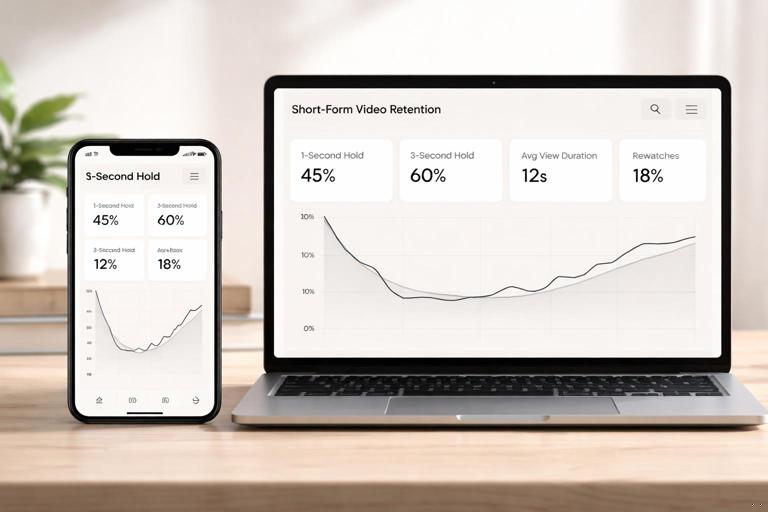
What to measure
- 1-second view rate / hold: Are people staying past the first second?
- 3-second hold: Does your second-second bridge work?
- Average view duration and completion: Did the hook match the content, or did viewers feel misled?
- Rewatches: Often indicates satisfying reveals, tight pacing, or dense value.
A simple A/B hook test method
Create two versions of the same video with different first seconds (different first frame, first line, or hook type). Keep the rest identical. Post them at similar times on different days, or use platform tools if available. Track which version wins on 1-second and 3-second holds first; then check completion.
Important: A hook that boosts 1-second hold but hurts completion is often overpromising or confusing. The best hooks are accurate previews of the experience.
Hook debugging checklist (when retention drops fast)
- Is the first frame visually understandable without context?
- Does the first line contain a clear benefit or problem?
- Is there an open loop that will be resolved soon?
- Is the pacing too slow (dead air, pauses, long words)?
- Is the claim too generic (no specificity)?
- Is the hook mismatched to the actual content (promise not delivered)?
Worked Example: Turning a Weak Opener into an Engineered Hook
Scenario: You’re making a short about improving hooks in vertical videos.
Weak opener (common): “Hey everyone, today I’m going to talk about how to make better hooks for your shorts.”
Problems: No proof, no urgency, no specificity, and it delays the point.
Engineered version A (Mistake-first + specificity)
First frame: Big text: “STOP THIS OPENER” while you point to a caption that says “Hey guys…”
First line: “If you start with ‘hey guys,’ you’re giving people a reason to swipe.”
Second-second bridge: “Use this instead—three words.”
Engineered version B (A/B comparison + participation)
First frame: Split screen: “Hook A” vs “Hook B” with the same clip paused mid-action.
First line: “Which one would you watch—A or B?”
Second-second bridge: “Here’s why B wins in one second.”
Engineered version C (Result-first + proof)
First frame: A retention graph-like simple line rising (stylized overlay) next to the words “+38% hold” (keep it minimal).
First line: “This one-second change raised my hold by 38%.”
Second-second bridge: “It’s not louder. It’s clearer—watch.”
Notice how each engineered hook makes a different promise and sets a different expectation for the video’s structure. The best choice depends on your audience and the content you can deliver immediately.
Hook Swipe-Proofing: Matching the Hook to the Payoff
A hook is only “good” if it leads into a payoff that feels inevitable. If the hook is sensational but the next seconds are slow, viewers feel a mismatch and leave. Engineer continuity by ensuring the first second contains the same “language” as the rest of the video: same energy, same specificity, same topic, same pace.
Make the hook a preview, not a trailer
A trailer teases without delivering; a preview shows the actual experience. In shorts, previews win. Show the exact thing you’ll teach or reveal, just compressed.
Pay off the open loop early, then open a new one
If you open a loop in the first second, close it quickly (within the next few beats), then open the next loop to carry retention forward. This creates a chain of micro-payoffs rather than one distant payoff.
Loop 1 (0–1s): “Stop opening with this.” Payoff (2–4s): show the better opener Loop 2 (4–6s): “Here’s why it works.” Payoff (6–12s): explain the principle with an exampleCommon First-Second Hook Mistakes (and Fixes)
Mistake: Starting with context
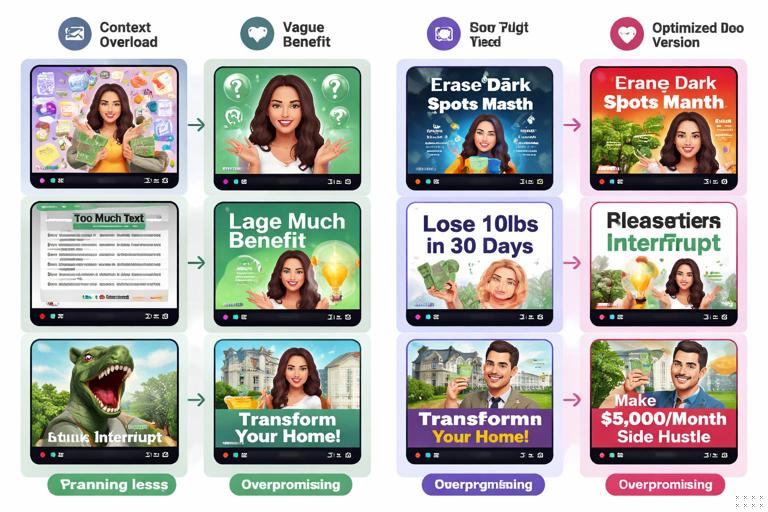
Symptom: “So I was thinking…” “Today we’re going to…”
Fix: Start with the claim, result, or mistake. Add context only after the viewer is anchored.
Mistake: Vague benefit
Symptom: “Make your videos better.”
Fix: Name the specific outcome: “Get people to stop swiping,” “increase hold,” “make the first line clearer.”
Mistake: Overstuffed text
Symptom: Multiple lines of small text that can’t be read instantly.
Fix: One line, one idea. If you need more, reveal it later.
Mistake: Pattern interrupt without meaning
Symptom: Loud sound or fast movement but no clear topic.
Fix: Pair the interrupt with a promise or question in the same second.
Mistake: Overpromising
Symptom: “This will go viral” or “Guaranteed” claims.
Fix: Promise what you can demonstrate: “This increases clarity,” “This reduces drop-off,” “This gives you three options.”