What “High-Utility Vocabulary” Means (and Why Collocations Matter)
High-utility vocabulary is the small-to-medium set of words you can reuse across many everyday situations: errands, work messages, family talk, small problems, plans, and opinions. In Korean, knowing a word’s dictionary meaning is not enough to sound natural. You also need to know what that word typically “goes with.” Those typical pairings are called collocations (자주 같이 쓰는 말의 조합). In addition, Korean has many set phrases (관용적으로 굳어진 표현) that appear again and again in real conversations and short narratives.
For example, you may know the verb 하다 (“to do”), but high-utility Korean often prefers specific collocations: 결정을 내리다 (to make a decision), 예약을 잡다 (to make a reservation), 연락을 하다 (to contact), 실수를 하다 (to make a mistake). If you only translate word-by-word, you might produce unnatural combinations like 결정을 하다 (understandable, but less natural in many contexts) or 예약을 하다 (possible, but “잡다” is very common for “to book”).
Set phrases go one step further: they are ready-made chunks that carry a typical social meaning. Examples include 어쩔 수 없다 (there’s no choice), 별 수 없다 (no other way), 말이 되다 (to make sense), 시간이 나다 (to have time), 손이 가다 (to take effort / to be drawn to doing something). These are not random; they are patterns you can reuse in many mini-stories and daily conversations.
Collocations vs. Set Phrases: How to Tell Them Apart
Collocations: flexible but typical
A collocation is a frequent pairing that can still be adjusted. For instance:
- 약속을 잡다 (to set an appointment) → 약속을 다시 잡다 (to reschedule), 약속을 잡아야 하다 (need to set)
- 기분이 좋다/나쁘다 (feel good/bad) → 기분이 좀 나아지다 (feel a bit better)
- 문제를 해결하다 (solve a problem) → 문제가 해결되다 (be solved)
Set phrases: chunked meaning, limited substitution
A set phrase is more fixed. You can conjugate it, but swapping words often breaks the meaning. For example:
- Listen to the audio with the screen off.
- Earn a certificate upon completion.
- Over 5000 courses for you to explore!

Download the app
- 어쩔 수 없다 → 어쩔 수 없었어요, 어쩔 수 없지 (conjugation changes), but replacing 수 or 어쩔 usually doesn’t work.
- 말이 되다 → 말이 안 돼요 (doesn’t make sense) is a very common fixed negative form.
- 손이 가다 (take effort) → you can say 손이 많이 가요, but you don’t typically replace 손 with another noun.
A Practical Method: Build a “Collocation Bank” Instead of a Word List
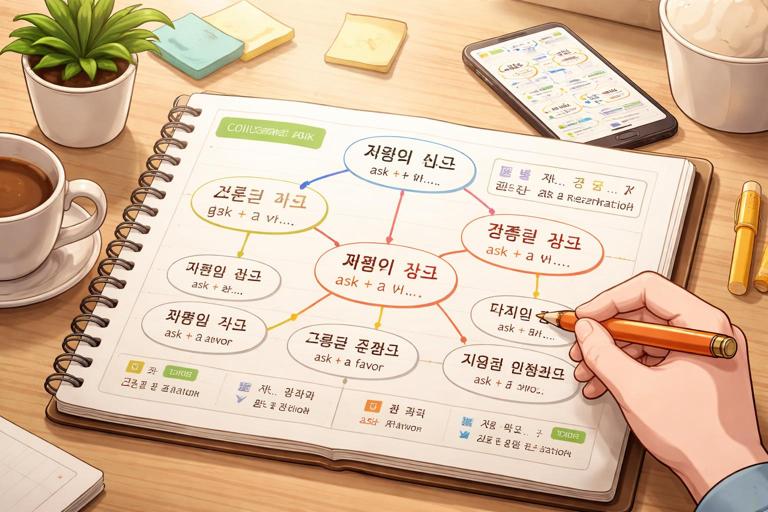
If you want vocabulary that actually shows up in your speaking and writing, store it as mini-templates. Here is a step-by-step method you can apply to any text or dialogue you read.
Step 1) Choose a high-utility base word
Pick a word that appears often and travels across contexts. Good candidates are: common nouns (시간, 마음, 일, 말, 돈, 약속), common verbs (하다, 되다, 나오다, 들다, 놓다, 잡다), and adjectives (편하다, 불편하다, 중요하다).
Step 2) Collect 3–5 natural pairings
For each base word, collect a small set of pairings you can reuse. Example with 시간:
- 시간이 나다 (to have time)
- 시간이 없다 (to not have time)
- 시간을 내다 (to make time)
- 시간이 걸리다 (to take time)
- 시간을 맞추다 (to be on time / coordinate timing)
Notice how the particle changes: 시간이 vs. 시간을. This is part of the collocation. Memorize the pairing with the particle included.
Step 3) Add one “story-ready” expansion
Turn each collocation into a line you could realistically say in a mini-fiction or daily life.
- 시간이 나면 연락할게요. (If I have time, I’ll contact you.)
- 생각보다 시간이 걸렸어요. (It took longer than I thought.)
- 이번 주에 시간을 좀 내야 해요. (I need to make some time this week.)
Step 4) Create a contrast pair (positive/negative or formal/casual)
High-utility language becomes usable when you can flip it quickly.
- 시간이 나요 (I have time) ↔ 시간이 안 나요 (I don’t have time)
- 말이 돼요 (That makes sense) ↔ 말이 안 돼요 (That doesn’t make sense)
- 가능해요 (It’s possible) ↔ 어려울 것 같아요 (It might be difficult)
Step 5) Recycle in three contexts
To make collocations automatic, reuse them in three different everyday contexts: (1) personal life, (2) work/school, (3) service situations (store, clinic, delivery). Example with 예약을 잡다:
- 개인: 미용실 예약 잡았어. (I booked a hair salon appointment.)
- 업무: 다음 주에 미팅 예약을 잡아 주세요. (Please schedule the meeting.)
- 서비스: 내일 오전으로 예약 잡을 수 있을까요? (Could I book for tomorrow morning?)
High-Utility Collocations You Can Use Immediately
The goal is not to memorize hundreds at once, but to master a compact set that appears constantly. Below are practical collocation clusters with example sentences you can adapt.
1) “Decision / Plan / Choice” cluster
- 결정을 내리다 (make a decision)
오늘 안에 결정을 내려야 해요.
- 계획을 세우다 (make a plan)
주말 계획 세웠어?
- 선택을 하다 (make a choice)
둘 중에 하나를 선택해야 해요.
- 마음을 먹다 (make up one’s mind)
이번에는 진짜 마음 먹었어.
Note: “마음을 먹다” is a set-like collocation. It’s not literally “eat 마음.” It signals determination and is common in everyday narratives.
2) “Contact / Message / Response” cluster
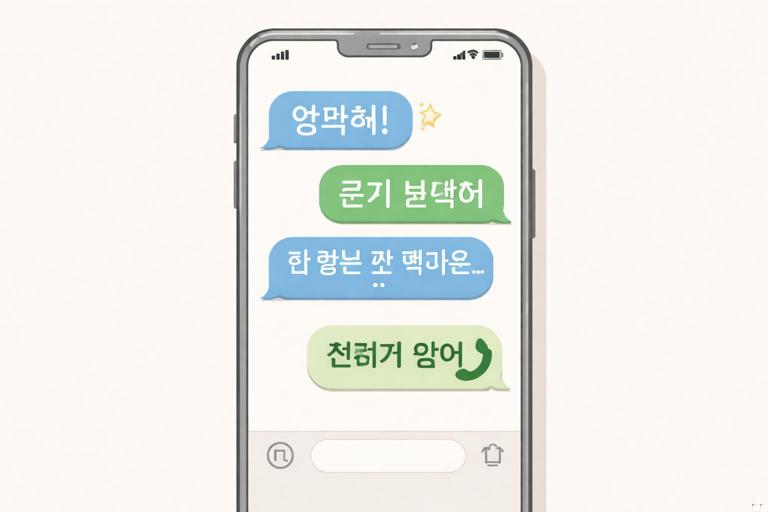
- 연락을 하다 (contact)
도착하면 연락해.
- 문자를 보내다 (send a text)
지금 문자 보냈어.
- 답장을 하다 / 답장을 보내다 (reply)
바빠서 답장을 못 했어요.
- 전화가 오다 (receive a call)
아까 모르는 번호로 전화가 왔어.
3) “Problem / Mistake / Fix” cluster
- 문제가 생기다 (a problem comes up)
배송에 문제가 생겼어요.
- 문제를 해결하다 (solve)
일단 문제부터 해결하자.
- 실수를 하다 (make a mistake)
제가 실수했어요. 죄송합니다.
- 고치다 (fix/repair)
제가 바로 고칠게요.
Tip: Pair “problem” with verbs that sound natural: 문제가 생기다 is far more common than a literal “문제가 오다.”
4) “Emotion / Mood / Mind” cluster
- 기분이 좋다/나쁘다 (feel good/bad)
오늘은 왠지 기분이 좋아.
- 마음이 편하다/불편하다 (feel at ease/uneasy)
그 얘기 들으니까 마음이 좀 불편해.
- 신경이 쓰이다 (to bother/concern)
그 말이 계속 신경 쓰여.
- 스트레스를 받다 (get stressed)
요즘 일이 많아서 스트레스 받아요.
5) “Time / Schedule / Pace” cluster
- 시간이 걸리다 (take time)
조금 시간이 걸릴 것 같아요.
- 시간을 내다 (make time)
이번 주에 시간 좀 내 줄래?
- 일정이 잡히다 (schedule gets set)
내일은 이미 일정이 잡혀 있어요.
- 서두르다 (hurry)
안 서둘러도 돼.
Set Phrases That Make Your Korean Sound Natural

Set phrases are especially useful in mini-fictions because they compress meaning: one chunk can express resignation, surprise, persuasion, or a polite refusal. Below are high-frequency set phrases with usage notes and examples.
1) 어쩔 수 없다 (no choice)
Used when a situation cannot be changed. Often appears when plans fail, weather changes, or rules apply.
- 비가 오니까 어쩔 수 없지. (It’s raining, so we can’t help it.)
- 오늘은 일이 많아서 어쩔 수 없이 야근했어요. (I had to work late.)
2) 말이 되다 / 말이 안 되다 (make sense / not make sense)
Used for logic, fairness, or plausibility.
- 그건 말이 돼. (That makes sense.)
- 갑자기 가격이 두 배라니, 말이 안 되잖아. (That doesn’t make sense.)
3) 시간이 나다 (have time)
Very common for arranging meetings and casual promises.
- 시간 나면 커피 한 잔 하자. (If you have time, let’s grab coffee.)
- 요즘은 시간이 잘 안 나요. (These days I can’t really find time.)
4) 손이 가다 (take effort / require attention)
Used for tasks that are fiddly or require repeated care (kids, pets, cooking, paperwork).
- 이 요리는 생각보다 손이 많이 가요. (This dish takes more work than you’d think.)
- 서류가 많아서 손이 좀 가네. (The paperwork is a bit of a hassle.)
5) 눈치가 보이다 (feel self-conscious / worry about others’ reactions)
Used when you hesitate because of social pressure.
- 상사 눈치가 보여서 먼저 못 나갔어요. (I couldn’t leave first because I felt self-conscious.)
- 혼자만 쉬면 눈치 보이잖아. (If only I rest, it feels awkward.)
6) 마음에 들다 (like it; be pleasing)
Used for preferences about items, places, people’s behavior, and decisions.
- 이 색이 제일 마음에 들어요. (I like this color the most.)
- 새로 바꾼 의자가 마음에 안 들어. (I don’t like the new chair.)
How to Practice Collocations: Controlled Output Drills
To make collocations and set phrases usable, practice them in controlled ways before you try free speaking. Here are drills you can do in 10–15 minutes.
Drill 1: Particle-locked substitution
Keep the collocation frame and swap only the noun. This trains you not to break the pairing.
예약을 잡다 → (병원/미용실/식당/미팅) 예약을 잡다 예: 병원 예약을 잡았어요. 예: 내일 식당 예약을 잡을까요?Drill 2: Tense and politeness ladder
Conjugate the same chunk across common speech levels. This helps you use the phrase in messages, service situations, and casual talk.
시간이 나다 - casual: 시간 나? / 시간 나면 말해. - polite: 시간 나세요? / 시간 나시면 연락 주세요. - past: 어제는 시간이 났어요. - future/guess: 내일은 시간이 날 것 같아요.Drill 3: Cause → reaction mini-lines
Set phrases often express a reaction. Practice them as a two-part line: situation + set phrase.
비가 온다 → 어쩔 수 없다 예: 비가 오네. 어쩔 수 없지. 가격이 갑자기 오른다 → 말이 안 되다 예: 갑자기 두 배야? 말이 안 되는데.Drill 4: One collocation, three settings
Reuse one collocation in three settings to make it flexible.
문제가 생기다 1) 집: 세탁기가 멈췄어. 문제가 생겼나 봐. 2) 회사: 결제 시스템에 문제가 생겼습니다. 3) 가게: 주문에 문제가 생겨서 다시 확인 부탁드려요.Common “Wrong but Understandable” Combinations (and Better Options)
Many learners produce Korean that is understandable but not idiomatic because they translate directly. Here are frequent cases and more natural alternatives. Use these as “repair rules.”
1) “Make a decision”
- Less natural: 결정을 하다
- More natural: 결정을 내리다
Example: 오늘 결정을 내릴게요. (I’ll decide today.)
2) “Have a promise”
- Less natural: 약속이 있다 (this is actually natural for “I have plans,” but not for “I promised”)
- More precise: 약속이 있다 (I have an appointment/plans) / 약속을 하다 (make a promise/appointment) / 약속을 잡다 (set an appointment)
Example: 오늘 저녁은 약속이 있어요. (I have plans tonight.)
3) “Get stress”
- Less natural: 스트레스를 얻다
- More natural: 스트레스를 받다
Example: 그 얘기 들으면 스트레스 받아. (It stresses me out.)
4) “Time is enough”
- Often awkward: 시간이 충분하다 (grammatically fine, but not always the go-to in casual talk)
- Common everyday options: 시간이 있어요, 시간 괜찮아요, 시간이 좀 남아요
Example: 지금 시간 괜찮으세요? (Is now a good time?)
Mini-Fiction Style Practice: Use Collocations as “Story Engines”
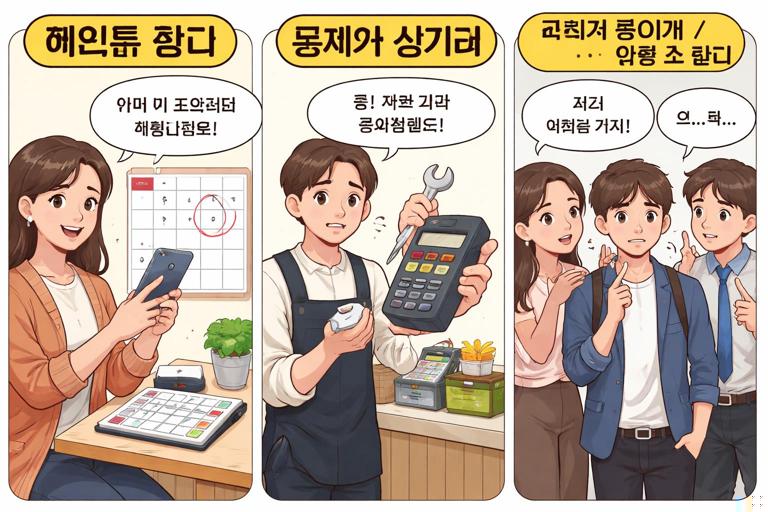
In everyday mini-fictions, events often move forward through a small set of actions: making plans, contacting someone, a problem happening, fixing it, reacting emotionally. Collocations are the “story engines” that make those actions sound natural. Below are short practice scripts built from high-utility chunks. Read them aloud and swap details (time, place, person) while keeping the collocations.
Script A: Scheduling and contact
오늘은 일정이 잡혀 있어서 시간이 잘 안 나요. 그래도 저녁에 시간 나면 연락할게요. 내일 오전으로 예약을 잡을 수 있을지 먼저 확인해 볼게요.Swap practice:
- 일정이 잡혀 있어서 → 회의가 있어서 / 약속이 있어서
- 저녁에 → 점심에 / 퇴근하고
- 예약을 잡다 → 약속을 잡다 / 미팅을 잡다
Script B: Problem and repair
결제에 문제가 생겼어요. 제가 실수한 것 같아서 바로 확인했는데, 생각보다 시간이 걸리네요. 일단 문제부터 해결하고 다시 연락드릴게요.Focus collocations: 문제가 생기다, 실수를 하다, 시간이 걸리다, 문제를 해결하다, 연락드리다.
Script C: Social pressure and resignation
다들 바쁜데 혼자만 먼저 가면 눈치가 보이잖아요. 그래서 조금 더 기다렸어요. 근데 막차 시간이 다가와서 어쩔 수 없이 먼저 나왔죠.Focus set phrases: 눈치가 보이다, 어쩔 수 없이, plus time pressure vocabulary.
Personalization: Turn Collocations into Your Own “Reusable Lines”
High-utility vocabulary becomes truly high-utility when it matches your real life. Use this checklist to personalize without needing long writing.
1) Pick your top 5 life domains
- 출퇴근/통학 (commute)
- 집안일 (household tasks)
- 건강/운동 (health)
- 업무/프로젝트 (work)
- 친구/가족 (relationships)
- 쇼핑/배달 (shopping/delivery)
2) For each domain, choose 3 collocations
Example for 쇼핑/배달:
- 주문을 하다 (place an order)
- 배송이 오다 (delivery arrives)
- 교환/환불을 하다 (exchange/refund)
3) Write one reusable line per collocation
- 지금 주문할게요. (I’ll order now.)
- 오늘 배송이 올 줄 알았는데 아직 안 왔어요. (I thought it would arrive today.)
- 사이즈가 안 맞아서 교환하고 싶어요. (I want to exchange it.)
4) Add one polite service version
Service situations are where collocations matter most because you want to sound smooth and respectful.
- 교환 가능할까요? (Would an exchange be possible?)
- 환불 처리 부탁드립니다. (Please process a refund.)
- 확인해 주실 수 있을까요? (Could you check?)
Compact Reference: High-Utility Verb Collocations (하다/되다/나다/들다)
Some Korean verbs act like “magnets” that form many natural collocations. Instead of learning them as separate vocabulary items, learn them as families.
하다 family
- 연락하다 / 연락을 하다
- 실수하다 / 실수를 하다
- 준비하다 / 준비를 하다
- 정리하다 / 정리를 하다
되다 family
- 예약이 되다 (be booked)
내일 오전으로 예약이 됐어요.
- 해결이 되다 (be resolved)
이제 해결이 됐나요?
- 말이 되다 (make sense)
그렇게 하면 말이 돼요.
나다 family
- 시간이 나다 (have time)
- 생각이 나다 (remember / come to mind)
갑자기 네가 생각났어.
- 문제가 나다 (something goes wrong; often with machines)
프린터가 또 났어. (colloquial; context-dependent)
들다 family
- 마음에 들다 (like it)
- 돈이 들다 (cost money)
생각보다 돈이 많이 들어요.
- 시간이 들다 (take time/effort; similar to 걸리다)
이건 좀 시간이 들어요.