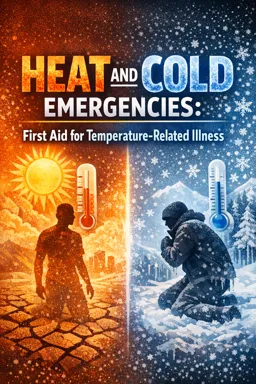
What Heat Stroke Is (and Why It’s Different)
Heat stroke is a life-threatening emergency defined by dangerously high body temperature together with central nervous system (CNS) dysfunction. The CNS signs are the key: a person may become confused, disoriented, irrational, collapse, have seizures, or become unconscious. Sweating may be present or absent; do not rely on skin moisture to rule it out.
Think of heat stroke as overheating plus brain involvement. Your priorities are to activate emergency response and cool the person rapidly while protecting the airway.
Common Red Flags Suggesting Heat Stroke
- Altered mental status: confusion, agitation, slurred speech, unusual behavior
- Collapse, fainting with persistent confusion
- Seizure
- Unresponsiveness
- Very hot skin and rapid breathing/heart rate (temperature may be very high if measured)
Emergency Algorithm (Do This in Order)
Use this simple field algorithm. The goal is to cool first aid immediately while arranging rapid transport.
- Call emergency services now. State: “Suspected heat stroke with altered mental status.” If you are alone, call first; if others are present, delegate the call.
- Move to a cooler environment. Shade, air-conditioned space, or at least away from direct sun/heat sources.
- Begin rapid cooling immediately. Do not wait for a thermometer or for EMS to arrive.
- Protect the airway and position safely. If drowsy, vomiting, or not fully alert, place on their side (recovery position) and keep the head/neck aligned. Remove obvious obstructions from the mouth only if easily accessible.
- Prepare for vomiting or seizures. Clear nearby hazards, cushion the head, and time seizures if they occur.
- Continuous observation until help arrives. Recheck responsiveness, breathing, and skin temperature frequently; be ready to start CPR if the person stops breathing normally.
Quick Decision Point: Can They Swallow Safely?
If the person is confused, very drowsy, vomiting, or having seizures, assume they cannot swallow safely. Focus on cooling and airway protection; do not give drinks.
Rapid Cooling Methods (Safe and Effective)
Cooling is the most important action you can take while waiting for professional care. Choose the fastest method available and continue without interruption.
- Listen to the audio with the screen off.
- Earn a certificate upon completion.
- Over 5000 courses for you to explore!

Download the app
1) Cold-Water Immersion (Best When Feasible)
If you have a tub, large container, kiddie pool, or safe body of water and enough helpers, cold-water immersion is one of the most effective cooling methods.
- How: Immerse the person up to the neck in cold water. Keep the head above water.
- Monitor continuously: Maintain airway control and watch breathing and responsiveness.
- Practical setup: Use a tub with cold tap water; add ice if available. If outdoors, a clean stock tank or portable pool can work.
- When to avoid: If you cannot keep the airway safe, if the person is combative and cannot be safely restrained, or if immersion would delay cooling compared with other immediate options.
2) Continuous Dousing + Aggressive Fanning (Highly Practical)
If immersion is not possible, use continuous cool water application plus strong airflow to speed evaporation.
- How: Remove excess clothing. Pour or spray cool water over the skin continuously (especially torso, back, and limbs).
- Fan hard: Use a fan, cardboard, towel, or anything that moves air. Position airflow across wet skin.
- Keep it going: This method works best when it is uninterrupted and vigorous.
3) Ice Packs to Key Areas (Adjunct, Not the Only Method)
Ice packs can help but are usually slower than immersion or dousing/fanning when used alone. Use them as an add-on while doing other cooling.
- Place ice packs (wrapped in cloth) at the neck, armpits, and groin.
- Combine with dousing and fanning whenever possible.
- Do not tightly wrap the person in ice or cold towels in a way that traps heat or limits evaporation.
Cooling Checklist (What to Remove/Loosen)
- Loosen or remove heavy clothing, helmets, pads, and tight gear
- Open vents, remove socks/shoes if they trap heat
- Keep modesty with light, breathable covering if needed, without stopping cooling
Airway Protection and Seizure Readiness
If the Person Is Vomiting or Not Fully Alert
- Place in the recovery position (on their side) to reduce aspiration risk.
- Keep the airway open; watch chest rise and listen for normal breathing.
- Continue cooling while positioned on the side (douse/fan; apply ice packs to neck/armpits/groin).
If a Seizure Happens
- Do not restrain their movements.
- Protect from injury: move objects away; cushion the head with folded clothing.
- Do not put anything in the mouth.
- After the seizure, place on their side and resume aggressive cooling.
- If possible, note start time and duration to tell EMS.
What Not to Do (Common Mistakes That Worsen Outcomes)
- Do not delay calling emergency services. Heat stroke requires urgent medical care even if the person seems to improve.
- Do not wait for a thermometer. CNS symptoms plus suspected overheating is enough to act.
- Do not give alcohol. It worsens dehydration and impairs temperature regulation and judgment.
- Do not force fluids if the person is confused, drowsy, vomiting, or not fully alert (choking/aspiration risk).
- Do not overbundle with blankets or heavy towels “to prevent shock.” Use only light coverings if needed and keep cooling active.
- Do not rely on small ice packs alone while delaying more effective cooling (immersion or dousing/fanning).
- Do not leave the person alone. Mental status and breathing can deteriorate quickly.
Continuous Observation Until Help Arrives
Heat stroke can change rapidly. Assign someone to watch the person continuously while cooling continues.
| What to monitor | What to look for | What to do |
|---|---|---|
| Responsiveness | Worsening confusion, inability to answer, unresponsiveness | Keep cooling; protect airway; update EMS on changes |
| Breathing | Very fast breathing, noisy breathing, pauses, not breathing normally | If not breathing normally, start CPR and follow dispatcher instructions |
| Vomiting | Gagging, retching, vomit in mouth | Recovery position; clear mouth only if easy; continue cooling |
| Seizures | Shaking, stiffening, loss of awareness | Protect from injury; time it; resume cooling immediately after |
| Cooling effectiveness | Skin remains very hot; no improvement in alertness | Escalate cooling method if possible (immersion > dousing/fanning > ice packs) |
Information to Hand Off to EMS
- When symptoms started and what you observed (confusion, collapse, seizure)
- Cooling methods used and for how long (immersion, dousing/fanning, ice packs)
- Any vomiting, seizure duration, or loss of consciousness
- Any known exertion, environment, or medications if available (only if you already know—do not delay care to investigate)