Why Tools and Setup Matter
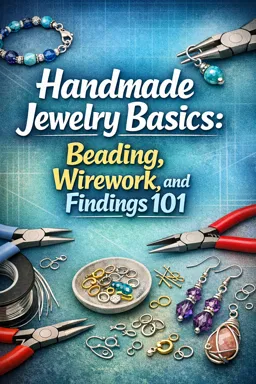
In beading and wirework, precision comes from two things: the right hand tool for the job and a workstation that prevents parts from rolling away, wire from springing unpredictably, and your hands from tiring. This chapter focuses on the core tools you’ll use most often, how to evaluate and hold them for control, and how to set up a safe, efficient workspace.
Core Hand Tools and What Each One Does
Chain-nose and Flat-nose Pliers (Gripping, Opening/Closing)
Role: These are your general-purpose gripping tools. Use them to hold jump rings, grip wire while forming bends, and stabilize findings while you twist or wrap with your other hand.
- Chain-nose pliers taper to a point, letting you reach into small spaces (tight loops, small jump rings).
- Flat-nose pliers have wider jaws for broad, even pressure (flattening a bend, holding a component without twisting it).
Practical example: When opening a jump ring, hold one side with chain-nose pliers and the other side with flat-nose pliers. Twist the ends past each other (side-to-side), rather than pulling them apart (front-to-back), to keep the ring round.
Round-nose Pliers (Loops and Curves)
Role: Round-nose pliers create consistent loops and smooth curves in wire. The jaws are conical, so where you place the wire determines loop size.
Practical example: To make a small loop at the end of a headpin or wire, place the wire near the tip of the jaws. For a larger loop, place it closer to the base of the jaws.
- Listen to the audio with the screen off.
- Earn a certificate upon completion.
- Over 5000 courses for you to explore!

Download the app
Nylon-jaw Pliers (Straightening and Smoothing)
Role: Nylon jaws grip without marring most jewelry wire. Use them to straighten wire, smooth gentle kinks, and lightly work-harden wire without leaving tooth marks.
Practical example: After cutting wire from a coil, pull it through nylon jaws in one direction several times to reduce curvature before measuring or forming.
Flush Cutters (Clean, Controlled Cuts)
Role: Flush cutters are designed to make a clean cut with one flat side of the blades. They’re used for trimming wire ends, cutting headpins/eyepins, and snipping beading wire or soft craft wire (within the tool’s rated capacity).
Key idea: The flat side of the cutter should face the piece you want to keep, so the kept end is as flat and neat as possible.
Crimping Pliers (Securing Crimps)
Role: Crimping pliers compress crimp beads/tubes in a controlled way so they hold beading wire securely. Many have two stations: one to form the crimp and one to fold/round it.
Practical example: After threading a crimp and passing beading wire back through it, use the first station to compress and shape the crimp, then the second station to fold and round it for a compact finish.
How to Choose Tool Quality (What to Check Before Buying)
Jaw Alignment and Finish
- Alignment: Close the pliers gently and look at the tips. The jaws should meet evenly without crossing or leaving a gap.
- Jaw finish: Smooth jaws reduce scratches on wire and findings. If jaws have machining marks, they can leave unwanted texture.
- Tip precision: For chain-nose and round-nose pliers, tips should be fine enough for small work but not so thin that they flex easily.
Spring Tension and Handle Comfort
- Spring return: Many jewelry pliers have a spring that reopens the jaws. It should feel smooth, not stiff or gritty.
- Handle shape: Choose handles that fit your hand size. Softer grips can reduce fatigue during repetitive tasks like wrapping or crimping.
Cutter Type and Cutting Capacity
- True flush cutters: Look for a clearly flat cutting face on one side. This improves the quality of the kept end.
- Capacity: Use cutters only for wire types and gauges they’re designed for. Cutting steel or memory wire with standard flush cutters can nick blades and ruin the cutting edge.
- Blade alignment: Blades should meet cleanly without visible gaps when closed.
Crimping Pliers: Station Shape and Fit
- Defined stations: The crimping “notches” should be crisp and well-formed so the crimp compresses predictably.
- Match to your crimps: Some crimping pliers work best with certain crimp tube sizes. If possible, test with the crimps you plan to use most.
How to Hold Each Tool for Control and Comfort
General Grip Principles
- Hold near the joint for precision: Choking up (holding closer to the pivot) gives better control for tiny movements.
- Hold farther back for power: Gripping near the ends of the handles increases leverage for thicker wire (within tool limits).
- Neutral wrist: Keep your wrist straight when possible; rotate the work with your fingers rather than twisting your wrist into awkward angles.
Chain-nose/Flat-nose Pliers
Use your thumb and first two fingers to guide the tool, with the handle resting lightly in your palm. For delicate gripping, apply pressure gradually to avoid denting wire or slipping off a jump ring.
Round-nose Pliers
For consistent loops, keep the pliers steady and move the wire around the jaw rather than rotating the pliers wildly. Marking a spot on the jaws with a fine marker (or remembering a reference point) can help you repeat loop sizes.
Nylon-jaw Pliers
Use a firm, even squeeze and pull wire through in one smooth direction. Avoid sawing back and forth, which can create uneven straightening and extra wear on the nylon.
Flush Cutters
Position the wire deep enough into the blades for stability, but not so deep that the cut is forced. Keep the flat side toward the piece you’re keeping, and stabilize the offcut with your fingers or a cloth to prevent it from flying.
Crimping Pliers
Align the crimp in the correct station before squeezing. Use steady, controlled pressure rather than a sudden hard squeeze, which can distort the crimp or damage the beading wire.
Step-by-Step Workstation Setup
1) Choose a Stable Surface and Seat Height
- Use a table that doesn’t wobble.
- Adjust your chair so your forearms can rest comfortably on the table with shoulders relaxed.
2) Place the Bead Mat
- Center the bead mat in your main working area so beads don’t roll.
- Keep the mat edge a few inches from the table edge to reduce accidental spills.
3) Set Up Lighting
- Use a bright, focused task light aimed at the bead mat.
- Position the light to reduce shadows from your hands (often slightly in front and to the side of your dominant hand).
- If glare is an issue on metal findings, adjust the angle rather than dimming the light.
4) Arrange Parts Trays for Workflow
- Use small trays or compartment boxes for beads, findings, and components.
- Place frequently used items (jump rings, crimps, ear wires) closest to your dominant hand.
- Keep “finished components” in a separate tray to avoid mixing them back into raw parts.
5) Add a Magnetic Dish (for Metal Findings)
- Place a magnetic dish near the top corner of your mat to park jump rings, clasps, and headpins.
- Use it as a “temporary holding zone” while you switch tools, reducing dropped parts.
6) Set a Waste Container for Wire Snippets
- Place a small container (cup, tin, or lidded jar) within easy reach.
- Drop wire ends and trimmed pieces into it immediately after cutting.
- If you work with very sharp offcuts, choose a container with higher sides or a lid to prevent spills.
7) Tool Layout (Simple and Repeatable)
- Line up pliers horizontally above the mat (or to the side of your dominant hand) in the order you tend to use them: chain/flat-nose, round-nose, nylon-jaw, cutters, crimping pliers.
- Keep cutters slightly separated to avoid accidentally grabbing them when you need gripping pliers.
Safety and Care While Working
Eye Protection (When and Why)
Wear eye protection when cutting wire, trimming headpins, or working with springy wire that can snap or launch small pieces. Even soft wire offcuts can travel unpredictably, especially when cut close to the tool’s tip.
Safe Cutting Direction and Controlling Offcuts
- Angle cutters so the offcut points down into the mat or toward your waste container.
- Hold the short end with your fingers (or cover it with a cloth) before cutting to prevent it from flying.
- Cut slowly and deliberately; rushing increases the chance of slipping and creating sharp, uneven ends.
Handling Sharp Wire Ends
- After cutting, assume the end is sharp until checked.
- Use chain-nose/flat-nose pliers to tuck or turn in ends rather than pushing with fingertips.
- Keep unfinished pieces on the mat, not loose in your lap or on the chair, where sharp ends can snag.
Tool Cleaning (Quick Routine)
- Wipe tool jaws with a soft cloth after use to remove skin oils and residue.
- If adhesive or grime builds up, use a small amount of rubbing alcohol on a cloth (keep it away from some handle materials if they degrade).
- Keep nylon jaws clean; embedded grit can scratch wire.
Simple Maintenance
- Lubricate joints: Add a tiny drop of light machine oil at the pivot if movement feels stiff; open/close several times and wipe away excess.
- Protect cutter edges: Don’t cut materials beyond the cutter’s rating. Store cutters closed or with a protective cap if available.
- Check screws/pivots: If a tool loosens over time, tighten gently if it has an adjustable pivot (avoid overtightening, which can bind the joint).
Readiness Checklist (Before You Start Any Project)
- Bead mat placed and clear working area established
- Task light on and positioned to minimize shadows
- Parts trays set: raw materials separated from finished components
- Magnetic dish ready for small metal findings
- Waste container in reach for wire snippets
- Core tools on hand: chain/flat-nose, round-nose, nylon-jaw, flush cutters, crimping pliers
- Eye protection available and worn for cutting steps
- Cutting plan: offcuts controlled and directed safely
- Tools clean, joints moving smoothly, cutter edges protected