Why “Connected” Korean Sounds More Natural
When learners write or speak Korean, a common issue is producing a series of short, separate sentences: “I went. I ate. I came home.” Each sentence is correct, but the overall rhythm can feel choppy. Natural Korean often connects ideas inside one sentence or across clauses, using grammar patterns that show relationships like sequence, cause, contrast, background, and intention. These patterns do more than “join sentences”: they signal what information is central, what is supporting detail, and how the speaker wants the listener to interpret the flow.
This chapter focuses on grammar patterns that help you connect clauses smoothly and choose the right “bridge” depending on meaning. You will learn how to: (1) pick a connector based on relationship (time, reason, contrast, etc.), (2) control formality and tone, and (3) avoid common overuse of one connector (especially 그리고 and -고) by expanding your options.
Core Principle: Choose the Relationship First
Before choosing a grammar pattern, decide the relationship between clause A and clause B. Ask: Is B happening after A? Because of A? Despite A? While A is happening? Is A background information and B the main point? Korean connectors are precise about these relationships.
- Sequence (A then B): -고, -아서/어서 (sometimes), -고 나서, -자마자
- Simultaneous / background (while A, B): -(으)면서, -는 동안, -는데 (background)
- Reason / cause (because A, B): -아서/어서, -(으)니까, -기 때문에
- Contrast / concession (although A, B): -지만, -(으)ㄴ/는데도, -아/어도
- Soft contrast / topic shift (A, and then…): -는데
- Condition (if A, then B): -(으)면, -아/어야
- Purpose / intention (in order to A, B): -(으)려고, -기 위해(서)
- Result / discovery (A, so B happened / I found that…): -더니, -았/었더니
Pattern Set 1: Simple Linking with -고 (and/then)
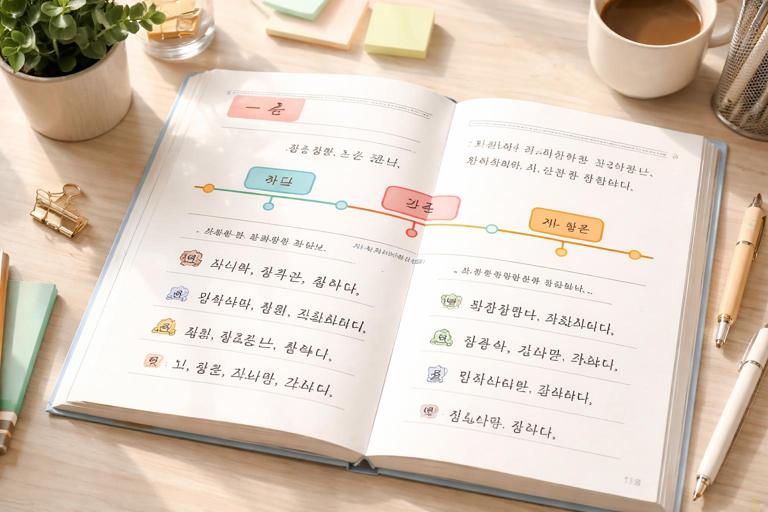
Form: Verb/Adj stem + -고 + next clause
Meaning: “and,” “and then,” neutral listing of actions or states. It is flexible and common in speech. However, overusing -고 can make your Korean sound like a simple timeline without nuance.
- Listen to the audio with the screen off.
- Earn a certificate upon completion.
- Over 5000 courses for you to explore!

Download the app
Examples
- 집에 가고 샤워했어요. (I went home and showered.)
- 커피를 마시고 일을 시작했어요. (I drank coffee and started work.)
- 오늘은 바쁘고 정신이 없어요. (Today is busy and hectic.)
Practical step-by-step: Upgrade a “-고 chain”
Start with a basic chain, then replace one connector with a more precise one.
Base: 아침에 일어나고 씻고 밥을 먹고 나갔어요.
- Step 1 (sequence emphasis): 아침에 일어나서 씻고 밥을 먹고 나갔어요. (Use -아서/어서 for “after doing A” feel.)
- Step 2 (clear “after”): 아침에 일어나서 씻고 나서 밥을 먹고 나갔어요. (After washing, then ate.)
- Step 3 (background + main point): 아침에 일어나서 씻고 나서 밥을 먹었는데, 시간이 없어서 바로 나갔어요. (Background routine, then main point: no time.)
Pattern Set 2: Sequence and Timing (-아서/어서, -고 나서, -자마자)
-아서/어서 (so/and then, because)
Form: Verb/Adj stem + -아서/어서
Main uses: (1) natural sequence (“do A and then B”), (2) reason (“because A, B”). Context decides.
- 문을 열어서 들어갔어요. (I opened the door and went in.)
- 비가 와서 택시를 탔어요. (Because it rained, I took a taxi.)
Nuance tip: If you want to avoid ambiguity between “sequence” and “reason,” choose a more explicit pattern: -고 나서 (after) for sequence, -(으)니까 or -기 때문에 for reason.
-고 나서 (after doing A, then B)
Form: Verb stem + -고 나서
Clear “after” relationship; very useful for instructions and routines.
- 손을 씻고 나서 요리하세요. (Wash your hands and then cook.)
- 회의가 끝나고 나서 이야기해요. (Let’s talk after the meeting ends.)
-자마자 (as soon as)
Form: Verb stem + -자마자
Immediate sequence; good for vivid storytelling and everyday complaints.
- 집에 도착하자마자 잠들었어요. (As soon as I got home, I fell asleep.)
- 알람이 울리자마자 일어났어요. (I got up as soon as the alarm rang.)
Pattern Set 3: Background and Flow with -는데
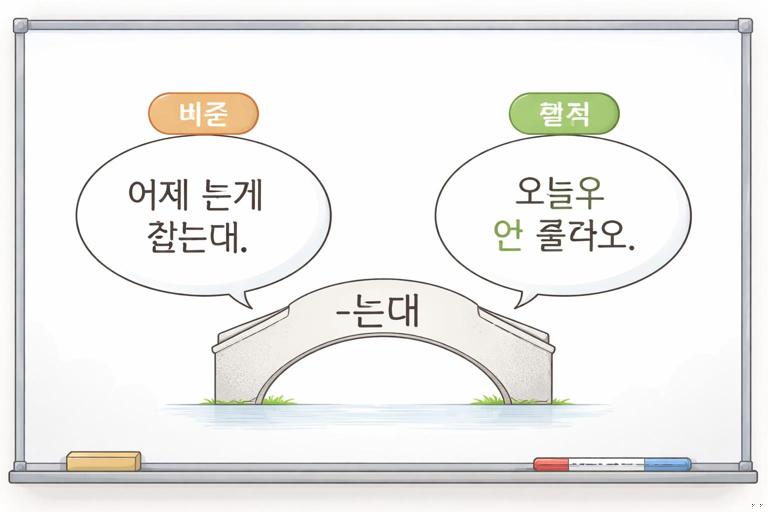
Form: Verb: -는데 / Adj: -(으)ㄴ데 / Noun: 인데
-는데 is one of the most powerful tools for natural flow. It can: (1) provide background, (2) soften a statement, (3) introduce a contrast, (4) set up the next clause like “so…” or “and then…” without sounding abrupt.
Common uses
- Background → main point: 지금 밖에 비가 오는데, 우산 있어요? (It’s raining outside—do you have an umbrella?)
- Soft contrast: 맛있는데 좀 비싸요. (It’s tasty, but a bit expensive.)
- Context setting: 친구를 기다리는데 버스가 안 와요. (I’m waiting for my friend, but the bus isn’t coming / and the bus isn’t coming.)
Practical step-by-step: Make requests sound less blunt
Direct: 물 좀 주세요. (Give me water, please.)
Softer with context: 목이 마른데 물 좀 주세요. (I’m thirsty, so could you give me some water?)
Even more natural in conversation: 죄송한데 물 좀 주실 수 있어요? (Sorry, but could you give me some water?)
Notice how -는데 helps you “enter” the request gently by providing a reason or social cushion.
Pattern Set 4: Cause and Reason (-(으)니까, -기 때문에, -아서/어서)
-(으)니까 (because / since; speaker’s reasoning)
Form: Verb/Adj stem + -(으)니까
Often used when the speaker is giving a reason that leads to a suggestion, command, or decision. It can feel more “speaker-centered” than -아서/어서.
- 늦었으니까 택시 타요. (Since we’re late, let’s take a taxi.)
- 피곤하니까 오늘은 쉬세요. (Because you’re tired, rest today.)
-기 때문에 (because; formal/explicit)
Form: Verb stem + -기 때문에 / Adj + -기 때문에
More formal and explicit; common in writing, announcements, and careful explanations.
- 비가 오기 때문에 행사가 취소됐습니다. (Because it’s raining, the event was canceled.)
- 시간이 없기 때문에 간단히 말할게요. (Because there’s no time, I’ll speak briefly.)
Choosing among the three
- -아서/어서: natural cause or sequence; very common in daily speech
- -(으)니까: reason + suggestion/command/decision; “since…” feel
- -기 때문에: formal, clear, sometimes heavier
Pattern Set 5: Contrast and Concession (-지만, -는데도, -아/어도)
-지만 (but)
Form: Verb/Adj stem + -지만
Direct contrast. Good when you want a clear “A is true, but B.”
- 가고 싶지만 시간이 없어요. (I want to go, but I don’t have time.)
- 조용하지만 좀 심심해요. (It’s quiet, but a bit boring.)
-(으)ㄴ/는데도 (even though)
Form: Verb: -는데도 / Adj: -(으)ㄴ데도
Stronger concession than -지만; emphasizes that B happens despite A.
- 비가 오는데도 사람들이 많았어요. (Even though it was raining, there were many people.)
- 피곤한데도 잠이 안 와요. (Even though I’m tired, I can’t sleep.)
-아/어도 (even if / even though; “regardless”)
Form: Verb/Adj stem + -아/어도
Often implies “no matter what” or “it’s okay even if.”
- 늦어도 괜찮아요. (It’s okay even if you’re late.)
- 비가 와도 갈 거예요. (Even if it rains, I’ll go.)
Pattern Set 6: Simultaneous Actions and Ongoing Time (-(으)면서, -는 동안)
-(으)면서 (while doing A, do B)
Form: Verb stem + -(으)면서
Two actions happen at the same time, usually with the same subject.
- 음악을 들으면서 공부해요. (I study while listening to music.)
- 걸으면서 전화했어요. (I called while walking.)
Common mistake: Using -(으)면서 when the subjects differ. If subjects differ, use -는 동안에 or separate clauses with context.
-는 동안 (during the time A happens)
Form: Verb + -는 동안
Focuses on the time period. Subjects can differ more naturally than with -(으)면서.
- 제가 요리하는 동안 아이는 숙제했어요. (While I cooked, the child did homework.)
- 한국에 있는 동안 많이 걸었어요. (During the time I was in Korea, I walked a lot.)
Pattern Set 7: Conditions and Requirements (-(으)면, -아/어야)
-(으)면 (if/when)
Form: Verb/Adj stem + -(으)면
Neutral condition. Often used for plans, habits, and general truths.
- 시간이 있으면 같이 점심 먹어요. (If you have time, let’s eat lunch together.)
- 이 버튼을 누르면 시작돼요. (If you press this button, it starts.)
-아/어야 (must / only if)
Form: Verb/Adj stem + -아/어야
Stronger requirement: “only if A, then B” or “must do A to achieve B.”
- 예약하셔야 들어갈 수 있어요. (You must make a reservation to enter.)
- 일찍 자야 내일 괜찮아요. (You have to sleep early to be okay tomorrow.)
Pattern Set 8: Purpose and Intention (-(으)려고, -기 위해(서))
-(으)려고 (intend to / in order to; conversational)
Form: Verb stem + -(으)려고
Shows intention or purpose, common in speech.
- 운동하려고 공원에 갔어요. (I went to the park to exercise.)
- 일찍 일어나려고 알람을 두 개 맞췄어요. (I set two alarms to wake up early.)
-기 위해(서) (in order to; more formal/goal-focused)
Form: Verb stem + -기 위해(서)
More explicit and often used in writing or careful speech.
- 건강을 지키기 위해서 매일 걸어요. (I walk every day to maintain my health.)
- 실수를 줄이기 위해 체크리스트를 만들었어요. (To reduce mistakes, I made a checklist.)
Pattern Set 9: Natural “Then I noticed…” (-더니, -았/었더니)
-더니 (observed change/contrast based on experience)
Form: Verb/Adj stem + -더니
Often used when the speaker observed A, and then B happened (change or contrast). It has an “I saw/experienced this” feeling.
- 아까는 조용하더니 지금은 시끄러워요. (It was quiet earlier, but now it’s noisy.)
- 열심히 연습하더니 실력이 늘었어요. (After practicing hard, their skill improved.)
-았/었더니 (I did A, and then I found/realized B)
Form: Past verb + -았/었더니
Useful for everyday mini-stories: you did something, and a result/discovery followed.
- 문을 열었더니 고양이가 있었어요. (When I opened the door, there was a cat.)
- 약을 먹었더니 좀 나아졌어요. (After taking medicine, I felt a bit better.)
Putting It Together: Building One Natural Paragraph

Below is a model paragraph that uses multiple connectors to create smooth flow. Read it and notice how each connector signals a different relationship.
아침에 눈을 뜨자마자 휴대폰을 확인했는데, 메시지가 하나 와 있었어요. 답장을 하려고 했지만 배터리가 거의 없어서 충전기를 찾았어요. 충전기를 꽂고 나서 커피를 내렸고, 커피를 마시면서 오늘 일정도 정리했어요. 시간이 없으니까 아침은 간단히 먹고 바로 나갔는데도, 버스가 늦게 와서 결국 지각했어요.Key links inside the paragraph:
- -자마자 sets immediate timing.
- -는데 provides background and smooth continuation.
- -지만 marks clear contrast (intention vs obstacle).
- -아서/어서 gives reason (battery low → find charger).
- -고 나서 gives explicit “after.”
- -(으)면서 shows simultaneous action.
- -(으)니까 supports a decision (no time → simple breakfast).
- -는데도 emphasizes “despite” (left quickly, still late).
Practice: Connector Selection Drills
To make these patterns automatic, practice choosing the connector based on relationship. Try to avoid defaulting to -고 unless it truly fits.
Drill A: Choose the best connector
Fill in the blank with a connector that matches the meaning. Multiple answers may be possible, but choose the most natural based on the intended relationship.
- 비가 오____ 우산을 가져왔어요. (Reason) → 와서 / 오니까 / 오기 때문에
- 집에 가____ 바로 씻었어요. (After) → 가서 / 가고 나서
- 음악을 들____ 숙제했어요. (Simultaneous) → 으면서
- 피곤하____ 잠이 안 와요. (Despite) → ㄴ데도
- 시간이 있____ 영화 볼래요? (If) → 으면
Drill B: Rewrite to add nuance
Rewrite each pair of short sentences into one connected sentence. Aim for a natural relationship marker.
- 배가 고팠어요. 라면을 끓였어요. → 배가 고파서 라면을 끓였어요.
- 카페에 갔어요. 사람이 많았어요. 그래서 나왔어요. → 카페에 갔는데 사람이 너무 많아서 나왔어요.
- 알람이 울렸어요. 바로 일어났어요. → 알람이 울리자마자 일어났어요.
- 예약이 없었어요. 들어갈 수 없었어요. → 예약이 없으면 들어갈 수 없어요. / 예약하셔야 들어갈 수 있어요.
Common Problems and How to Fix Them
1) Overusing 그리고 / -고
If every sentence uses 그리고 or -고, listeners may feel you are listing events without showing why they matter. Fix it by replacing one connector with a relationship marker: reason (-아서/어서), contrast (-지만), background (-는데), or timing (-고 나서, -자마자).
2) Mixing up -아서/어서 vs -(으)니까
Both can mean “because,” but -(으)니까 often supports suggestions/commands and feels like the speaker’s reasoning. If your second clause is “let’s…” or “do…” then -(으)니까 is often more natural.
- 늦었으니까 빨리 가요. (We’re late, so let’s go quickly.)
- 늦어서 미안해요. (I’m sorry because I’m late.)
3) Using -(으)면서 with different subjects
When subjects differ, -(으)면서 can sound incorrect or confusing. Use -는 동안 or split the sentence.
- 제가 요리하는 동안 동생은 설거지했어요. (Different subjects, natural.)
4) Making contrast too strong
-지만 is clear and direct. If you want a softer, more conversational flow, -는데 can be better.
- 맛있지만 비싸요. (Clear “but.”)
- 맛있는데 좀 비싸요. (Softer, more conversational.)
Mini-Templates You Can Reuse in Daily Life

Memorize these templates and swap in your own verbs. They help you produce longer, natural sentences quickly.
Template 1: Background → request
(상황) -는데, (요청) -(아/어) 주세요 / 주실 수 있어요?- 지금 회의 중인데, 조금만 조용히 해 주세요. (We’re in a meeting, so please be a bit quiet.)
- 길을 잘 모르겠는데, 도와주실 수 있어요? (I’m not sure of the way—could you help?)
Template 2: Intention → action
(목적) -(으)려고 / -기 위해(서) + (행동) 했어요- 살을 빼려고 저녁을 가볍게 먹었어요. (To lose weight, I ate a light dinner.)
- 집중하기 위해서 알림을 껐어요. (To focus, I turned off notifications.)
Template 3: Despite → unexpected result
(상황) -(으)ㄴ/는데도 + (결과)- 일찍 나왔는데도 길이 막혔어요. (Even though I left early, traffic was bad.)
- 연습을 많이 했는데도 긴장했어요. (Even though I practiced a lot, I was nervous.)
Template 4: Do A, then discover B
A-았/었더니 B- 검색해 봤더니 오늘 휴무였어요. (I searched, and it turned out they were closed today.)
- 문을 열었더니 바람이 너무 차가웠어요. (I opened the door and found the wind was very cold.)