What “flow” means in Korean: beyond grammar
Even when your grammar is correct, your Korean can still feel “choppy” if each sentence stands alone. Flow comes from how you guide the listener or reader through your ideas: adding background, signaling contrast, softening claims, showing sequence, and indicating what matters most. Korean does this heavily through discourse markers (담화 표지) and sentence connectors (연결 표현). These are short words or phrases that manage the relationship between sentences and clauses, and they often carry speaker attitude (politeness, certainty, hesitation, emphasis).
In everyday mini-fictions and daily conversation, these markers are what make narration feel natural: the speaker sets the scene (근데/일단), adds a reason (그래서), corrects themselves (아니, 그러니까), or returns to the main point (어쨌든). Learning them is less about memorizing “meanings” and more about learning what they do in discourse: how they steer attention and how they shape tone.
Two big categories you should separate
1) Discourse markers (sentence-level “traffic signals”)
Discourse markers usually appear at the beginning of a sentence or turn. They connect chunks of discourse (whole sentences, paragraphs, turns in conversation). They can also show emotion or stance. Examples: 근데, 그래서, 그러면, 일단, 아무튼/어쨌든, 그러니까, 사실, 솔직히, 근데 말이야.
2) Sentence connectors (clause-level “bridges”)
Sentence connectors link clauses inside a sentence or tightly connect two sentences. Many are grammatical endings, but here we focus on their discourse function for flow: how they package information (background vs main event), how they show sequence, and how they manage contrast. Examples: -고, -아서/어서, -는데, -지만, -니까, -면서, -자마자, -다가, -더니.
In real Korean, you often combine both: a discourse marker to set direction, then a connector to shape the sentence internally.
- Listen to the audio with the screen off.
- Earn a certificate upon completion.
- Over 5000 courses for you to explore!

Download the app
근데 (discourse marker) 집에 가는데 (connector -는데) 비가 오는 거야.Core discourse markers for everyday storytelling flow
근데: pivot, contrast, or “new development”
근데 is not only “but.” In mini-fictions it often introduces a twist, a new scene, or a slight shift in focus. It can be gentle (changing topic) or dramatic (plot turn).
Contrast: 오늘은 일찍 자려고 했어. 근데 갑자기 친구가 전화했어.
New development: 문을 열었어. 근데 안에 불이 켜져 있더라.
Soft topic shift: 근데 내일 시간 돼?
Tip: If you overuse 근데, your narration can sound like a chain of surprises. Balance it with 그래서 (cause/result), 그러다가 (sequence), 그리고 (addition).
그래서: result, consequence, “this is why”
그래서 pushes the story forward by showing outcome. It’s one of the easiest ways to make your Korean sound coherent because it tells the listener how the next sentence relates.
비가 너무 와서 우산을 샀어. 그래서 지하철까지 뛰어갔지.
배가 고팠어. 그래서 편의점에 들렀어.
Common pitfall: Using 그래서 when there is no clear cause. If the relationship is just “next thing,” use 그리고/그러다가 instead.
그러면: conditional step, “in that case”
그러면 is excellent for step-by-step logic in dialogue and daily tasks. It can mean “then” (next step) or “if so/in that case.”
지금 비 와? 그러면 택시 타자.
그러면 먼저 주문부터 할까요?
일단: “for now,” first step, temporary decision
일단 is a flow tool for managing uncertainty. It tells the listener you’re making a provisional move before deciding everything.
일단 앉아. 얘기부터 하자.
일단 집에 가서 생각해 볼게.
Mini-fiction effect: 일단 often signals a character is improvising, which builds realism.
그러니까: clarification, correction, “what I mean is”
그러니까 is used to reframe or clarify. It’s also used to draw a conclusion from what was just said, but in everyday speech it often functions like “so, I mean…”
아니, 그러니까 내가 늦은 게 아니라 버스가 안 온 거야.
그러니까 내 말은, 오늘은 쉬자는 거지.
Placement: It often appears after a small pause, and it can follow 아니 to signal self-correction.
사실 / 솔직히: stance markers (“to be honest”)
These markers change the tone by signaling sincerity or confession. They’re powerful in mini-fictions because they reveal inner voice.
사실 나도 좀 무서웠어.
솔직히 말하면, 그때는 이해가 안 됐어.
Pragmatic note: 솔직히 can sound slightly blunt depending on context; 사실 is often softer.
아무튼 / 어쨌든: returning to the main line
These are “reset” markers. They help you escape side comments and return to the main narrative. In storytelling, they prevent rambling.
어쨌든 그날은 그냥 집에 갔어.
아무튼 결론은, 내가 계산했지.
Nuance: 아무튼 can feel a bit dismissive (“anyway, whatever”), while 어쨌든 is often more neutral (“anyway”).
Connectors that create smooth narrative rhythm
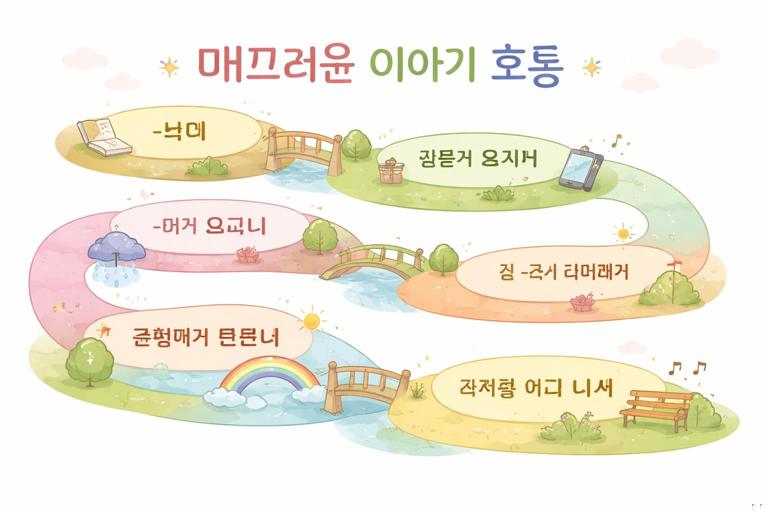
-는데: background, contrast, “setting the scene”
-는데 is one of the most important flow tools in Korean. It often gives background information that sets up the next clause, or it creates a soft contrast. In mini-fictions, it’s used to paint the scene before the main event.
Background: 집에 가는데 비가 오기 시작했어. (While I was going home, it started raining.)
Soft contrast: 열심히 했는데 결과가 별로였어.
Inviting response (conversation): 지금 바쁜데… (implies “so…” / “but…”)
Flow tip: Use -는데 to avoid “A happened. B happened.” Instead: “A was happening, and then B happened.”
-다가: interruption, change mid-action
-다가 shows that an action was in progress and then something changed or interrupted it. It’s excellent for plot movement.
걷다가 친구를 만났어.
책을 읽다가 잠들었어.
Story effect: -다가 makes events feel accidental and natural, like real life.
-더니: change based on observation, “and then (surprisingly)”
-더니 often links an observed situation to a later result, frequently with a sense of contrast or surprise. It’s common in spoken storytelling.
아까는 조용하더니 갑자기 시끄러워졌어.
비가 오더니 금방 그쳤어.
Note: -더니 typically reflects the speaker’s observation/experience, which adds a “narrator’s eye” feeling.
-자마자: immediate sequence
-자마자 creates a crisp, cinematic sequence: as soon as X happened, Y happened.
집에 도착하자마자 샤워했어.
문을 열자마자 고양이가 뛰어나왔어.
Flow tip: Use it sparingly for emphasis; too much can make the narration feel rushed.
-면서: simultaneous actions, layered scenes
-면서 helps you layer actions and create a richer scene.
커피를 마시면서 창밖을 봤어.
웃으면서도 눈물이 났어.
Mini-fiction effect: -면서 is great for emotional contrast (smiling while crying).
-고 나서 / -고서는: sequence with completion
These connectors emphasize that the first action is completed before the next begins. They’re useful for clear step order in daily routines.
숙제를 하고 나서 게임했어.
문을 닫고 나서야 안심했어.
Step-by-step method: building flow in your own Korean
Step 1: Decide the relationship between sentences
Before choosing a marker, label the relationship in simple terms. Common labels: contrast, result, sequence, background, correction, return-to-topic, emphasis, confession.
Sentence A: I was going home. Sentence B: It started raining. Relationship: background + new event.Step 2: Choose one discourse marker (optional) to set direction
If you want a “turn” feeling, choose a discourse marker. If the relationship is already clear through a connector, you can skip the discourse marker.
Twist/new development: 근데
Result: 그래서
Next step / conditional: 그러면
Temporary plan: 일단
Clarification: 그러니까
Return: 어쨌든
Step 3: Choose one connector to shape the sentence internally
Pick a connector that matches your label.
Background scene: -는데
Interrupted action: -다가
Observed change: -더니
Immediate sequence: -자마자
Simultaneous: -면서
After completion: -고 나서
Step 4: Read it aloud and adjust “weight”
Flow is also about rhythm. If your sentence feels heavy, remove one marker. If it feels abrupt, add a background connector like -는데 or a discourse marker like 근데/그래서.
Too heavy: 근데 그래서 집에 가는데 비가 와서 결국 택시 탔어. (overloaded)Better: 집에 가는데 비가 오기 시작했어. 그래서 택시를 탔어.Step 5: Use “one main event per sentence” and attach background
A practical rule for mini-fictions: keep one main event in the final clause, and attach background before it.
Background + main event pattern: (배경) -는데 / -다가 + (핵심 사건).편의점에 들렀는데 계산대에 줄이 너무 길었어.
문을 열다가 손이 멈췄어.
Mini-fiction style examples: choppy vs flowing
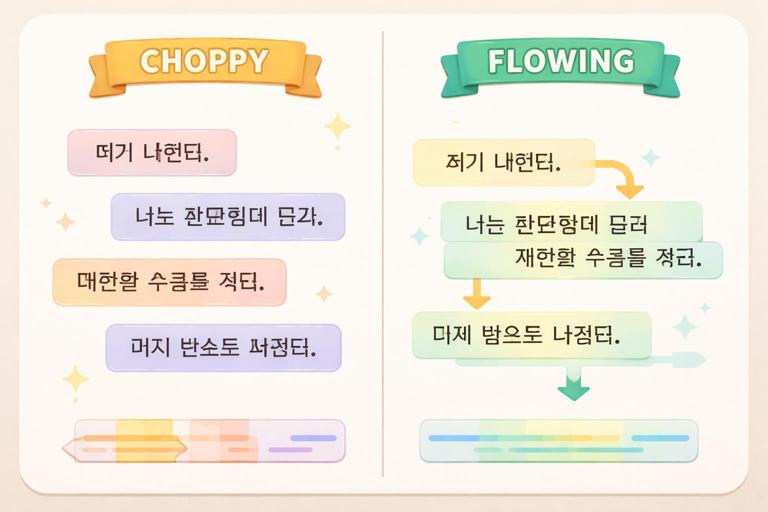
Example 1: simple daily scene
Choppy:
오늘 늦게 일어났어. 버스를 놓쳤어. 비가 왔어. 기분이 안 좋았어.Flowing:
오늘 늦게 일어났는데 버스를 놓쳤어. 게다가 비까지 오는 거야. 그래서 하루 종일 기분이 좀 가라앉았어.What changed: -는데 sets background and links the first two events; 게다가 adds “and on top of that”; 그래서 ties emotion as a result.
Example 2: small twist
Choppy:
문을 열었어. 아무도 없었어. 불이 켜져 있었어. 무서웠어.Flowing:
문을 열었는데 아무도 없었어. 근데 불은 켜져 있더라. 사실 그때 좀 무서웠어.What changed: -는데 creates a calm setup; 근데 introduces the twist; 사실 signals inner confession.
Example 3: dialogue with decision-making
Choppy:
지금 비 와? 택시 탈까? 돈이 아까워.Flowing:
지금 비 와? 그러면 택시 탈까? 일단 빨리 가는 게 낫지.What changed: 그러면 makes the logic explicit; 일단 frames a practical temporary choice.
How to avoid common “flow mistakes”
Mistake 1: Overusing 그래서 for simple sequence
그래서 needs a reason-result feeling. If you mean “and then,” use 그리고, 그러다가, or a connector like -고 나서.
Awkward: 밥을 먹었어. 그래서 이를 닦았어. (sounds like brushing is a “consequence”)
Natural: 밥을 먹고 나서 이를 닦았어.
Mistake 2: Using 근데 as a filler in every sentence
근데 is powerful; too much makes your narration feel like constant contradiction. Replace with markers that match your intent.
Addition: 그리고, 게다가
Return to topic: 어쨌든
Sequence: 그러다가, 그러고 나서
Mistake 3: Confusing -는데 (background) with -지만 (strong contrast)
-는데 can be contrast, but often it’s softer and more “setup.” -지만 is clearer opposition. Choose based on how sharp you want the contrast to feel.
Softer: 가고 싶은데 시간이 없어. (invites negotiation)
Stronger: 가고 싶지만 시간이 없어. (more final, more “but”)
Mistake 4: Stacking too many markers in one breath
Korean allows stacking, but for learners it often creates heaviness. Use a simple rule: one discourse marker + one connector is usually enough.
Good: 근데 + -는데 / 그래서 + -고 나서 / 사실 + (plain sentence)Practice drills you can do with any short scene
Drill 1: Relationship labeling (3 minutes)
Write 4 short sentences about a daily moment (commute, café, elevator, convenience store). Then label the relationship between each pair: sequence, result, contrast, background, interruption.
1) 편의점에 갔어. 2) 카드가 안 됐어. 3) 현금이 없었어. 4) 그냥 나왔어.Labels: 1→2 (new development), 2→3 (reason), 3→4 (result).
Drill 2: Add one discourse marker per pair (5 minutes)
Insert a discourse marker that matches each label.
편의점에 갔어. 근데 카드가 안 됐어. 그래서 현금이 없다는 걸 깨달았어. 어쨌든 그냥 나왔어.Notice how 어쨌든 helps you “wrap” the chain and return to the main line without sounding dramatic.
Drill 3: Convert two sentences into one with a connector (5 minutes)
Take each pair and merge them using a connector that creates smoother rhythm.
편의점에 갔는데 카드가 안 됐어. 현금이 없어서 그냥 나왔어.Now the story has fewer stops and feels more like spoken Korean.
Drill 4: Create a “scene + event” pattern with -는데 (5 minutes)
Write one background clause with -는데 and one main event clause. Keep the main event at the end.
줄을 서 있는데 내 뒤에서 누가 내 이름을 불렀어.
버스를 기다리는데 메시지가 하나 왔어.
조용히 걷는데 갑자기 음악 소리가 들렸어.
Useful connector bundles for mini-fictions (templates)
These are practical “plug-in” templates. Replace the brackets with your own content.
Template A: calm setup → twist
[장소/상황] -는데, 근데 [예상 밖의 일] (거야/더라).집에 가는데, 근데 지갑이 없는 거야.
문 앞에 섰는데, 근데 열쇠가 안 보이더라.
Template B: small problem → decision
[문제] -아서/어서, 그래서 [결정].시간이 없어서, 그래서 그냥 뛰었어.
비가 너무 와서, 그래서 약속을 미뤘어.
Template C: interruption → new direction
[하다가] -다가 [중단/사건]. 그러고 나서 [다음 행동].요리하다가 손을 데였어. 그러고 나서 찬물부터 틀었지.
전화하다가 배터리가 꺼졌어. 그러고 나서 충전기를 찾았어.
Template D: confession/inner voice → main point
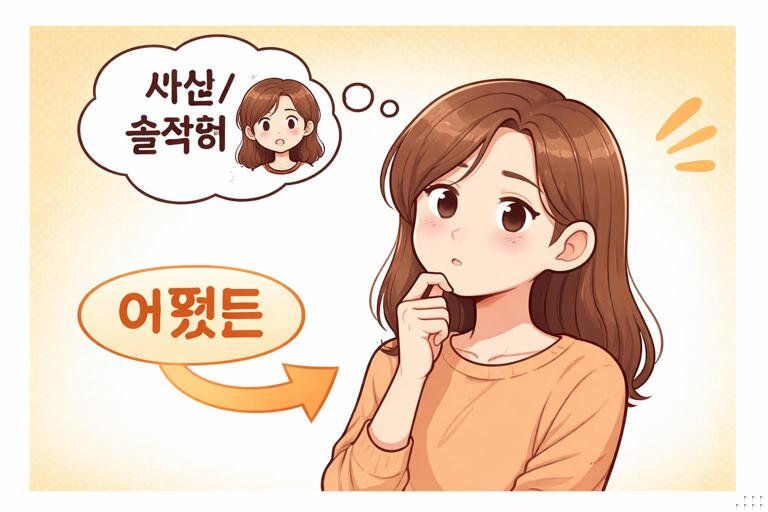
사실/솔직히 [속마음]. 어쨌든 [핵심 사건].사실 좀 기대했어. 어쨌든 결과는 생각보다 좋았어.
솔직히 말하면 망설였어. 어쨌든 문을 두드렸지.