What Governance Cadences, Reporting, and Stakeholder Management Actually Do
Once an alliance moves from “signed” to “running,” the main failure mode is not strategy—it is drift. Drift shows up as missed follow-ups, unclear ownership, changing priorities, and silent dissatisfaction that only surfaces when renewal time arrives. Governance cadences, reporting, and stakeholder management are the operating system that prevents drift. They create predictable touchpoints, shared visibility, and a way to resolve issues before they become relationship damage.

Governance is not bureaucracy. It is a lightweight set of routines and artifacts that answer four questions repeatedly: What did we commit to? What happened since last time? What is blocked and who owns the unblock? What decisions are needed and by when? When these are answered consistently, partners trust the process even when results fluctuate.
Core Components of Alliance Governance
1) Cadences (the meeting rhythm)
Cadences are the recurring meetings that keep execution aligned. A good cadence design separates “doing” from “deciding.” Working sessions focus on tasks and coordination; steering sessions focus on decisions, trade-offs, and escalation. Without this separation, meetings either become status theater or devolve into tactical rabbit holes.
2) Reporting (the shared truth)
Reporting is the set of dashboards, summaries, and narratives that create a single source of truth. It should be consistent, comparable over time, and understandable to both operators and executives. Reporting is not just metrics; it includes context: what changed, why it changed, and what will be done next.

3) Stakeholder management (the human network)
Stakeholder management is the deliberate practice of mapping who influences the partnership, what they care about, and how you keep them informed and supportive. Partnerships fail when the “real decision makers” are surprised, when internal teams feel burdened, or when champions leave and no one rebuilds sponsorship.
- Listen to the audio with the screen off.
- Earn a certificate upon completion.
- Over 5000 courses for you to explore!

Download the app
Designing Governance Cadences: A Practical Step-by-Step
Step 1: Define the governance layers
Most partnerships need three layers. First, an operator layer for day-to-day execution. Second, a manager layer for monthly prioritization and resource alignment. Third, an executive layer for quarterly decisions and strategic direction. If you skip a layer, issues either never escalate or escalate too late.
- Operating Working Group (weekly or biweekly): partner managers, marketing ops, sales ops, solution/implementation leads. Purpose: coordinate tasks, review pipeline/activities, remove small blockers.
- Performance & Planning Review (monthly): partnership lead, functional managers, finance/ops as needed. Purpose: review performance narrative, adjust plan, approve changes in scope, align resourcing.
- Steering Committee / Executive Business Review (quarterly): exec sponsors, partnership lead, key functional heads. Purpose: confirm strategic fit, approve major investments, resolve escalations, set next-quarter priorities.
Step 2: Assign roles using a simple RACI
Governance breaks when ownership is ambiguous. Use a RACI (Responsible, Accountable, Consulted, Informed) for the recurring outputs: meeting agendas, reporting pack, action log, and escalation items. Keep it small: one accountable owner per artifact.
Artifact: Weekly agenda + notes  | A: Partner Manager | R: Ops Lead | C: Sales/CS | I: Exec Sponsor (optional)
Artifact: Monthly report pack    | A: Partnership Lead | R: Analyst/Ops | C: Finance | I: Stakeholders list
Artifact: Action log             | A: Partner Manager | R: All owners | C: PMO (if any) | I: Working group
Step 3: Set meeting SLAs (service-level agreements for governance)
Meeting SLAs prevent the “we’ll send notes later” problem. Define: agenda sent 24 hours before, pre-reads attached, decisions captured in the first 24 hours after, and action items assigned with due dates. If either side repeatedly violates SLAs, treat it as a governance risk and escalate early.
- Agenda + pre-read: sent 24 hours prior
- Attendance: required roles; substitutes allowed with handoff
- Notes: distributed within 24 hours
- Action items: owner + due date + success definition
- Decision log: what was decided, by whom, and implications
Step 4: Build a standard agenda template per cadence
Templates reduce cognitive load and keep meetings outcome-driven. Each agenda should include a “decision needed” section so the meeting produces progress, not just updates.
Weekly Working Group agenda (45 minutes):
- 5 min: wins and critical updates since last meeting
- 10 min: activity/pipeline snapshot (only deltas, not full recitation)
- 15 min: blockers and dependencies (internal and partner-side)
- 10 min: next 7–14 days plan (what, who, by when)
- 5 min: decisions needed + confirm action items
Monthly Performance & Planning agenda (60–90 minutes):
- 10 min: scorecard review (trend lines, targets, variance)
- 15 min: narrative—what drove results (top 3 drivers)
- 15 min: funnel health and execution quality checks
- 20 min: next-month plan + resourcing asks
- 10 min: risks, escalations, and decisions
Quarterly Steering agenda (60 minutes):
- 10 min: partnership health summary (outcomes + relationship)
- 15 min: strategic alignment and market feedback
- 15 min: major bets and investment decisions
- 10 min: escalations requiring executive authority
- 10 min: commitments for next quarter
Step 5: Create an escalation path that is explicit and fast
Escalation is not conflict; it is a mechanism to protect momentum. Define triggers that automatically escalate to the next layer. Examples: repeated missed commitments, unresolved cross-functional dependency beyond two weeks, or a material change in partner priorities. Include a “time-to-escalate” rule so issues do not linger.
- Trigger: action item overdue twice → Escalate to: monthly review owner
- Trigger: resource request blocked > 10 business days → Escalate to: functional manager
- Trigger: partner-side reorg or champion departure → Escalate to: exec sponsor for relationship reset
Reporting That Works: From Raw Metrics to Decision-Ready Narratives
Principle: reporting should answer “so what?”
Operators need detail; executives need clarity. The best reporting pack has a consistent structure: a one-page summary, a scorecard, a pipeline/activity view, a risks/issues log, and a forward plan. The “one-page summary” is the most valuable part: it forces interpretation and highlights decisions needed.
Build a reporting pack (step-by-step)
Step 1: Standardize the reporting period and definitions
Pick a reporting period (weekly for operators, monthly for management) and stick to it. Use consistent definitions for stages, sources, and statuses. Inconsistent definitions create arguments about the numbers instead of decisions about actions.
Step 2: Use a layered format
Layered reporting means the first page is readable in 60 seconds, while deeper pages support drill-down. A practical structure:
- Page 1: Executive summary (outcomes, key drivers, decisions needed, top risks)
- Page 2: Scorecard (trend vs target, variance, notes)
- Page 3: Funnel/pipeline view (movement, conversion, aging)
- Page 4: Execution tracker (top initiatives, status, next milestone)
- Page 5: Issues & escalations (owner, impact, ETA, ask)
Step 3: Add a “variance narrative” for every key line
For each key metric or outcome, include a short variance narrative: what changed, why it changed, what you will do, and what you need. This turns reporting into a management tool rather than a scoreboard.
Metric: Partner-sourced opportunities
Target: 30 | Actual: 18 | Variance: -12
Why: Two planned webinars slipped; partner SDR team reallocated mid-month.
Action: Reschedule webinars; run joint outbound sprint; provide refreshed talk track.
Ask: Partner to confirm SDR allocation for next 4 weeks by Friday.
Step 4: Track relationship health alongside performance
Numbers can look fine while the relationship deteriorates. Add a simple relationship health section with signals such as responsiveness, meeting attendance, decision speed, and stakeholder sentiment. Keep it factual: “average response time increased from 1 day to 5 days” is more useful than “they seem less engaged.”
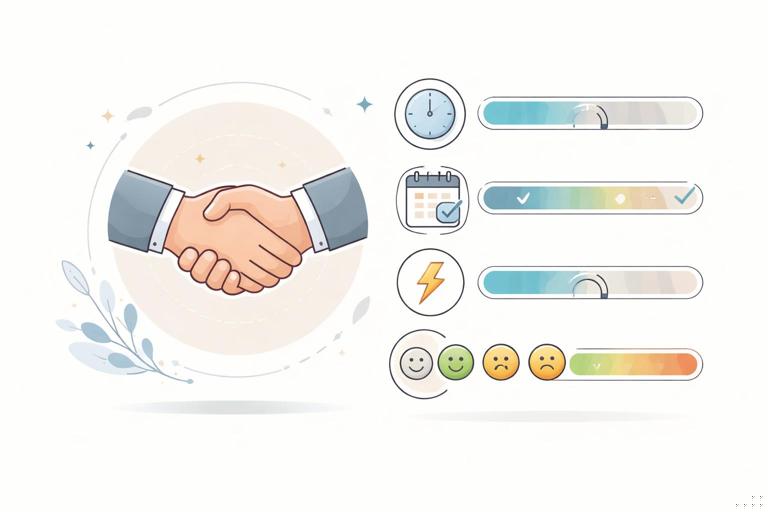
- Responsiveness (avg response time, open items aging)
- Engagement (attendance rate, cancellations, prep quality)
- Decision velocity (time from request to decision)
- Stakeholder sentiment (quick pulse notes from key contacts)
Step 5: Make reporting reciprocal
One-sided reporting creates suspicion. Agree on what each side will share and when. If one party cannot share certain data, replace it with proxy indicators or qualitative summaries. The goal is symmetry of effort and transparency, not identical datasets.
Stakeholder Management: Mapping Influence and Preventing Surprises
Stakeholder categories you must manage
In most alliances, stakeholders fall into four categories: sponsors (who can allocate resources), champions (who push the partnership internally), operators (who do the work), and gatekeepers (legal, security, finance, brand). Each category needs a different communication style and cadence.
- Sponsors: care about strategic outcomes, risk, and reputation
- Champions: care about wins, visibility, and internal credibility
- Operators: care about clarity, workload, and fast decisions
- Gatekeepers: care about compliance, process, and avoiding surprises
Build a stakeholder map (step-by-step)
Step 1: List every stakeholder on both sides
Include names, roles, and what they control. Do not stop at the people you meet regularly. Add the “shadow stakeholders” who influence decisions indirectly, such as a finance leader who approves discounts or a security lead who can delay execution.
Step 2: Capture their goals and success measures
Write down what each stakeholder wants to achieve in their own words. This helps you frame updates in a way that matters to them. For example, a sales leader may care about pipeline coverage, while a customer success leader may care about implementation load and churn risk.
Step 3: Score influence and support
Use a simple 2x2: influence (low/high) and support (low/high). Your governance plan should focus most on high-influence stakeholders, especially those with uncertain support. The goal is not to “sell” them continuously; it is to keep them informed and involved at the right moments.
Step 4: Create a communication plan by stakeholder type
Define what each stakeholder receives, how often, and through which channel. Avoid spamming everyone with the same deck. Tailor the format: a sponsor may want a 5-bullet email; operators may need a detailed tracker.
- Exec sponsor: monthly email summary + quarterly steering pre-read
- Functional managers: monthly performance pack + escalation alerts
- Operators: weekly working notes + shared action log
- Gatekeepers: early heads-up on changes that affect compliance or brand
Step 5: Build redundancy for champion risk
People change roles. To reduce dependency on a single champion, maintain at least two relationships per function on the partner side (for example, one in sales and one in marketing). Keep a lightweight “relationship dossier” so a new stakeholder can be onboarded quickly: current priorities, open decisions, and recent wins.
Running High-Quality Governance Meetings
Pre-work: make meetings decision-ready
The fastest way to waste a governance meeting is to use it to discover information. Instead, use pre-reads to align on facts and reserve meeting time for interpretation and decisions. Pre-reads should be short: a scorecard, a pipeline delta, and a list of decisions needed.
During the meeting: control the flow
Use a facilitator (often the partner manager) who keeps time, parks unrelated topics, and confirms decisions. If a topic needs deep work, schedule a separate working session with the right people rather than hijacking the governance cadence.
After the meeting: close the loop
Send notes with three sections: decisions, action items, and open questions. Update the action log immediately. If you do not close the loop within 24 hours, the meeting’s value decays quickly and accountability becomes fuzzy.
Artifacts That Make Governance Lightweight and Scalable
1) Shared action log
A shared action log is the simplest governance tool with the highest ROI. It should include: action, owner, due date, status, and a link to evidence. Keep it in a shared workspace both parties can access.
2) Decision log
Decision logs prevent re-litigating old debates. Record what was decided, the date, who approved it, and what it changes. This is especially useful when stakeholders rotate.
3) Issues and risks register (operational)
Separate “issues” (current problems) from “risks” (potential problems). Each entry needs an owner and a mitigation plan. This register feeds escalations and keeps surprises out of steering meetings.
4) Stakeholder directory
Maintain a simple directory: names, roles, time zones, preferred channels, and backup contacts. Add notes on what each person cares about. This reduces friction when urgent coordination is needed.
Common Governance Failure Patterns and How to Fix Them
Failure pattern: meetings become status recitals
If meetings are mostly reading dashboards aloud, move the data to pre-reads and use meeting time for decisions and trade-offs. Add a rule: every meeting must produce at least one decision or a clear next step with an owner.
Failure pattern: too many stakeholders, too early
Over-inviting creates noise and slows decisions. Keep working groups small and invite specialists only when their input is needed. Use the stakeholder map to decide who is “core” versus “on call.”
Failure pattern: executive steering is disconnected from reality
Steering committees fail when they only see polished slides. Include a short “ground truth” section: top three blockers, what has been tried, and what authority is needed. Executives should leave with clear asks, not vague awareness.
Failure pattern: silent misalignment on priorities
Partners can agree on goals but disagree on what matters this month. Fix this by adding a “top 3 priorities” section to every monthly review and requiring both sides to confirm them explicitly.
Practical Example: Setting Up Governance for a Co-Selling Alliance
Scenario
You and a partner are actively co-selling into mid-market accounts. There are multiple moving parts: lead sharing, account mapping, joint calls, and enablement updates. The risk is that each side assumes the other is driving.
Governance setup
- Weekly working group: partner managers + sales ops. Output: updated action log, next-week joint call plan, list of stalled deals needing help.
- Monthly performance review: partnership lead + sales leaders. Output: variance narrative, resourcing decisions, enablement needs.
- Quarterly steering: exec sponsors. Output: confirm strategic focus segments, approve next-quarter investment (events, headcount time allocation), resolve escalations.
Reporting pack highlights
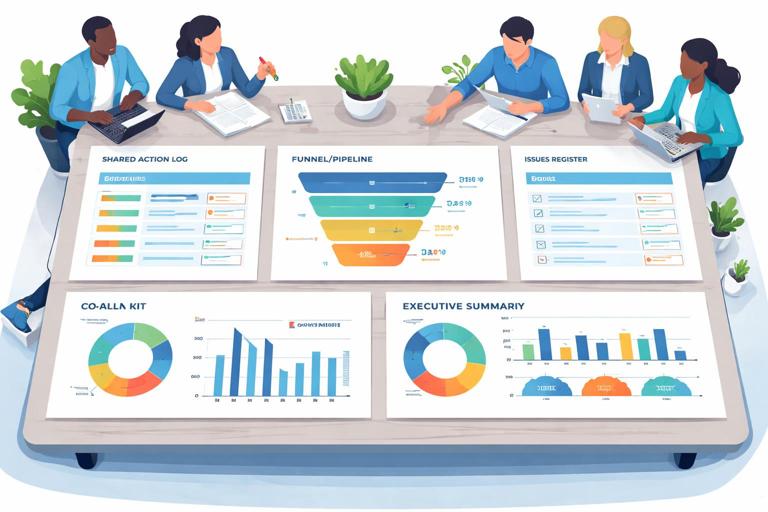
The monthly pack includes: a one-page summary with decisions needed (for example, “approve two joint workshops next month”), a funnel view with aging to spot stuck opportunities, and an issues register showing cross-functional blockers (for example, delayed security review impacting multiple deals).
Stakeholder management moves
You maintain redundancy by having two contacts in partner sales leadership and one in partner operations. You send sponsors a short monthly email that ties progress to their priorities (pipeline coverage and win rate) and flags only the decisions that require their authority.