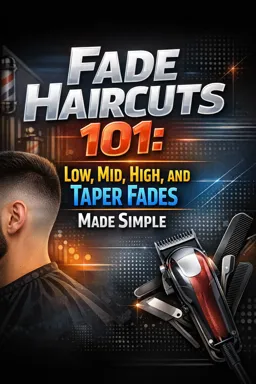
Core Tools for Low, Mid, High, and Taper Fades
Clean fades come from controlling length (how much hair remains) and finish (how smooth the transition and edges look). Each tool changes one or both. Think of your kit as a system: clippers set the bulk length, guards standardize it, the lever fine-tunes it, trimmers define edges, and finishing tools refine the blend and skin contact.
Adjustable Clippers (Lever Open/Closed)
What they do: Adjustable clippers are the main fade tool. The lever changes the blade gap, which changes how short the clipper cuts without changing guards. This is how you “erase” lines between lengths.
- Lever closed = shortest setting on that clipper (tightest cut).
- Lever open = longer setting on that clipper (softer, slightly longer cut).
- Half lever positions create in-between lengths for smoother blending.
How it affects finish: A sharp, well-oiled clipper with a consistent lever action produces cleaner transitions and fewer “steps.” Dull blades or dry clippers can snag hair and leave patchy areas that look like dark spots in the fade.
Guards (Guide Combs)
What they do: Guards standardize length and help you build the fade in predictable steps. They also reduce the risk of taking the hair too short too quickly.
How it affects finish: Guards create consistent length panels. The blend quality depends on how you connect those panels using lever play, clipper-over-comb, and detailing.
- Listen to the audio with the screen off.
- Earn a certificate upon completion.
- Over 5000 courses for you to explore!

Download the app
Trimmers (Outliners/Detailers)
What they do: Trimmers cut closer than clippers and are used for outlining (neckline, around ears, sideburns) and for creating a clean “bald” guideline when doing skin fades.
How it affects finish: Trimmers sharpen the perimeter and can tighten the lowest part of a fade. Used carefully, they make the fade look crisp; used aggressively, they can push a line too high and create a harsh step that’s harder to remove.
Foil Shaver (Optional)
What it does: A foil shaver takes hair down to a very close finish (closer than trimmers) for a smooth skin result. It is typically used below the lowest guideline in a skin fade.
How it affects finish: It creates the cleanest “skin” look, but it also increases contrast. Higher contrast means any remaining line above the shaved area is more visible, so your blending must be tighter.
Straight Shears (Cutting Scissors)
What they do: Shears remove length with precision, especially on top or when refining weight near the parietal ridge (the area where the head starts to round).
How it affects finish: Shears can soften bulky corners and help the fade flow into longer hair. They’re also useful for scissor-over-comb to refine transitions where clippers may leave a shelf.
Blending/Texturizing Shears
What they do: These remove some hair without removing all hair in the section, reducing weight and softening visible lines.
How it affects finish: They can “blur” minor imperfections in the blend, especially in thicker hair. Overuse can create frizz, uneven density, or a chewed-up look—use them as a refinement tool, not the main blending method.
Combs (Fade Comb, Cutting Comb)
What they do: Combs control elevation and tension, and they act as a movable “guard” for clipper-over-comb or scissor-over-comb work.
How it affects finish: A good comb technique helps you remove weight gradually and prevents hard ledges. A fade comb with a flatter spine can help keep a consistent angle against the head.
Sectioning Clips
What they do: Clips hold longer hair out of the way (especially when fading into longer tops or when working around cowlicks).
How it affects finish: Better control and visibility. When hair falls into the fade area, it can trick you into thinking the blend is darker than it is, leading to overcutting.
Spray Bottle (Water Mister)
What it does: Lightly dampens hair for control during scissor work and to reset hair direction when checking the blend.
How it affects finish: Damp hair can look darker and lie flatter, which may hide lines temporarily. Use misting strategically: dampen for control, then check the fade again with hair closer to dry to confirm the blend.
Neck Strips and Cape
What they do: Neck strips create a hygienic barrier between skin and cape and help catch loose hair. The cape protects clothing and keeps hair contained.
How it affects finish: Comfort and cleanliness affect client stillness. A secure, comfortable setup reduces movement, which improves precision around the ears and neckline.
Brushes (Fade Brush, Neck Duster)
What they do: Remove cut hair so you can see true density and lines. A small fade brush is especially useful during detailing.
How it affects finish: Hair clippings can mimic a shadow line. Brushing frequently reveals whether a line is real or just loose hair sitting on the scalp.
Structured Setup Routine for Clean, Consistent Fades
Use the same setup sequence every time. Consistency reduces mistakes and speeds up your workflow.
Step 1: Sanitize Hands and Tools
- Hands: Wash or sanitize before touching the client and after handling non-sanitized items (phone, drawers, door handles).
- Clippers/trimmers: Ensure blades are clean and disinfected according to your local regulations and product instructions.
- Brushes/combs: Use clean, disinfected tools. Keep “used” tools separate from clean ones during the service.
Step 2: Prepare the Workstation (Before the Client Sits)
- Lay out tools in order of use: clipper, trimmer, guards, combs, brush, spray bottle, clips, shears.
- Arrange guards by length: smallest to largest so you can grab without thinking.
- Check clipper lever movement: open/close it a few times to confirm smooth action.
- Oil the clipper: apply a small amount of clipper oil to the blade (per manufacturer guidance), run the clipper briefly, then wipe excess to avoid dripping onto the client.
- Power and cords: confirm battery level or cord placement so you’re not pulling across the client’s face or shoulder.
Step 3: Cape and Neck Strip Application
- Neck strip: stretch gently and wrap around the neck so it sits comfortably and fully covers the skin where the cape will touch.
- Cape: secure snugly over the neck strip (not on bare skin). Ensure it’s tight enough to stop hair from falling inside but not restrictive.
- Client comfort check: ask if the cape feels too tight before you start.
Step 4: Client Consultation Basics (Fade-Specific)
Keep it focused on decisions that affect the fade outcome. Confirm these points before you pick up the clipper:
- Desired fade height: low, mid, high, or taper. Ask the client to point to where they want the fade to start/peak on the sides.
- Finish preference: natural (not to skin), very tight, or skin finish (if you offer it). If skin is requested, confirm comfort with trimmer/foil shaver contact.
- Edge style: natural neckline vs squared/rounded; natural hairline vs sharp lineup (if applicable).
- Problem areas: ask about sensitive skin, bumps, or areas to avoid; note scars, moles, and cowlicks.
Step 5: Organize Your “In-Use” Zone
- Dominant-hand side: keep clipper, trimmer, and brush closest.
- Guards: line them up in a single row by length so you can swap quickly.
- Clean vs used separation: designate a spot for tools that have touched the client so you don’t mix them with sanitized items.
Quick Reference: Guard Lengths and Lever Changes
Guard systems vary slightly by brand, but these are common reference points used in fade work. Always test your specific clipper and guards if you’re unsure.
| Guide | Approx. Length | Typical Use in Fades |
|---|---|---|
| No guard (bare clipper) | ~0.5–1.5 mm (varies by lever) | Detailing low area above trimmer line; removing faint lines with lever play |
| 0.5 guard | ~1.5 mm | Bridging between no-guard and #1; softening the “first line” |
| #1 guard | ~3 mm | Early fade stage; building the lower blend zone |
| #1.5 guard | ~4.5 mm | Connecting #1 to #2; smoothing mid transition |
| #2 guard | ~6 mm | Upper fade area; setting a longer step before blending into bulk |
| #3 guard | ~10 mm | Higher blending into longer sides/top; reducing weight |
| #4 guard | ~13 mm | Blending into longer lengths; often used near the ridge |
What “Lever Open vs Closed” Changes (In Real Cutting Terms)
The lever changes the cutting length of the clipper blade. Practically, it gives you a built-in “half size” range without switching guards.
- Lever closed: cuts shorter and removes more hair. Use it to erase darker lines and tighten the fade.
- Lever open: cuts longer and removes less hair. Use it to approach a line gently and avoid creating a new harsh step.
- Micro-adjustments: moving the lever in small increments lets you blend gradually rather than jumping from one length to another.
Simple mental model: treat lever open as “safer/softer” and lever closed as “stronger/tighter.” When you see a line, start with a longer setting (lever more open) and close gradually only as needed.
Fast Lever + Guard Reference (Practical)
Use this as a quick way to remember how to connect lengths:
- No guard lever open often helps blend into a 0.5 guard lever closed.
- 0.5 guard lever open often helps blend into a #1 guard lever closed.
- #1 guard lever open often helps blend into a #1.5 guard lever closed.
- #1.5 guard lever open often helps blend into a #2 guard lever closed.
This is not a strict rule, but it’s a reliable starting structure when you’re learning to remove lines systematically.