What Makes External Negotiations Different
External negotiations are agreements with parties outside your organization—vendors, implementation partners, agencies, contractors, consultants, and service providers. Even when you are not in sales or procurement, you may negotiate external terms when you own a budget, lead a project, manage a tool stack, run operations, or are accountable for delivery outcomes.
External negotiations differ from internal ones because the other side has its own commercial model, risk tolerance, and contractual constraints. They may be optimizing for margin, utilization, renewal probability, or legal exposure. Your job is to translate your organization’s needs into terms that can be priced, delivered, and enforced—without overpaying, accepting hidden risks, or creating operational friction.

In practice, external negotiations are rarely about a single number. They are about service terms: what is included, how performance is measured, how changes are handled, who owns what, what happens when things go wrong, and how either side can exit. Strong external negotiators focus on the full lifecycle: selection, contracting, onboarding, delivery governance, and renewal/exit.
Common External Negotiation Scenarios for Non‑Sales Roles
- Software/SaaS procurement: licenses, user tiers, usage limits, support levels, security addenda, renewal terms.
- Professional services: statement of work (SOW), deliverables, acceptance criteria, staffing, travel, change orders.
- Agencies and freelancers: scope boundaries, revision limits, turnaround times, ownership of creative assets.
- Logistics and facilities: service windows, penalties, escalation paths, insurance, liability.
- Partnerships: co-marketing, referral terms, data sharing, exclusivity, joint roadmap commitments.
- Outsourced operations: SLAs, quality metrics, audit rights, staffing continuity, compliance.
Across these scenarios, the core skill is shaping terms so that the supplier’s incentives and your outcomes align, while keeping flexibility for change.
Key Building Blocks of Vendor and Partner Agreements
1) Scope and Deliverables (What You’re Actually Buying)
Ambiguity is expensive. Define deliverables in observable terms: artifacts, features, reports, response times, training sessions, integrations, or capacity. For services, specify what “done” means through acceptance criteria.
- Listen to the audio with the screen off.
- Earn a certificate upon completion.
- Over 5000 courses for you to explore!

Download the app
Example: Instead of “provide onboarding,” specify “two admin training sessions (90 minutes each), configuration of SSO, and migration of up to 5,000 records; acceptance when SSO works for 3 test users and migration error rate is below 1%.”
2) Service Levels and Support (How Performance Is Measured)
Service Level Agreements (SLAs) should match business impact. Avoid vanity metrics and focus on what affects users and operations: uptime, incident response, resolution time, and escalation. Ensure measurement methods are defined (whose monitoring, what counts as downtime, maintenance windows).
Tip: Ask for service credits, but also negotiate operational remedies: dedicated escalation channel, named support contacts, or root-cause analysis timelines for severe incidents.
3) Pricing Model and Commercial Levers
External deals often hide cost in structure: per-seat vs usage-based, minimum commitments, overage fees, implementation add-ons, required support tiers, auto-renew uplifts, or currency adjustments. Understand what drives total cost over the contract term.
Example: A “discounted” per-seat price can be worse than a higher price with flexible true-ups and a cap on annual increases.
4) Term, Renewal, and Exit
Renewal terms can be more important than initial pricing. Watch for auto-renewal, notice periods, uplift clauses, and termination fees. For critical vendors, negotiate exit assistance: data export, transition support, and continued access for a limited period.
5) Data, Security, and Compliance
For tools and partners handling data, negotiate: data ownership, permitted uses, retention, deletion timelines, breach notification windows, audit rights, and subcontractor controls. Align with your internal security team’s requirements without letting security become a last-minute blocker.
6) Intellectual Property (IP) and Work Product Ownership
For agencies, contractors, and consultants, clarify who owns deliverables, source files, code, and derivative works. If the vendor uses pre-existing templates or libraries, specify what license you receive and whether you can reuse internally.
7) Change Control (How Scope Changes Without Chaos)
Most external work changes. Without a change process, you get disputes: “That wasn’t included.” Define how changes are requested, estimated, approved, and billed. Include turnaround times for change quotes and a rule that work starts only after written approval.
8) Liability, Indemnity, and Insurance (Who Bears Which Risks)
Even if legal owns final language, you influence risk allocation by identifying operational risks early. Negotiate caps on liability, carve-outs for confidentiality and data breaches, and appropriate insurance. Ensure the contract matches reality: if the vendor is mission-critical, extremely low liability caps may be unacceptable.
A Practical Step-by-Step Process for External Negotiations
Step 1: Translate Your Needs Into “Contractable” Requirements
External parties can only commit to what is specific and measurable. Convert internal goals into requirements that can be priced and delivered.
- Operational requirements: uptime, support hours, onboarding timeline, training, documentation.
- Integration requirements: APIs, SSO, data formats, rate limits, sandbox access.
- Governance requirements: weekly status, steering meetings, escalation path.
- Risk requirements: security controls, compliance, audit rights, incident response.
Practical example: If your goal is “reduce customer response time,” your vendor requirement might be “tool must integrate with our ticketing system within 30 days; vendor provides 24/7 P1 support; response time for P1 incidents under 30 minutes.”
Step 2: Build a Comparable Offer Structure (So You Can Evaluate Fairly)
When negotiating with multiple vendors, force comparability. Provide a template for pricing and terms so you can compare “apples to apples.” Without this, vendors optimize their proposals to look cheaper while shifting cost into exclusions or add-ons.
- Ask for pricing by component (licenses, implementation, support, add-ons).
- Request assumptions explicitly (number of users, usage volume, regions).
- Require a draft order form and key legal terms early (not after selection).
Practical example: For an agency, require a rate card, estimated hours by role, and a list of included revision rounds. This prevents a low headline price followed by heavy change orders.
Step 3: Identify the Supplier’s Business Model and Constraints
You do not need to “mindset” your way into empathy; you need to understand the commercial mechanics. Ask direct questions that reveal what they can flex.
- What drives your pricing most: volume, term length, support tier, implementation complexity?
- Which terms are standard vs negotiable?
- What approvals are needed for exceptions?
- What is your preferred contract structure (MSA + SOW, order form, subscription agreement)?
Practical example: A SaaS vendor may discount heavily for multi-year commitments but resist removing auto-renew. A services firm may flex on rates but not on payment milestones because of cash flow.
Step 4: Negotiate the “Term Sheet” Before Redlining Everything
Legal redlines can consume weeks. A faster approach is to align on a short list of business terms first, then send those to legal for drafting/redlining.
- Commercial: price, term, renewal uplift cap, payment schedule.
- Delivery: scope, timeline, acceptance, staffing commitments.
- Service: SLAs, support, escalation.
- Risk: liability cap, data protection, confidentiality, IP ownership.
Tip: Put term-sheet items in writing in a single email or document. This reduces “we never agreed to that” later.
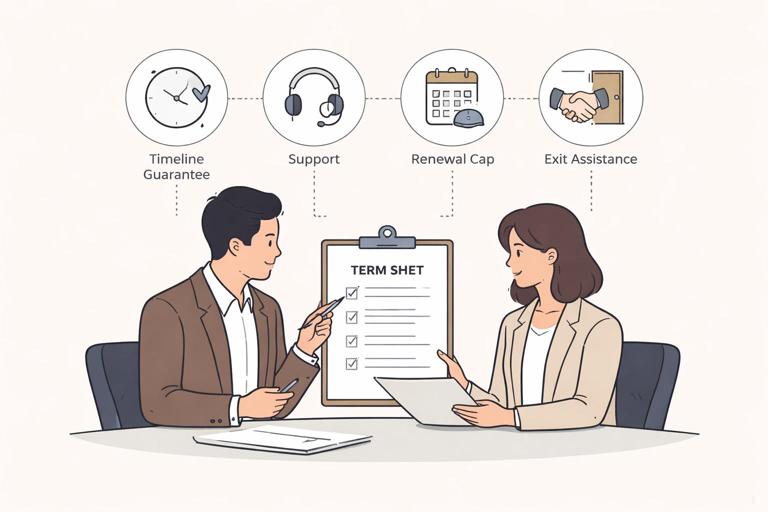
Step 5: Use Service Terms as Negotiation Currency
External negotiations often stall when both sides fixate on price. Move the conversation to terms that change value and risk. Examples of high-leverage service terms include:
- Implementation timeline guarantees (with remedies if missed).
- Staffing continuity (named roles, limits on substitutions).
- Support upgrades (premium support for first 90 days).
- Renewal protections (cap annual increases, remove auto-renew, longer notice).
- Usage flexibility (pooled licenses, quarterly true-ups, overage caps).
- Exit assistance (data export, transition services at pre-agreed rates).
Practical example: If a vendor won’t reduce price, ask for a renewal uplift cap (e.g., max 3% annually) and free premium support during rollout. These can be worth more than a small discount.
Step 6: Make the Agreement Operable (Governance and Escalation)
A contract that cannot be run day-to-day creates hidden costs. Define how you will manage the relationship.
- Meeting cadence (weekly delivery, monthly service review, quarterly business review).
- Reporting (SLA reports, incident summaries, roadmap updates).
- Escalation ladder (who to contact at each severity level).
- Decision rights (who approves changes, who signs off on acceptance).
Example: “P1 incidents: notify within 15 minutes via phone + email; escalation to support manager after 30 minutes; escalation to VP after 2 hours; written RCA within 5 business days.”
Step 7: Lock in Change Control and Acceptance to Prevent Scope Creep
Many external projects fail not because the vendor is bad, but because changes are unmanaged. Your goal is to make changes visible, priced, and approved.
- Define what is included vs excluded.
- Define acceptance tests and sign-off process.
- Define change request format and approval steps.
- Define how disputes are handled (pause work, escalate, decide within X days).
Practical example clause concept: “Any request that adds new integrations, increases data volume beyond assumptions, or requires new compliance controls triggers a change order. Vendor provides estimate within 5 business days. Work begins only after written approval.”
Negotiating With Vendors: Tactics That Fit Non‑Sales Roles
Use “Operational Proof” Instead of Pure Bargaining
Vendors respond well to evidence: rollout plans, user counts, integration diagrams, and risk assessments. When you show you understand delivery, you gain credibility and can ask for stronger commitments.
Example: “We have a fixed launch date tied to a regulatory deadline. We need a committed implementation schedule and named resources. If you can commit to that, we can sign by Friday.”
Ask for Options, Not Just Exceptions
Instead of “remove this clause,” ask for structured alternatives.
- Option A: lower price with standard terms.
- Option B: same price with stronger SLAs and exit assistance.
- Option C: multi-year with uplift cap and flexible true-ups.
This invites the vendor to solve the problem within their approval system.
Negotiate the Renewal on Day One
Renewal is where leverage often shifts to the vendor (switching costs). Protect yourself early.
- Cap annual increases.
- Require renewal notice and pricing 90–120 days before renewal.
- Remove auto-renew or require explicit renewal.
- Include a right to reduce seats/usage at renewal without penalty.
Negotiating With Partners: Aligning Incentives and Responsibilities
Partnerships are not just vendor relationships; they involve shared outcomes, joint activities, and reputational risk. The negotiation focus is clarity: who does what, who pays, who owns leads/data, and how conflicts are resolved.
Define the Partnership Operating Model
- Responsibilities: marketing, sales handoffs, implementation, support.
- Lead ownership: who owns the relationship, how referrals are tracked.
- Data sharing: what data is shared, for what purpose, retention limits.
- Brand usage: approvals, guidelines, and restrictions.
- Governance: cadence, KPIs, escalation.
Practical example: In a co-marketing partnership, specify who creates content, who pays for ads, how leads are distributed, and the minimum follow-up SLA for each side (e.g., “contact within 24 hours”).
Watch for Exclusivity and “Soft Commitments”
Exclusivity can block future options. If exclusivity is requested, define boundaries: geography, segment, duration, and performance requirements. Avoid vague commitments like “best efforts” without measurable actions.
Example: “Exclusivity applies only to mid-market customers in Region A for 6 months, contingent on 3 joint webinars and a minimum of 50 qualified leads delivered.”
Service Terms Deep Dive: What to Specify (and How)
SLAs That Matter
Choose a small set of metrics tied to business impact. Define severity levels and measurement.
- Availability: e.g., 99.9% monthly uptime excluding scheduled maintenance with 72-hour notice.
- Incident response: P1 response within 30 minutes, P2 within 2 hours.
- Resolution targets: P1 workaround within 4 hours, full fix within 2 business days (where feasible).
- Support hours: 24/7 for P1, business hours for lower severities.
Service Credits and Remedies
Credits alone may not compensate for operational damage, but they create accountability. Pair credits with process remedies.
- Credits for missing uptime or response targets.
- RCA timelines and prevention plans.
- Right to terminate for chronic SLA failure.
Implementation and Delivery Milestones
For services and implementations, tie payments to milestones and acceptance.
- Milestone definitions (deliverable + acceptance test).
- Dependencies (what you must provide, by when).
- Consequences of delays (schedule adjustments, re-planning, escalation).
Example: “30% on kickoff, 40% after successful integration test, 30% after go-live + 2 weeks of stable operation.”
Red Flags and How to Respond
Red Flag: “Standard Terms Only” With No Rationale
Response: Ask which terms are truly non-negotiable and why, and propose a limited set of exceptions tied to risk. “We can accept your standard MSA if we add a data breach notification window of 72 hours and a renewal uplift cap.”
Red Flag: Vague Scope With High Day Rates
Response: Require a SOW with deliverables, estimated hours by role, and a change process. If they insist on time-and-materials, negotiate a not-to-exceed cap and weekly burn reporting.
Red Flag: Auto-Renew With Short Notice Period
Response: Remove auto-renew or extend notice (e.g., 90–120 days). Add a requirement that renewal pricing be provided before the notice deadline.
Red Flag: Vendor Can Change Terms Unilaterally
Response: Push for mutual written amendment only. If they must update policies, require notice and a right to terminate if changes materially degrade service or increase obligations.
Red Flag: Weak Exit and Data Portability
Response: Add data export formats, timelines, and transition support rates. For critical systems, negotiate a short post-termination access window for export.
Templates You Can Reuse
Vendor Clarifying Questions (Email-Friendly)
- Please confirm what is included/excluded in the proposed scope and list assumptions.
- Please provide SLA definitions (measurement method, maintenance windows, severity levels).
- Please outline implementation plan with milestones, dependencies, and staffing.
- Please share renewal terms, including any uplift and notice period.
- Please confirm data ownership, retention, deletion timelines, and breach notification window.
- Please confirm whether subcontractors are used and how they are controlled.
Simple “Term Sheet” Outline
Commercial: term, pricing, payment schedule, renewal uplift cap, true-up/down rules Service: uptime, support hours, response/resolution targets, escalation path Delivery: scope, milestones, acceptance criteria, staffing commitments, change control Risk: data protection addendum, confidentiality, IP ownership, liability cap, insurance Exit: termination rights, notice periods, data export, transition assistanceChange Request Mini-Form
Change request title: Description of change: Reason/business impact: Impact on timeline: Impact on cost: Impact on requirements/security: Vendor estimate provided on: Approved by (name/date):