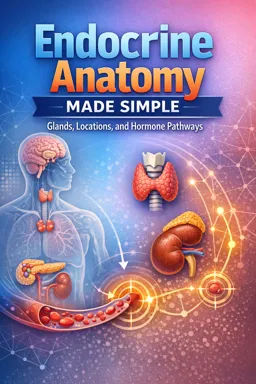
What “Endocrine” Means in Anatomical Terms
The endocrine system is a network of ductless glands and endocrine cells that release chemical messengers (hormones) into the body’s internal fluids. Anatomically, the key idea is no ducts: endocrine secretions do not travel through tubes to a surface. Instead, hormones move from the secreting cell into the interstitial fluid (the fluid between cells) and then enter nearby capillaries to be carried through the bloodstream to target tissues.
Ductless design: the basic pathway
Think of endocrine secretion as a short, local “handoff” into the circulation:
- Endocrine cell synthesizes hormone (often stored in vesicles or produced on demand, depending on hormone type).
- Hormone is released across the cell membrane into the interstitial fluid.
- Hormone diffuses to nearby capillaries (endocrine tissues are typically richly vascularized).
- Hormone enters the bloodstream and travels to distant targets (or sometimes acts locally in paracrine/autocrine ways, but the defining endocrine route is blood-borne).
Practical anatomy cue: when you see a structure described as “highly vascular” with clusters/cords of secretory cells and no duct system, you should suspect endocrine tissue.
Endocrine glands vs. endocrine cells within organs
Some endocrine structures are discrete glands (e.g., thyroid, adrenal), while others are endocrine cell clusters embedded within larger organs (e.g., pancreatic islets within the pancreas, gonadal endocrine cells within ovaries/testes). In anatomy, you will locate both by region and by their relationships to neighboring landmarks.
Core Spatial Language for Finding Glands
Endocrine anatomy is easiest when you consistently use spatial terms. The same terms apply whether you are looking at a person from the outside (surface anatomy) or at a CT/MRI/cadaver section (sectional anatomy).
- Listen to the audio with the screen off.
- Earn a certificate upon completion.
- Over 5000 courses for you to explore!

Download the app
| Term | Meaning | Quick endocrine example |
|---|---|---|
| Superior / Inferior | Above / below | The pituitary is inferior to the hypothalamus. |
| Anterior / Posterior | Front / back | The thyroid is generally anterior in the neck, wrapping the trachea. |
| Medial / Lateral | Toward midline / away from midline | Adrenal glands sit medial to the upper poles of the kidneys (and are relatively medial compared with the kidney’s lateral contour). |
| Deep / Superficial | Farther from surface / closer to surface | Parathyroid glands are deep to the thyroid tissue (typically on the posterior aspect). |
Step-by-step: applying spatial terms on images and on the body
- Pick a reference line: midline (for medial/lateral) and the front of the body (for anterior/posterior).
- Identify the region first: cranial cavity, neck, thorax/abdomen, pelvis.
- Anchor to a “hard” landmark: a bone (skull base, hyoid, sternum, vertebrae, pelvis) or a major vessel (aorta, carotids, renal vessels).
- Describe relationships in pairs: “posterior to trachea,” “superior to kidney,” “medial to carotid sheath,” etc.
- Confirm depth: decide whether the gland is superficial (palpable/near surface) or deep (requires imaging/dissection to see clearly).
Guided Body Map: Major Endocrine Glands by Region and Neighboring Landmarks
Use this as a mental “GPS.” For each gland, learn (1) the region, (2) the closest big neighbors you can reliably recognize, and (3) one or two spatial descriptors you can say out loud.
Cranial cavity (inside the skull)
- Hypothalamus
- Region: cranial cavity (diencephalon)
- Key neighbors to recognize later: optic chiasm (anterior/inferior relationship), third ventricle (midline), pituitary stalk/infundibulum (inferior connection)
- Spatial language practice: hypothalamus is superior to the pituitary and medial around the third ventricle.
- Pituitary gland (hypophysis)
- Region: cranial cavity (sella turcica of sphenoid bone)
- Key neighbors: sphenoid bone (bony seat), optic chiasm (superior/anterior), cavernous sinuses with internal carotid arteries and cranial nerves (lateral)
- Spatial language practice: pituitary is inferior to the hypothalamus, deep within the skull base, and medial between cavernous sinuses.
- Pineal gland
- Region: cranial cavity (posterior diencephalon/epithalamus)
- Key neighbors: midline brain structures, posterior third ventricle region, nearby tectal area (posterior midbrain region)
- Spatial language practice: pineal is posterior and deep, near the midline.
Neck
- Thyroid gland
- Region: anterior neck
- Key neighbors: larynx (superior), trachea (medial/posterior relationship as the gland wraps it), carotid arteries and internal jugular veins (lateral in the carotid sheath), esophagus (posterior, especially left of midline)
- Spatial language practice: thyroid is anterior in the neck, with lobes lateral to the trachea and an isthmus crossing anterior to it.
- Parathyroid glands
- Region: neck (associated with posterior thyroid)
- Key neighbors: posterior surface of thyroid, recurrent laryngeal nerves (nearby in the tracheoesophageal groove), inferior thyroid vessels (vascular neighborhood)
- Spatial language practice: parathyroids are typically posterior and deep relative to the thyroid’s more superficial anterior surface.
Thorax and abdomen
- Thymus
- Region: superior anterior mediastinum (behind sternum)
- Key neighbors: sternum (anterior), heart/pericardium (posterior/inferior), great vessels (aorta/pulmonary trunk region nearby)
- Spatial language practice: thymus is anterior in the mediastinum and deep to the sternum.
- Adrenal (suprarenal) glands
- Region: upper posterior abdomen (retroperitoneal)
- Key neighbors: kidneys (inferior/adjacent at superior poles), diaphragm (superior), major vessels (aorta and inferior vena cava medially), renal vessels nearby
- Spatial language practice: adrenals are superior to kidneys, relatively medial, and deep (retroperitoneal).
- Pancreas (endocrine islets within)
- Region: upper abdomen (mostly retroperitoneal)
- Key neighbors: duodenum (head nestled in its curve), stomach (anterior relationship), spleen (tail toward it), major vessels posteriorly (abdominal aorta region; splenic vessels along superior border)
- Spatial language practice: pancreas is deep in the upper abdomen; head is more right (near duodenum), tail extends left toward spleen.
Pelvis
- Ovaries
- Region: pelvis (lateral pelvic cavity)
- Key neighbors: uterus (medial), uterine tubes (superior/adjacent), pelvic brim and iliac vessels region (vascular landmarks nearby), ureter (important neighbor to recognize in pelvic anatomy)
- Spatial language practice: ovaries are lateral to the uterus and deep within the pelvic cavity.
- Testes
- Region: scrotum (external to abdominopelvic cavity)
- Key neighbors: spermatic cord (superior connection), inguinal canal (pathway toward abdomen), epididymis (posterior aspect of testis)
- Spatial language practice: testes are inferior to the pelvis and relatively superficial compared with internal pelvic organs.
Checkpoint: Match Each Gland to Region and Adjacent Landmarks
Instructions: For each gland, choose (A) its main region and (B) the best adjacent landmark pair. Say your answer using at least one spatial term (e.g., “anterior to,” “superior to,” “lateral to,” “deep to”).
Regions (choose one per gland)
- 1. Cranial cavity
- 2. Neck
- 3. Thorax/abdomen
- 4. Pelvis/scrotum
Landmark pairs (choose one per gland)
- A. Sphenoid bone (sella turcica) + cavernous sinus/internal carotid (lateral)
- B. Trachea + carotid sheath (lateral vessels)
- C. Posterior thyroid surface + recurrent laryngeal nerve neighborhood
- D. Sternum (anterior) + heart/pericardium (posterior)
- E. Kidney (inferior) + aorta/IVC region (medial)
- F. Duodenum + spleen
- G. Uterus (medial) + uterine tube
- H. Epididymis (posterior) + spermatic cord (superior)
- I. Optic chiasm + third ventricle (midline)
- J. Midline posterior diencephalon + third ventricle region
| Gland | Region (1–4) | Landmarks (A–J) |
|---|---|---|
| Hypothalamus | __ | __ |
| Pituitary | __ | __ |
| Pineal | __ | __ |
| Thyroid | __ | __ |
| Parathyroids | __ | __ |
| Thymus | __ | __ |
| Adrenals | __ | __ |
| Pancreas (islets) | __ | __ |
| Ovaries | __ | __ |
| Testes | __ | __ |