How to Use This “Anatomical Route”
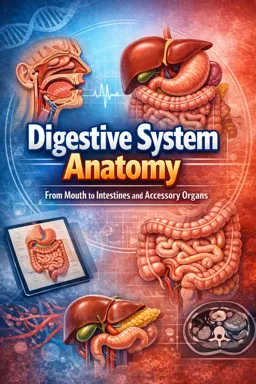
This chapter maps the digestive system as a continuous tube (the gastrointestinal, or GI, tract) plus a set of accessory organs that add secretions to help digestion. You will move head-to-toe, using consistent spatial language so you can orient yourself on models, cadavers, and cross-sectional images.
Core spatial orientation terms (quick reset)
- Anterior = toward the front (ventral); posterior = toward the back (dorsal).
- Superior = toward the head; inferior = toward the feet.
- Medial = toward the midline; lateral = away from the midline.
- Proximal and distal in the GI tract refer to closer to the mouth vs closer to the anus.
GI Tract vs Accessory Digestive Organs
GI tract (the continuous hollow tube)
The GI tract is the passageway food and fluid travel through: oral cavity → pharynx → esophagus → stomach → small intestine (duodenum, jejunum, ileum) → large intestine (cecum/appendix, colon segments) → rectum → anal canal. Most of these organs have a lumen and a wall.
Accessory digestive organs (not part of the tube)
Accessory organs contribute secretions into the GI tract but are not part of the continuous lumen:
- Liver: produces bile; located mostly in the right upper abdomen, tucked under the diaphragm.
- Gallbladder: stores and concentrates bile; sits on the inferior surface of the liver.
- Pancreas: produces digestive enzymes and bicarbonate (exocrine function) delivered to the duodenum; lies posterior to the stomach, extending toward the spleen.
Practical distinction on images: if you can “trace a continuous hollow path” through it, it’s GI tract; if it’s a solid gland/organ that drains into the tract via ducts, it’s accessory.
Regional Naming Framework: Foregut, Midgut, Hindgut
Use foregut, midgut, hindgut as a positional naming framework for abdominal GI segments. This helps you organize what you see on cross-sections and when describing where pathology is located.
- Listen to the audio with the screen off.
- Earn a certificate upon completion.
- Over 5000 courses for you to explore!

Download the app
- Foregut (upper abdomen): includes the stomach and proximal small intestine (duodenum) and is closely associated with the liver, gallbladder, and pancreas via ducts.
- Midgut (central abdomen): includes most of the small intestine (jejunum and ileum) and the beginning of the large intestine (cecum and proximal colon).
- Hindgut (lower abdomen/pelvis): includes the distal colon, rectum, and anal canal.
When you are unsure of a structure’s identity, first place it into one of these regions based on location (upper vs central vs lower/pelvic) and then refine the label.
The Guided Anatomical Route (Mouth to Anal Canal)
Step 1: Oral cavity (entry portal)
Location/orientation: in the head, anterior to the pharynx. On sagittal images, it is the anterior space bounded by lips/cheeks and leading posteriorly to the oropharynx.
What to locate: the oral cavity proper (inside the dental arches) and the vestibule (between lips/cheeks and teeth). For route-mapping, focus on the posterior opening toward the pharynx.
Step 2: Pharynx (shared passageway)
Location/orientation: posterior to the nasal and oral cavities; superior to the esophagus and larynx. It is a muscular tube that funnels swallowed material inferiorly.
Practical cue: on sagittal sections, the pharynx is the vertical corridor behind the nasal/oral spaces; the GI route continues inferiorly toward the esophagus.
Step 3: Esophagus (thoracic conduit)
Location/orientation: a muscular tube running inferiorly from the pharynx through the neck and thorax, typically posterior to the trachea. It passes through the diaphragm to reach the stomach.
Step-by-step identification on a midline sagittal image:
- Find the trachea (air-filled, anterior).
- Immediately posterior to it, identify a collapsed muscular tube: the esophagus.
- Track it inferiorly to where it passes through the diaphragm and meets the stomach.
Step 4: Stomach (upper left abdominal reservoir)
Location/orientation: mostly in the left upper quadrant, inferior to the diaphragm and anterior to the pancreas. The stomach transitions from the esophagus at the superior aspect and empties into the duodenum on the right side.
Key regions to distinguish:
- Cardia: region around the gastroesophageal junction (where esophagus enters).
- Fundus: dome-like superior portion, often gas-filled on imaging.
- Body: main central portion.
- Pylorus: distal region leading to the duodenum (pyloric antrum/canal as subregions on some models).
Practical cue: on axial CT, the stomach is often an anterior-left structure with variable gas/fluid; the fundus tends to be the most superior portion.
Step 5: Duodenum (C-shaped first small intestine segment)
Location/orientation: immediately distal to the pylorus, curving in a C-shape in the upper abdomen and wrapping around the head of the pancreas. It is a key junction where bile and pancreatic secretions enter the GI tract.
How to recognize it: look for a short, relatively fixed segment just beyond the stomach, often closely associated with the pancreas and located more posterior than the stomach.
Step 6: Jejunum (mobile central small intestine)
Location/orientation: typically occupies much of the central and left abdomen. It is intraperitoneal and mobile, forming loops.
Practical mapping approach: after identifying the duodenum, follow the continuous small-bowel loops; label the more proximal loops as jejunum before transitioning to ileum.
Step 7: Ileum (distal small intestine to the right lower abdomen)
Location/orientation: tends to occupy the lower abdomen and often the right lower quadrant as it approaches the large intestine.
Key endpoint landmark: the ileum empties into the large intestine at the ileocecal junction (ileocecal region), near the cecum.
Step 8: Cecum and appendix (start of the large intestine)
Location/orientation: the cecum is a pouch-like beginning of the large intestine in the right lower abdomen. The appendix is a narrow, blind-ended tube attached to the cecum.
Practical cue: on models, the cecum is the first “bulb” of large bowel after small intestine; the appendix is a wormlike projection from it.
Step 9: Colon segments (framing the abdomen)
Location/orientation: the colon forms a broad frame around the small intestine.
- Ascending colon: rises superiorly on the right side from the cecum.
- Transverse colon: crosses the upper abdomen from right to left.
- Descending colon: travels inferiorly on the left side.
- Sigmoid colon: S-shaped segment in the left lower abdomen leading into the pelvis.
Step-by-step “frame” method on an abdominal model:
- Find the cecum in the right lower region.
- Trace upward to the right upper region (ascending).
- Trace across the top (transverse).
- Trace down the left side (descending).
- Follow the S-shaped curve into the pelvis (sigmoid).
Step 10: Rectum (pelvic reservoir)
Location/orientation: in the pelvis, posterior to the bladder (and uterus/vagina in females), anterior to the sacrum. It continues from the sigmoid colon and ends at the anal canal.
Practical cue: on sagittal pelvic images, the rectum is a posterior midline hollow structure just anterior to the sacrum.
Step 11: Anal canal (terminal segment)
Location/orientation: the short terminal passage through the pelvic floor to the exterior. It is inferior to the rectum and ends at the anal opening.
Practical cue: on models, identify it as the final straight segment passing through the muscular pelvic floor region.
Accessory Organs Along the Route (Where They “Join In”)
Liver
Where to look: right upper abdomen, immediately inferior to the diaphragm, extending toward the midline. It is anterior and superior relative to much of the GI tract.
Functional map point: bile produced here is delivered to the duodenum (via the biliary tree), so the liver is “upstream” in the foregut region even though it is not part of the tube.
Gallbladder
Where to look: tucked on the inferior surface of the liver, right upper abdomen.
Functional map point: concentrates and releases bile into the duodenum; on imaging, it may appear as a small fluid-filled sac under the liver.
Pancreas
Where to look: posterior to the stomach, extending across the upper abdomen. It is often more posterior on axial images than the stomach.
Functional map point: drains digestive enzymes and bicarbonate into the duodenum, making the duodenum a key “mixing junction” for accessory secretions.
Checklist: Macroscopic Landmarks to Locate on Models and Cross-Sections
Use this as a rapid self-test. You should be able to point to each structure and state whether it is GI tract or accessory.
| Landmark | GI tract or accessory? | Where to find it (high-yield cue) |
|---|---|---|
| Oral cavity | GI tract | Head; anterior entry space leading to pharynx |
| Pharynx | GI tract | Posterior throat; corridor to esophagus |
| Esophagus | GI tract | Posterior to trachea; passes through diaphragm to stomach |
| Stomach: cardia | GI tract | Junction where esophagus enters stomach |
| Stomach: fundus | GI tract | Superior dome; often gas-filled |
| Stomach: body | GI tract | Main central portion in left upper abdomen |
| Stomach: pylorus | GI tract | Distal outlet to duodenum (rightward/inferior direction) |
| Duodenum | GI tract | Short C-shaped segment just beyond stomach; near pancreas |
| Jejunum | GI tract | Proximal small-bowel loops; often central/left abdomen |
| Ileum | GI tract | Distal small-bowel loops; often lower/right abdomen near cecum |
| Cecum | GI tract | Right lower pouch at start of large intestine |
| Appendix | GI tract | Narrow blind tube attached to cecum |
| Ascending colon | GI tract | Right-sided vertical colon from cecum upward |
| Transverse colon | GI tract | Upper abdominal horizontal segment |
| Descending colon | GI tract | Left-sided vertical colon downward |
| Sigmoid colon | GI tract | S-shaped segment entering pelvis |
| Rectum | GI tract | Posterior pelvic midline hollow organ anterior to sacrum |
| Anal canal | GI tract | Terminal short segment through pelvic floor to exterior |
| Liver | Accessory | Right upper abdomen under diaphragm |
| Gallbladder | Accessory | Small sac on inferior surface of liver |
| Pancreas | Accessory | Posterior to stomach; associated with duodenum |
Common Reference Planes and Surface Anatomy Cues for Abdominal Descriptions
Reference planes used in anatomy and imaging
- Sagittal plane: divides left and right; helpful for tracing oral cavity → pharynx → esophagus and for pelvic rectum/anal canal relationships.
- Coronal (frontal) plane: divides anterior and posterior; useful for appreciating how the stomach is anterior to the pancreas and how the colon frames the small intestine.
- Transverse (axial) plane: divides superior and inferior; the standard for CT; excellent for locating liver (right upper), stomach (left upper), and posterior structures like pancreas.
Surface anatomy cues (how clinicians describe locations)
- Quadrants: right upper (liver/gallbladder), left upper (stomach), right lower (cecum/appendix region), left lower (sigmoid region).
- Midline vs lateral: small-bowel loops often occupy central regions; ascending/descending colon are more lateral “side rails.”
- Diaphragm as a superior boundary: foregut organs cluster just inferior to it; pelvic organs (rectum/anal canal) are inferior and posterior within the pelvis.
When describing an organ, combine a plane + a surface cue, for example: “On axial images, the pancreas is posterior to the stomach in the upper abdomen.” or “The cecum is in the right lower quadrant, marking the start of the large intestine.”