What Co-Marketing and Content Collaboration Actually Mean
Co-marketing is when two (or more) brands coordinate marketing activities to reach each other’s audiences with a shared message, shared assets, and shared distribution. Content collaboration is the most common co-marketing format: partners co-create a piece of content (webinar, report, template, email course, podcast episode, toolkit) and then co-promote it. The goal is not “more content”; it is efficient demand creation by combining credibility, expertise, and distribution.
In practice, co-marketing sits between “simple cross-promotion” (a one-off social post) and “deep product partnership” (integrations, bundled offers). It is ideal when you want measurable pipeline impact without heavy engineering or long implementation cycles. It also works well when partners serve the same buyer but solve different parts of the workflow (for example: a CRM plus a sales engagement tool; an accounting platform plus a payroll provider; a cybersecurity vendor plus an IT services firm).

Where Co-Marketing Fits in the Partnership Portfolio
Co-marketing campaigns are best used for three situations: (1) launching a new positioning or category narrative, (2) accelerating pipeline in a specific segment, and (3) building authority through research or thought leadership. Unlike pure lead swaps, co-marketing should create a reason for the audience to engage: a new insight, a practical asset, or a live experience.
Choose co-marketing when you can answer “yes” to these questions: Do we share a target persona or buying committee? Do we have complementary expertise that creates a stronger story together than alone? Can both partners commit real distribution (email, community, events, paid, sales teams)? If any of these are missing, the campaign becomes lopsided and results will disappoint.
Core Playbook: The Co-Marketing Campaign Lifecycle
Step 1: Define the campaign “job” and the audience slice
Start by naming the job the campaign must do. Examples: “Generate 120 demo requests from mid-market IT managers in 60 days,” “Create a new narrative around compliance automation,” or “Re-activate dormant leads with a practical toolkit.” Then narrow the audience slice: industry, company size, tech stack, maturity stage, and the specific role(s) you want to influence.
- Listen to the audio with the screen off.
- Earn a certificate upon completion.
- Over 5000 courses for you to explore!

Download the app
Practical tip: write a one-sentence audience statement that both partners sign off on, such as: “This campaign is for operations leaders at 200–2,000 employee e-commerce brands who are struggling with returns, inventory accuracy, and customer support load.” This prevents content drift and vague messaging.
Step 2: Pick the collaboration format using a “friction vs. yield” lens
Different formats create different levels of effort and different conversion behavior. Use a friction vs. yield lens: higher-friction assets (live webinars, workshops) often convert better but require more coordination; lower-friction assets (blog swaps, social threads) are easier but may produce weaker intent signals.
- Webinar / live workshop: strong lead capture, good for pipeline acceleration, requires speaker prep and rehearsal.
- Research report: strong authority and PR potential, longer production cycle, can fuel many derivative assets.
- Template / calculator / toolkit: high utility, strong conversion, requires product/ops input to be genuinely useful.
- Virtual event track: multiple sessions with multiple partners, strong reach, heavier project management.
- Podcast / video series: relationship-building and brand lift, slower pipeline impact unless paired with CTAs.
Rule of thumb: if you need near-term pipeline, choose webinar + follow-up workshop or template. If you need category authority, choose research + PR + derivative content.
Step 3: Build the campaign narrative and the “content spine”
A co-marketing campaign needs a content spine: a single core idea that can be expressed as a headline, a promise, and three proof points. The spine keeps both partners aligned and makes derivative content consistent across channels.
Use this simple structure: (1) the problem in the buyer’s language, (2) the cost of inaction, (3) the new approach, (4) the practical steps, (5) the proof (data, examples, frameworks). For example: “Most RevOps teams lose 15–25% of pipeline to handoff gaps. In this session, we’ll show a 5-step handoff system and the exact checklist to implement it.”
Practical tip: create a shared messaging doc with approved phrases, forbidden phrases, and a short glossary. This reduces brand conflicts and speeds approvals.
Step 4: Decide the offer, CTA, and conversion path
Co-marketing fails when the content is interesting but the next step is unclear. Define one primary CTA and one secondary CTA. The primary CTA should match the audience’s readiness: a template download, a diagnostic, a workshop seat, or a consultation. The secondary CTA can be “subscribe,” “join community,” or “watch the recording.”
Map the conversion path end-to-end: landing page → confirmation page → calendar options (if applicable) → email sequence → sales follow-up. Decide what happens for attendees vs. no-shows vs. registrants who never attend. Make sure both partners agree on the follow-up experience so prospects don’t receive conflicting messages.
Step 5: Create the asset production plan and responsibilities
Turn the campaign into a production plan with owners and deadlines. Co-marketing is mostly project management: drafts, reviews, design, landing page, email copy, speaker prep, and distribution scheduling. Assign a single campaign owner per partner and a single “final approver” per partner to avoid endless loops.
Use a simple responsibility matrix for each deliverable: who writes, who reviews, who designs, who publishes, who promotes. For a webinar, explicitly assign: moderator, primary speaker, secondary speaker, Q&A owner, and chat support.
Step 6: Build the distribution plan (not just “we’ll email it”)
Distribution is where co-marketing wins or loses. Build a channel-by-channel plan with dates, copy, and creative requirements. Include at least: partner emails, social posts, community posts, partner blog, partner newsletter placements, sales team enablement, and optional paid retargeting.
Practical distribution checklist: (1) two dedicated emails per partner (announce + last call), (2) at least six social posts per partner across two weeks, (3) one community post per partner, (4) sales sequences for relevant reps, (5) calendar blocks for speakers to promote personally, (6) a retargeting audience built from landing page visitors (if you run paid).
Step 7: Run the live moment and capture reusable assets
If the format is live, treat it like a product launch. Do a rehearsal, confirm the run-of-show, and prepare a shared Q&A doc. During the event, capture assets intentionally: record the session, clip 30–60 second highlights, export Q&A, and collect poll results. These become derivative content that extends the campaign’s life.
Practical tip: assign one person to “content capture” whose only job is to mark timestamps for key moments and write down quotable lines. This speeds post-production dramatically.
Step 8: Execute the follow-up sequence and partner handoffs
Follow-up is where pipeline is created. Design a sequence that respects the co-marketing context: attendees should receive the recording and the promised asset; no-shows should receive a “watch on-demand” email; high-intent actions (questions asked, poll responses, workshop sign-ups) should trigger faster outreach.
Keep follow-up helpful and specific. Instead of “Want a demo?”, use “If you’re trying to reduce X, here’s a 10-minute checklist and we can walk through it with your numbers.” Coordinate timing so both partners don’t email the same person on the same day with competing CTAs.
Playbook Templates You Can Reuse
1) Webinar-to-Workshop Pipeline Playbook
This playbook uses a webinar as the top-of-funnel event and a smaller workshop as the conversion step. It works well when the topic is operational and the audience benefits from implementation guidance.
- Core asset: 45-minute webinar teaching a framework.
- Conversion asset: 60-minute hands-on workshop with limited seats.
- CTA: “Apply for the workshop” (or “Reserve a seat”).
- Follow-up: attendees get recording + workshop invite; no-shows get on-demand + workshop invite; high-intent get personal outreach.
Example: A helpdesk platform and a returns management tool run “The 5-step playbook to cut ‘where is my order’ tickets by 30%.” The workshop is “Bring your last 7 days of ticket tags; we’ll map your automation opportunities.”
2) Research Report and Derivative Content Playbook
This playbook creates a flagship report and then repurposes it into many smaller assets. It is ideal when partners can contribute data, benchmarks, or unique expertise.
- Core asset: gated report with original findings.
- Derivative assets: press pitch angles, blog series, social charts, webinar “findings reveal,” email mini-course, sales one-pagers.
- CTA: download report; secondary CTA to a findings webinar.
Practical step-by-step: (1) agree on 5–7 research questions, (2) collect data (survey, anonymized usage stats, interviews), (3) draft narrative and charts, (4) pre-brief internal teams, (5) launch with coordinated PR and webinar, (6) release one chart per week for 8–10 weeks.
3) Toolkit/Template Collaboration Playbook
Toolkits convert because they save time. The key is making the toolkit specific enough to be used immediately, not a generic PDF. This playbook works especially well for operational personas.
- Core asset: spreadsheet, checklist, Notion template, or calculator.
- Support content: short tutorial video + “how to use it” blog post.
- CTA: download and optionally “get it implemented” call.
Example: A finance automation tool and a procurement platform co-create a “Vendor onboarding checklist + risk scoring sheet.” The tutorial video shows how to adapt it for different company sizes.
Content Collaboration Mechanics: How to Co-Create Without Chaos
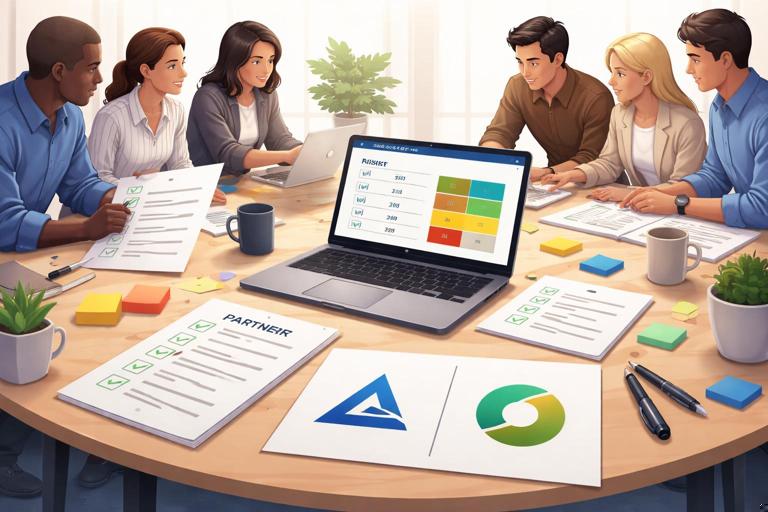
Editorial alignment: one outline, two voices
Start with a shared outline that assigns sections to each partner, but keep a single editor responsible for tone consistency. A common failure mode is “two blog posts stitched together.” Instead, write as one piece with two expert perspectives.
Practical workflow: (1) 30-minute outline session, (2) partner A drafts sections 1–2, partner B drafts sections 3–4, (3) editor merges and rewrites for one voice, (4) both partners review for accuracy and brand compliance, (5) final design and publish.
Approval and brand constraints: pre-decide what cannot happen
Before drafting, list constraints: logo usage rules, claims you cannot make, competitor mentions, customer logo permissions, and any regulated language. This prevents last-minute rewrites that derail timelines.
Create a “safe claims” list: statements that are true, provable, and approved. For example: “reduces manual steps,” “improves visibility,” “shortens time-to-resolution,” rather than unprovable superlatives.
Asset ownership and hosting: decide the primary home
Every campaign needs a primary home for the asset (landing page and form). If both partners host separate forms, you risk splitting traffic and confusing attribution. A common approach is: one partner hosts the landing page; the other partner gets a mirrored page for SEO or a short “partner page” that redirects with tracking parameters.
Also decide who owns the recording, who edits clips, and where the on-demand version lives. If you plan to run the campaign for months, build an evergreen on-demand page with updated dates removed and a clear “watch now” experience.
Distribution Enablement: Making It Easy for Teams to Promote
Sales and CS enablement pack
Co-marketing performs better when customer-facing teams promote it. Provide a simple enablement pack: (1) one paragraph of positioning, (2) three short outreach snippets, (3) one longer email, (4) a calendar invite blurb, (5) FAQ for common objections, (6) who the campaign is for and who it is not for.
Example snippets: “We’re hosting a practical session on reducing onboarding time by 20% using a standardized checklist. Want an invite?” or “We built a free calculator to estimate your current leakage; happy to send it.”
Executive and speaker amplification
Speakers and executives often have the highest-trust distribution. Give them pre-written posts and a schedule: one announcement, one behind-the-scenes post, one “last chance,” and one post-event insight. Make it easy: include the image, the link, and the exact text.
Operational Cadence: Timelines That Actually Work
Use a timeline that matches the format. For a webinar, a realistic timeline is 3–4 weeks from kickoff to live date. For a report, 6–10 weeks depending on data collection and design complexity. The most common reason campaigns slip is waiting too long to lock the topic, speakers, and landing page.
Sample 4-week webinar timeline: Week 1: topic, outline, landing page draft, speaker confirmation. Week 2: email copy, social copy, creative, rehearsal scheduled. Week 3: promotion wave 1, partner enablement, final deck. Week 4: promotion wave 2, rehearsal, live event, follow-up sequence.
Quality Control: What “Good” Looks Like in Co-Marketing Assets
Audience-first specificity
Good co-marketing content is specific: it names the persona, the situation, and the constraints. Replace generic promises (“grow revenue”) with operational outcomes (“reduce time-to-quote,” “increase renewal visibility,” “cut ticket backlog”). Specificity increases trust and improves conversion.
Balanced partner presence
Audiences dislike disguised sales pitches. A good rule is 80% education, 20% “how we help.” Ensure both partners appear as experts, not as sponsors. In a webinar, split speaking time intentionally and use a moderator to keep it practical.
Actionability and proof
Include at least one framework, one checklist, and one real example (anonymized if needed). If you cite numbers, explain the context and assumptions. If you cannot share customer names, share patterns: “In teams with X process, we see Y failure mode.”
Common Failure Modes and How to Prevent Them
Failure mode: “We agreed to co-market” but no one owns distribution
Prevention: lock distribution commitments in the campaign plan: number of emails, number of posts, community placements, and whether sales teams will promote. Put dates on the calendar and draft copy early so promotion does not become optional.
Failure mode: The asset is too broad and attracts the wrong audience
Prevention: narrow the topic and add qualifiers in the title. “For B2B SaaS RevOps teams” or “for IT managers at 200–2,000 employees” reduces volume but increases relevance and downstream conversion.
Failure mode: Partners compete for the same CTA
Prevention: agree on one primary CTA and a shared follow-up logic. If both partners need pipeline, use a neutral CTA first (toolkit/workshop) and then route high-intent leads based on fit signals (segment, stack, needs) rather than arbitrary splitting.
Failure mode: Post-event follow-up is slow
Prevention: pre-write follow-up emails and sequences before the event. Prepare a same-day “thank you + recording” email and a next-day “implementation asset” email. Speed matters because intent decays quickly.
Advanced Patterns: Scaling Co-Marketing Beyond One-Off Campaigns
Campaign series and seasonal programming
Instead of one webinar, run a three-part series with a consistent theme and escalating depth: “Foundations,” “Implementation,” “Optimization.” Series improve show-up rates over time and create a predictable content calendar for both partners.
Multi-partner roundtables
Roundtables with 3–5 partners can dramatically expand reach, but only if the topic is tightly moderated and the audience is well-defined. Use a strong moderator, limit panelist intros, and focus on tactical questions. Provide a shared promotion kit so each partner can promote without rewriting.
Evergreen co-marketing libraries
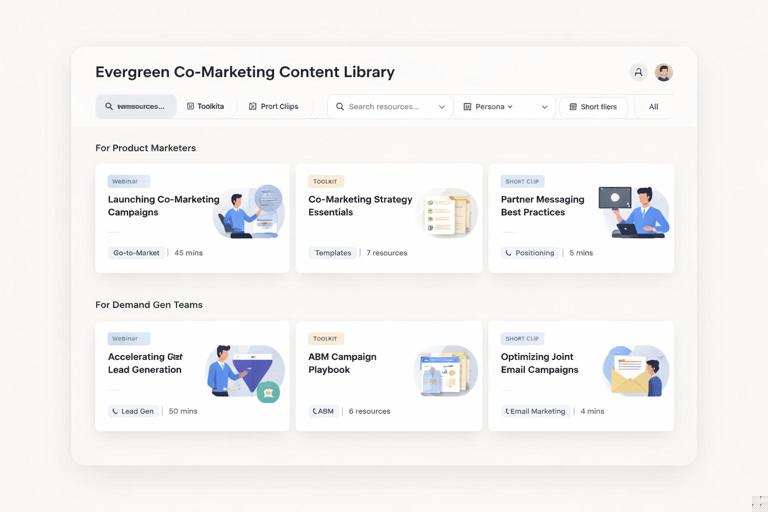
Turn successful campaigns into an evergreen library: on-demand webinars, toolkits, and short clips organized by persona and problem. This creates compounding returns: each new partner campaign adds assets that keep converting long after the live date.
Practical Artifacts to Create for Every Co-Marketing Campaign
- One-page campaign brief: audience, job-to-be-done, offer, CTA, timeline, owners.
- Messaging doc: content spine, headline options, proof points, glossary, safe claims.
- Production checklist: landing page, form, emails, social, design, rehearsal, recording, clips.
- Distribution calendar: dates, channels, copy, creative, owner per item.
- Enablement pack: sales/CS snippets, FAQ, who it’s for/not for.
- Follow-up map: attendee/no-show paths, triggers, and next steps.
Co-Marketing Brief (fill-in template) Audience: [persona + segment] Campaign job: [pipeline / narrative / activation] Core asset: [webinar/report/toolkit] Primary CTA: [workshop/apply/download] Secondary CTA: [recording/subscribe/community] Key message (content spine): [1 sentence] Proof points: [3 bullets] Owners: Partner A [name], Partner B [name] Timeline: Kickoff [date], Launch [date], Follow-up complete [date] Distribution commitments: A: [emails/posts/communities], B: [emails/posts/communities]