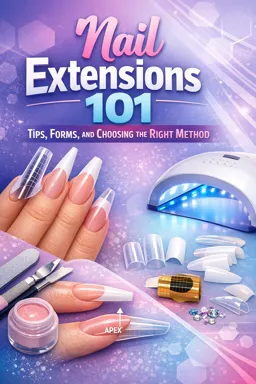
Choosing a nail extension method is easiest when you treat it like a structured assessment: you evaluate the natural nail and the client’s needs, then match them to the method that will create the most stable structure with the least risk of lifting, discomfort, or frequent repairs.
1) Client & Nail Assessment Criteria (Your Decision Inputs)
Natural nail length (free edge)
- Very short / no free edge: forms may be harder to seat and stabilize; soft gel tips or sculpting over a short form can be better depending on curvature and sidewalls.
- Some free edge: all three methods are possible—use other criteria to decide.
- Long natural nail (client wants overlay/short extension): forms or soft gel tips can work; tips are often unnecessary unless you need fast uniform length.
Curvature (C-curve) and nail plate shape
- Flat nail plates: full-cover soft gel tips may gap at the cuticle or sidewalls unless you find a flatter tip; forms allow you to build the curve you want.
- Strong natural curve: forms can match and enhance the curve; some soft gel tips may pinch or create pressure points if their curve doesn’t match.
- Uneven curvature (one side flatter): forms give the most control; tips/soft gel tips can exaggerate asymmetry if forced to fit.
Sidewall shape (straight, flared, tapered)
- Flared sidewalls: full-cover soft gel tips may not sit flush; forms can be customized to follow the flare and then refine with structure.
- Very tapered sidewalls: tips can look bulky if not blended well; forms can create a cleaner, narrower extension.
- Asymmetric sidewalls: forms typically win because you can correct the extension line.
Nail flexibility vs rigidity
- Very flexible nails: choose a method that allows a strong apex and good stress-area reinforcement; forms often excel because you can engineer structure. Soft gel tips can work if you reinforce with builder overlay when needed.
- Rigid nails: most methods work; prioritize fit and lifestyle.
Lifestyle & hand use
- Hands used heavily (manual work, frequent water exposure, cleaning): prioritize maximum fit and structure; forms or soft gel tips with reinforcement are often safer than standard tips.
- Low-impact lifestyle: speed methods (tips/soft gel tips) can be ideal if fit is good.
Desired length & shape
- Short–medium, classic shapes (square, squoval, short almond): tips or soft gel tips are efficient if they match the nail.
- Long length or sculpted shapes (coffin, stiletto, extreme almond): forms often provide better control of the extension line and apex placement.
- Corrective shaping (downward growth, ski-jump, uneven nails): forms usually offer the best correction potential.
Maintenance tolerance (fills vs full removal)
- Wants regular fills: forms (sculpted) or traditional tip+overlay systems are commonly fill-friendly; soft gel tips can be fillable depending on product system and condition, but many techs prefer rebalance/removal-and-reapply for best consistency.
- Prefers quick appointments, doesn’t mind periodic full refresh: soft gel tips are often a great match.
2) Strengths & Limitations of Each Method (Match the Tool to the Job)
Standard tips (partial-cover tips + overlay)
Where tips excel
- Speed and consistency: quick way to create uniform length across all nails.
- Great for “one-time length change”: events, photos, or clients who want predictable results.
- Helpful when forms are difficult to place: some bitten nails or very short nails (depending on sidewalls) can be easier with tips.
Limitations to plan for
- Fit is everything: a tip that’s too small causes sidewall pressure and lifting; too large creates overhang and bulk.
- Blend line management: if the tip/overlay transition isn’t smooth, it can create a weak point or visible ridge.
- Less corrective control: tips follow the natural nail’s direction; correcting downward growth or asymmetry is harder than with forms.
Forms (sculpted extensions)
Where forms excel
- Custom fit: you tailor the extension to the client’s sidewalls, curvature, and desired shape.
- Best for structural engineering: you can place apex and thickness exactly where the nail needs strength.
- Ideal for long lengths and advanced shapes: coffin, stiletto, and long almond are often cleaner and stronger when sculpted.
- Corrective work: helps straighten the look of nails that grow downward or have uneven sidewalls.
Limitations to plan for
- Listen to the audio with the screen off.
- Earn a certificate upon completion.
- Over 5000 courses for you to explore!

Download the app
- Placement skill required: a form that’s tilted up/down or not centered builds a crooked nail.
- Harder on extremely short/bitten nails: if there’s not enough edge to “hug,” the form can slip or open at the seam.
- Time: usually slower than tips or soft gel tips for beginners.
Soft gel tips (full-cover, pre-shaped tips cured to the nail)
Where soft gel tips excel
- Full-cover uniformity: consistent shape and surface; great for clients who want a clean, even set quickly.
- Quick structure: the tip provides an instant arch; you often only need minimal refining.
- Convenient for short–medium lengths: especially almond/oval/coffin when the tip shape matches the client.
Limitations to plan for
- Fit mismatch causes lifting: if the tip’s curve doesn’t match the nail plate, you’ll see gaps (especially at sidewalls/cuticle).
- Not always ideal for extreme shapes/corrections: pre-shaped tips can limit how much you can correct direction or asymmetry.
- Pressure points: on very curved nails, a rigid full-cover tip can feel tight if not properly sized/curved.
3) Contraindications & Red Flags (What Should Change Your Method Choice)
Lifting-prone nails (common signs)
- Client reports frequent lifting regardless of tech
- Very oily nail plates or heavy hand exposure to water/chemicals
- Visible separation near sidewalls from previous sets
How it influences choice: prioritize maximum customization and seal. Forms often allow the best sidewall/cuticle tailoring. Soft gel tips can work only if you can achieve a perfect fit (no gaps) and consider reinforcement overlay in the stress area.
Severe curvature or “pinched” nail plates
- Very deep C-curve
- Discomfort with pressure from full-cover products
How it influences choice: forms usually provide safer comfort control. Soft gel tips can be used only if you have multiple curvatures available and the tip seats without pressure. Avoid forcing a smaller tip “to match the curve.”
Bitten nails / very short nail beds
- Little to no free edge
- Skin close to the nail plate, uneven sidewalls
How it influences choice: soft gel tips can be excellent if you can cover evenly without flooding and the tip can be shortened and shaped. Forms can work but require advanced placement and sometimes specialized forms; standard tips may work but must be sized carefully to avoid sidewall pressure and must be stabilized with strong structure.
Thin, peeling, or fragile nails
- Layering/peeling at the free edge
- Very thin nail plate that flexes easily
How it influences choice: avoid methods that rely on aggressive blending or create stress at a transition line. Soft gel tips (full-cover) can reduce the need for blending, but only if removal/maintenance is gentle and the fit is perfect. Forms can be ideal when you build a protective structure with correct thickness and apex. Standard tips can be risky if heavy blending is needed or if the tip seam becomes a weak point.
Other “pause and reassess” flags
- Extreme downward growth (hooked nails): forms are usually best for correction; pre-shaped tips may follow the downward direction.
- Very flared sidewalls: forms often outperform full-cover tips because you can custom-build the side shape.
- Client wants very long length but does not want maintenance: any method will fail without upkeep; recommend shorter length or a more durable structure plan.
4) Case-Based Examples (Pick the Best Method and Explain Why)
Case 1: Office worker, medium nails, wants short almond, low maintenance time
Assessment: moderate curvature, straight sidewalls, low-impact lifestyle, wants consistent shape quickly.
Best method: Soft gel tips
Reasoning: full-cover uniformity delivers a clean short almond fast; low-impact lifestyle reduces risk; minimal refining needed.
Case 2: Hairdresser, frequent water exposure, wants medium coffin
Assessment: hands in water/chemicals, higher lifting risk, needs strong stress area.
Best method: Forms
Reasoning: custom fit at sidewalls/cuticle helps reduce lifting; you can engineer a stronger apex and side structure for coffin shape.
Case 3: Client with flat nail plates, wants medium square, previous full-cover sets lifted at sidewalls
Assessment: flat nails + history of sidewall lifting with full-cover tips suggests fit mismatch.
Best method: Forms (or standard tips only if perfectly fitted and reinforced)
Reasoning: forms let you build the curve and seal the sidewalls without forcing a pre-curved full-cover tip onto a flat plate.
Case 4: Bitten nails, no free edge, wants short natural-looking overlay with slight length
Assessment: very short nail beds, uneven sidewalls, needs quick stabilization and a natural look.
Best method: Soft gel tips (short length) or standard tips if soft gel fit is poor
Reasoning: full-cover support can protect the nail plate and create instant length; choose the option that seats flush with no pressure and minimal blending.
Case 5: Client wants long stiletto for a trip, nails are strong but asymmetric sidewalls
Assessment: long length + asymmetry needs correction; stiletto requires precise center line.
Best method: Forms
Reasoning: forms allow you to align the extension with the finger axis and correct sidewall imbalance; pre-shaped tips can amplify crookedness.
Case 6: Client wants medium almond, nails are very curved and complains full-cover tips feel tight
Assessment: strong C-curve and sensitivity to pressure.
Best method: Forms
Reasoning: you control curvature and thickness without compressing the nail; avoids pressure points from mismatched full-cover tips.
Quick Decision Tree (Step-by-Step Method Selection)
Step 1: Is the client requesting long length (longer than medium) or extreme shapes (stiletto, very long coffin)? - Yes → Choose FORMS (best control + structure). - No → Go to Step 2.Step 2: Is the natural nail very short/bitten with little to no free edge? - Yes → Go to Step 3. - No → Go to Step 4.Step 3: Can a full-cover soft gel tip seat flush (no gaps at sidewalls/cuticle, no pressure)? - Yes → Choose SOFT GEL TIPS (quick stabilization). - No → Choose FORMS (advanced placement) or STANDARD TIPS (only if sizing is perfect).Step 4: Does the client have high lifting risk (heavy water/chemical exposure, very flexible nails, repeated lifting history)? - Yes → Choose FORMS (custom seal + engineered apex). - No → Go to Step 5.Step 5: Is the nail plate shape compatible with full-cover tips (matching curvature, sidewalls not flared, no gapping)? - Yes → Choose SOFT GEL TIPS for speed and uniformity. - No → Go to Step 6.Step 6: Does the client prioritize fastest service with consistent length and the nail shape fits partial tips well? - Yes → Choose STANDARD TIPS (partial) + overlay. - No → Choose FORMS for maximum customization.| Client/Nail Factor | Often Best Choice | Why |
|---|---|---|
| Long length / extreme shapes | Forms | Maximum control of structure and alignment |
| Perfect fit for full-cover + wants speed | Soft gel tips | Uniform shape with minimal refining |
| Needs consistent length fast, nail shape suits partial tips | Standard tips | Quick, predictable length across all nails |
| Flared/asymmetric sidewalls or corrective needs | Forms | Custom shaping and correction |
| History of sidewall gapping with full-cover | Forms | Build curve/fit instead of forcing it |