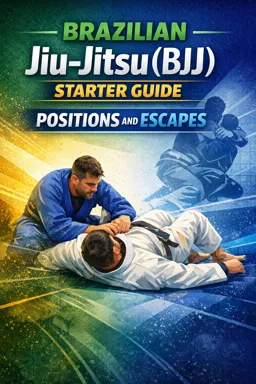
In BJJ, guard is a bottom position where you use your legs (and grips) to control distance, posture, and direction so you can attack, sweep, or disengage. For beginners, guard is not “being stuck on bottom”—it’s a platform to: (1) break posture, (2) create angles, (3) off-balance (kuzushi), and (4) stand up or sweep when appropriate.
(1) What Makes Guard Functional: Connection + Angle
Connection: you must be attached to something meaningful
A functional guard has reliable points of contact that stop the top player from freely backing away, posturing tall, or circling around your legs. Think in terms of “anchors”:
- Leg connection: closed guard lock; feet on hips; shin-to-shin; knee shield contact.
- Grip connection: sleeve control, collar tie/head control, overhook/underhook, pant grip (gi), or wrist control (no-gi).
- Hip connection: your hips stay active—small scoots, pivots, and hip escapes to keep your legs in front.
Angle: you rarely win square-on
When you’re flat and square, the top player can stack pressure straight through you. Your goal is to turn your hips so your knees and feet point across their body rather than directly into it. Even a small angle makes it easier to pull them forward, tip them, or insert a knee shield/shin connection.
Beginner checkpoint: if you feel like you’re “holding on for dear life,” ask: Do I have a real connection (legs/grips) and am I creating an angle?
Closed Guard Basics: Structure and Hips
Closed guard is when your legs are locked around the opponent’s waist. It’s strong because it limits their ability to back out and forces them to deal with your hips.
- Listen to the audio with the screen off.
- Earn a certificate upon completion.
- Over 5000 courses for you to explore!

Download the app
Structure cues (what to build first)
- Lock high enough to matter: aim your closed guard around their midsection, not sliding down to their hips/thighs.
- Knees squeeze, heels pull: think “knees in, heels down” to keep them close.
- Hips stay alive: small hip shifts create angles; don’t stay flat.
- Head position: keep your head off the mat when possible so you can sit up to connect to posture.
Closed guard is not just “legs locked.” It’s legs + posture control + angle.
(2) Posture-Breaking Basics (Collar Tie, Sleeve Control, Overhook Concept)
Your first job from guard is often to stop the opponent from being tall and stable. When they posture up, their spine stacks over their hips, making it harder to off-balance them and easier for them to open your guard or start passing.
Principle: pull them forward, then keep them there
Posture breaking is usually a two-part action:
- Bring them forward (pull their head/shoulders toward you).
- Block their recovery (control an arm so they can’t post or straighten back up).
A. Collar tie / head control (gi or no-gi)
Goal: make their head come forward and keep it from rising.
Step-by-step:
- Connect: one hand behind the head (collar tie), elbow heavy.
- Pull and curl: pull their head toward your chest while you slightly crunch and bring your knees toward your chest.
- Angle: shift your hips a few inches to one side so you’re not directly under them.
- Hold the win: once their posture is broken, keep your elbow tight and don’t let their head drift back up.
Common beginner mistake: pulling only with the arm. Use your core + legs to bring them forward.
B. Sleeve control (gi) / wrist control (no-gi)
Goal: remove their ability to post and base with their hands.
Simple concept: control one arm well and pair it with head control or an overhook so they can’t “catch themselves” when you off-balance them.
Step-by-step (basic):
- Pick a side: choose one sleeve/wrist and keep your elbow close to your ribs (stronger than reaching).
- Pull it across your centerline: bring their hand toward your bellybutton line to weaken their base.
- Combine: add collar tie/head control with the other hand to fold them forward.
C. Overhook concept (whizzer-style control from bottom)
Goal: trap one of their arms so their posture and pressure are limited.
When it shows up: they put a hand on your chest/belly, or they try to control your torso while posturing.
Step-by-step (conceptual):
- Overhook the arm: your arm goes over theirs and clamps down, shoulder heavy.
- Close the space: keep your elbow tight so their arm can’t freely retract.
- Use your legs to pull them in: knees squeeze and hips shift to create an angle.
Key idea: an overhook is not just a “hold”—it’s a way to remove a post and make them carry your weight forward.
(3) Guard Retention Fundamentals: Recover to Knees, Replace Guard, Keep Knees Between You and the Opponent
Guard retention is your ability to keep your legs between you and the opponent as they try to move around them. You don’t need fancy open-guard systems to start—your priorities are simple: reinsert your knees, reconnect your feet/shins, and face them.
Core retention rule: “knees win the race”
If your knees drift away from your chest, your legs become long and easy to pin. Keep your knees ready to reinsert as shields.
- Knees to chest when they pressure in.
- Knees point at them as you turn to follow.
- Feet/shins reconnect to create distance and steering.
Replacing guard (simple recovery loop)
When your guard is being opened or your legs are being pushed aside, think of a loop you can repeat:
- Track: turn your hips to face them (don’t let them get to your side).
- Insert a knee: bring your near-side knee back inside as a barrier.
- Reconnect your feet: feet to hips or shin-to-shin to re-establish control.
- Build to a stronger guard: close guard if they come in, or keep open guard if they stand.
Recovery to knees (when guard is failing)
Sometimes the best “retention” is to stop playing guard and come up to your knees to avoid being pinned.
Step-by-step (basic idea):
- Turn toward them so you’re not flat.
- Bring your bottom knee under you (think: “knee under hip”).
- Post your hand briefly if needed to stabilize, then bring the other knee under.
- Face them and re-engage: either re-guard (sit back to open guard) or continue coming up.
Beginner checkpoint: if you feel your hips getting pinned and your legs are no longer in front, prioritize turning and getting a knee back inside before trying to grab more grips.
Simple open-guard retention ideas (not a full system)
Open guard means your legs are not locked, so you rely on feet, shins, and knees as movable barriers.
1) Feet on hips (distance + steering)
- Why it works: your feet create a “frame” that manages distance and lets you pivot your hips.
- How to use it: keep one or both feet on their hips, knees bent; if they circle, swivel your hips and keep your feet pointing them back in front of you.
2) Shin-to-shin (connection to a leg)
- Why it works: it connects you to their base (a leg), making it harder for them to freely step around.
- How to use it: your shin lines up against their shin, knee bent; use it to follow their movement and to help you come up if they back away.
3) Knee shield as a transition concept
Knee shield is a temporary barrier where your knee and shin block their torso as you angle your hips away. You can use it as a “save” when they start to get close.
- Why it works: it creates space to reinsert your other leg and rebuild guard.
- How to think of it: not a final destination—more like a checkpoint that buys time to recover your legs and angle.
(4) Mini-Scenarios: What the Bottom Player Prioritizes
Scenario A: Opponent stands up inside/over your guard
Problem: when they stand, they often try to open closed guard, step back to break your legs apart, and start passing around your knees.
Your priorities (in order):
- Stay connected: don’t let them fully disengage. If you lose all contact, you lose control of distance.
- Get your feet/shins to useful targets: transition from closed guard to open guard with feet on hips or shin-to-shin rather than letting your legs drop.
- Keep your knees between you and them: as they step, your hips swivel and your knees track their movement.
- Create off-balance: if they’re tall, make them catch their balance—pull them forward with head/arm control or steer their hips with your feet.
- Choose: stand up or sweep when appropriate: if they back away and give space, coming up is often safer than hanging on from far away.
Practical example: they stand and your legs open—immediately place both feet on their hips, knees bent. If they step to your right, you pivot your hips to the right and keep your left knee and foot tracking them so they can’t run around your legs.
Scenario B: Opponent tries to pass to side control (circling around your legs)
Problem: they’re trying to get their chest past your knees and pin your hips/shoulders.
Your priorities (in order):
- Win the inside line with your knees: bring your near knee back inside and point it at them.
- Rebuild a barrier: use knee shield or shin-to-shin to stop their chest from closing the distance.
- Follow with your hips: turn to face them; don’t stay flat while they run around.
- Replace guard: once you’ve stopped their forward progress, reinsert your other leg to return to feet-on-hips/open guard or close guard if they drive back in.
- If you’re losing the race, recover to knees: when your legs are being cleared and your hips are getting pinned, turning in and coming up can prevent the pin.
Practical example: they circle to your left trying to clear your legs. You turn your hips left, bring your left knee back in front as a shield, and place your shin across their line of approach (knee shield). As they pause, you reinsert your right leg to re-establish open guard contact (feet on hips or shin-to-shin) and square back up.
| Situation | Bottom player focus | Simple tool |
|---|---|---|
| Top player postures tall in closed guard | Break posture + remove a post | Collar tie + sleeve/wrist control or overhook concept |
| Top player stands | Maintain leg connection + keep knees in front | Feet on hips, shin-to-shin |
| Top player circles to pass | Turn to face + reinsert knee | Knee shield as a transition, replace guard |
| Guard is collapsing | Avoid being pinned | Recover to knees |