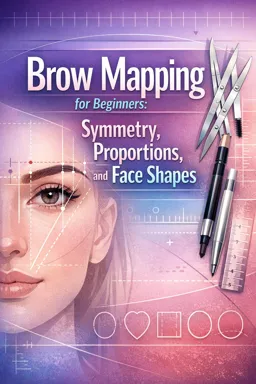
Workflow Overview: Stages, Timing, and Checkpoints
This workflow is designed for beginners to follow the same order every time, so your maps become repeatable. Each stage has: a goal, a time target, a “done looks like” checkpoint, and a quick troubleshooting prompt before you move on.
| Stage | Beginner time target | Checkpoint (“done” looks like) |
|---|---|---|
| 1) Consultation goals + contraindications | 2–4 min | Client goal is stated; irritation risks screened; plan agreed |
| 2) Cleanse + dry | 1–2 min | Skin is oil-free and fully dry; no slipping when marking |
| 3) Midline + landmark marks | 2–3 min | Midline is straight; key reference marks are visible but light |
| 4) Start/arch/tail points | 4–6 min | Points are mirrored from midline within a small tolerance |
| 5) Lower line | 3–5 min | Lower lines match in angle and flow; no “steps” or kinks |
| 6) Upper line | 3–5 min | Upper lines support the intended thickness; arch transition is smooth |
| 7) Connect + refine | 3–6 min | Outline is continuous; corners are intentional; no fuzzy overlaps |
| 8) Verify symmetry | 3–5 min | Heights/angles/directions match; differences are purposeful |
| 9) Cleanup + final outline | 2–4 min | Only final marks remain; map reads clearly at arm’s length |
Total beginner mapping time: ~23–40 minutes. As consistency improves, many learners reach ~12–20 minutes without rushing.
1) Consultation Goals and Contraindications (Skin Irritation Screen)
Goal
Confirm what the client wants today and whether the skin can tolerate mapping/cleanup without triggering irritation.
What to do
- Define the goal in one sentence: “Natural and soft,” “more lifted,” “more defined tail,” etc.
- Confirm the plan for hair removal (if any): tweezing, waxing, threading, or none (mapping only).
- Screen for irritation risk: ask about recent exfoliation/peels, retinoids, sunburn, active dermatitis, recent waxing, or any current tenderness.
- Set expectations: mapping is a guide; the final outline should look balanced from conversational distance.
Done looks like
- Client goal is clear and realistic for their current brow growth.
- You have identified any reason to avoid aggressive cleanup or to keep marks extra light.
Troubleshooting prompts
- If the skin is reactive or tender: reduce pressure, use fewer strokes, avoid harsh cleanup, and keep marks minimal.
- If the goal is vague: offer two options (softer vs. sharper) and have the client choose before you mark.
2) Cleanse and Dry
Goal
Create a surface that holds mapping marks consistently.
What to do
- Cleanse the brow area to remove makeup, skincare residue, and oils.
- Dry thoroughly (including brow hairs and skin beneath).
- Brush brow hairs into their natural direction so you see the true growth pattern.
Done looks like
- Marks apply without skipping or smudging.
- Skin does not look shiny; brow hairs are separated and visible.
Troubleshooting prompts
- If your pencil drags or skips: re-cleanse and dry again; check for leftover moisturizer or sunscreen.
- If marks smear immediately: reduce product on skin; use lighter pressure and shorter strokes.
3) Midline and Landmark Marks
Goal
Establish a stable reference so both brows are built from the same center and level cues.
- Listen to the audio with the screen off.
- Earn a certificate upon completion.
- Over 5000 courses for you to explore!

Download the app
What to do
- Mark the facial midline lightly.
- Add small, light reference ticks for your key landmarks (keep them minimal so they don’t confuse the outline later).
- Check head position: client facing forward, chin neutral, eyes relaxed.
Done looks like
- Midline is straight and readable.
- Landmark ticks are visible but not heavy.
Troubleshooting prompts
- If one brow “always maps higher”: pause and re-check head tilt and your midline placement before adding more marks.
- If you feel lost in too many marks: wipe back to midline + only the essential ticks and restart this stage.
4) Mark Start, Arch, and Tail Points
Goal
Place the three anchor points per brow so the outline has a controlled structure before you draw lines.
What to do
- Place the start point on each brow.
- Place the arch point (apex) on each brow.
- Place the tail point on each brow.
- After placing each pair (starts, then arches, then tails), compare both sides to the midline before moving on.
Done looks like
- Each pair of points is mirrored from the midline within a small tolerance (aim for ~1–2 mm as a beginner target).
- Tail points align in direction (both tails “aim” similarly rather than one dropping sharply).
Troubleshooting prompts
- If the tails look uneven in length: re-check tail points first; don’t “fix” length by thickening the tail line.
- If the arch looks too sharp: reassess apex location and plan a smoother upper-line curvature (don’t raise the arch by lifting the whole upper line).
- If one start looks too close to the midline: adjust the start point before drawing any lines; starts are hard to correct once the front block is outlined.
5) Draw the Lower Line
Goal
Create the baseline that controls brow direction and tail flow.
What to do
- Using short strokes, connect start → arch → tail along the lower edge.
- Keep pressure light; build the line gradually rather than in one heavy stroke.
- Match the lower-line angle on both brows, especially from arch to tail.
Done looks like
- Lower lines are smooth and continuous (no “stairs”).
- Both lower lines match in angle and flow; the tail direction is consistent side-to-side.
Troubleshooting prompts
- If the lower line dips too low at the tail: re-check tail point placement and redraw the tail segment with a gentler descent.
- If the lower line looks wavy: wipe only the wavy section and redraw using shorter strokes and a steadier hand position.
- If one brow looks longer: confirm tail points again before changing the lower line thickness.
6) Draw the Upper Line
Goal
Set thickness and define the top silhouette while keeping the arch transition natural.
What to do
- Start at the arch area and work outward to the tail, then return toward the front.
- Keep the upper line slightly softer at the front (avoid boxing the front unless that is the explicit style goal).
- Ensure the upper line supports the intended thickness without forcing the brow too high.
Done looks like
- Upper lines are smooth and consistent; the arch area transitions without a harsh point unless intentionally styled.
- Thickness looks even when comparing left vs. right at three zones: front, arch, tail.
Troubleshooting prompts
- If the arch looks too pointy: soften by rounding the upper line over the apex rather than moving the lower line.
- If the brow looks too thick: reduce thickness by lowering the upper line slightly (micro-adjust), not by raising the lower line.
- If the front looks boxy: lighten and taper the upper-front segment; keep the start point but soften the corner.
7) Connect and Refine the Outline
Goal
Turn your anchor points and two lines into one clean, readable shape.
What to do
- Connect any gaps so the outline is continuous.
- Refine corners: front corner, arch transition, and tail tip.
- Standardize line weight: final outline slightly darker than construction marks.
Done looks like
- Outline is continuous with intentional edges (no double lines).
- Tail tips look aligned in direction and sharpness (or softness) according to the goal.
Troubleshooting prompts
- If you see multiple overlapping lines: wipe back to the cleanest version and redraw once; don’t keep “tracing” over mistakes.
- If the tail looks blunt: refine by narrowing the last few millimeters rather than shortening the whole tail.
- If the front looks too narrow: confirm the start point first, then widen subtly by adjusting the upper-front line (small increments).
8) Verify Symmetry (Checkpoint Before Cleanup)
Goal
Confirm both brows read as a matched pair from normal viewing distance before you remove any hair or commit to a final outline.
What to do
- Step back to conversational distance and assess overall match.
- Compare side-to-side using the midline: start points, arch points, tail points.
- Check three symmetry cues: height (arch level), angle (lower line slope), direction (tail aim).
- Ask the client to relax their forehead; re-check if expression changes the map.
Done looks like
- Points are mirrored from the midline within your tolerance.
- Lower lines match in angle; tails align in direction.
- Any remaining differences are clearly intentional (style choice) rather than accidental.
Troubleshooting prompts
- If one arch reads higher: verify head tilt and brow elevation (expression). If posture is neutral, adjust the upper line subtly rather than moving multiple points.
- If one tail drops more: correct by adjusting the tail segment of the lower line (small lift) and re-taper the tail tip.
- If one brow looks heavier: compare thickness at front/arch/tail; lighten by reducing upper-line height in the heavy zone.
9) Cleanup and Final Outline
Goal
Remove only what supports the mapped shape and leave a crisp, final outline that guides filling or tinting.
What to do
- Brush hairs into place and identify which hairs fall clearly outside the outline.
- Clean up gradually: remove a few hairs, then re-check the outline and symmetry.
- Re-draw the final outline once cleanup is complete so it is clear and uncluttered.
Done looks like
- The final outline is clean, readable, and not crowded by construction marks.
- Both brows match in overall direction and thickness; the map looks balanced at arm’s length.
Troubleshooting prompts
- If redness appears quickly: stop aggressive cleanup; keep the map light and focus on outline clarity rather than perfection.
- If the outline looks “off” after removing hair: pause and re-map the affected segment (usually tail or arch) rather than continuing removal.
- If you removed too much at the tail: re-establish the tail point and redraw a softer, shorter tail rather than forcing length.
Printable Workflow Checklist (One Page)
[ ] 1. Consultation: goal stated; irritation risks checked; plan confirmed
    Done: client agrees on style + intensity

[ ] 2. Cleanse + dry: oil-free, fully dry, hairs brushed
    Done: pencil marks cleanly without smearing

[ ] 3. Midline + minimal landmarks placed
    Done: midline straight; reference ticks light

[ ] 4. Start/arch/tail points placed and compared to midline
    Done: pairs mirrored within tolerance; tails aim similarly

[ ] 5. Lower line drawn (start→arch→tail)
    Done: smooth; both sides match in angle; tail direction consistent

[ ] 6. Upper line drawn (arch→tail, then toward front)
    Done: thickness controlled; arch transition smooth

[ ] 7. Connect + refine outline
    Done: one clean outline; intentional corners; no double lines

[ ] 8. Symmetry verification (step back)
    Done: heights/angles/directions match; differences are intentional

[ ] 9. Cleanup + final outline redraw
    Done: clear final map; minimal marks; balanced at arm’s length
Consistency Rubric (Self-Assessment)
Score each category 0–2. Total /10. Re-map until you reach 8+ consistently.
| Category | 0 = Needs work | 1 = Developing | 2 = Consistent |
|---|---|---|---|
| Midline + setup | Midline unclear; head tilt not checked | Midline present but rechecked late | Midline clear; posture checked early |
| Point mirroring | Start/arch/tail not aligned to midline | Two of three pairs align | All point pairs mirror within tolerance |
| Lower line angle | Angles differ; one tail drops noticeably | Minor mismatch visible up close | Angles match; tails align in direction |
| Upper line + thickness | One brow heavier; arch looks forced | Thickness mostly matches; small uneven zone | Thickness matches front/arch/tail; smooth arch |
| Outline clarity | Double lines; messy construction marks | Readable but needs cleanup | Single clean outline; easy to follow |
Quick re-map rule: If you score 0 in any category, wipe back only to the stage that created the issue (points, lower line, or upper line), correct it, then re-run the symmetry check before cleanup.