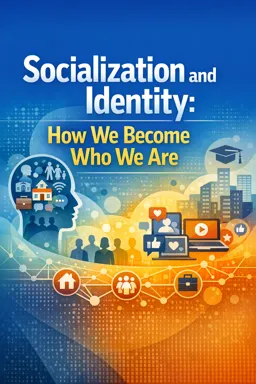
Socialization: the lifelong learning of “how to be” with others
Socialization is the lifelong process through which people learn the norms, values, roles, and interaction rules of their social world. It includes what we learn explicitly (being told rules) and implicitly (picking up cues, rewards, and reactions). Socialization does not stop in childhood: it continues when you change schools, start a job, join a team, move to a new neighborhood, or enter a new online community.
Socialization answers practical questions such as: “What counts as polite here?”, “What is expected of someone like me?”, “What happens if I do it differently?”, and “Who do I want to be within these expectations?”
Key terms: a working vocabulary for self and society
Identity
Identity is the set of meanings you attach to who you are (and who others recognize you as). Identity can be personal (e.g., “I’m curious”), relational (e.g., “I’m a supportive friend”), and social (e.g., “I’m a first-generation college student,” “I’m an employee,” “I’m a parent”). Identities are shaped in interaction: they are claimed by the self and confirmed (or challenged) by others.
Self-concept
Self-concept is your internal picture of yourself—your traits, abilities, values, and typical ways of acting. It includes statements like “I’m good at explaining things,” “I avoid conflict,” or “I’m the kind of person who shows up early.” Self-concept is influenced by feedback, comparison, and repeated experiences in groups.
Roles
A role is a set of expected behaviors tied to a position in a social setting. Roles come with “scripts” (what people assume you will do) and “boundaries” (what seems inappropriate). One person holds multiple roles (student, sibling, teammate), and roles can conflict (e.g., being a friend vs. being a supervisor).
- Listen to the audio with the screen off.
- Earn a certificate upon completion.
- Over 5000 courses for you to explore!

Download the app
Status
Status is a recognized social position in a group or society. Some statuses are ascribed (assigned at birth or not chosen), and others are achieved (earned or chosen). Status often shapes how others treat you and what they expect from you in a role.
Norms
Norms are shared expectations for behavior—what people in a group consider “normal,” “appropriate,” or “out of line.” Norms can be:
- Explicit (written rules, policies, posted guidelines)
- Implicit (unspoken expectations, “how we do things here”)
- Formal (institutional rules) or informal (customs, etiquette)
Sanctions
Sanctions are responses that encourage conformity to norms. They can be:
- Positive (praise, inclusion, promotions, likes)
- Negative (criticism, exclusion, penalties, awkward silence)
- Formal (grades, warnings, fines) or informal (eye-rolls, teasing, being ignored)
Sanctions are one of the main ways socialization “sticks”: people learn what is rewarded and what is punished.
Reference groups
Reference groups are the people or groups you use as a standard for comparison and guidance. They influence your goals, style, language, and sense of what is “normal.” A reference group might be your friends, a professional community, a sports team, a fandom, or even an imagined group you aspire to join.
Culture
Culture is the shared system of meanings, values, practices, and symbols that guide life in a group or society. Culture shapes what people consider respectful, successful, attractive, or “common sense.”
Subculture
A subculture is a group within a larger culture that has distinct norms, values, and styles (e.g., a workplace department, a gaming community, a religious youth group). Subcultures can overlap, and people often move between them daily, adjusting behavior across contexts.
Structure and agency: how society shapes you—and how you shape your life
To understand identity formation, it helps to hold two ideas at once:
- Structure: the patterned social forces that shape options and expectations (institutions, rules, status hierarchies, economic constraints, school/work routines, cultural scripts).
- Agency: your capacity to make choices, interpret situations, and act intentionally (deciding, resisting, negotiating, redefining roles).
Socialization happens where structure and agency meet. Structures provide the “menu” of likely behaviors and consequences; agency is how you choose from the menu, combine items, or sometimes refuse the menu and accept the costs.
| Question | Structure-focused lens | Agency-focused lens |
|---|---|---|
| Why do people act this way here? | Because norms and sanctions reward it. | Because individuals decide it fits their goals/values. |
| Why is change hard? | Rules and expectations are stable and enforced. | People fear costs or lack strategies to act differently. |
| How does identity form? | Positions and categories shape recognition and treatment. | People interpret experiences and craft self-stories. |
Concept explanations with scenario-based examples
Scenario 1: A new student learns the “hidden curriculum”
Situation: Maya transfers to a new school mid-year. The handbook explains formal rules, but the hardest part is the unspoken expectations.
- Norms (implicit): Students sit with their friend group at lunch; raising your hand is expected in some classes but not in others; certain jokes are “in.”
- Sanctions (informal): When Maya sits at a table without asking, conversation pauses (negative informal sanction). When she asks, “Is this seat taken?” people smile and make space (positive informal sanction).
- Roles: “New student” role includes being watched, asked questions, and expected to learn quickly.
- Status: Being new is a temporary status that affects access to groups and information.
- Reference groups: Maya watches a group of students who seem socially confident to learn how to dress and speak in this setting.
- Identity/self-concept: If Maya interprets early awkward moments as “I’m not likable,” her self-concept may shift; if she interprets them as “I’m learning a new environment,” she protects her identity while adapting.
Structure and agency in the scenario: The school’s routines and peer norms (structure) shape what is rewarded. Maya’s choices—asking questions, trying different groups, seeking a club—show agency within those constraints.
Scenario 2: A new employee learns workplace norms
Situation: Jordan starts a new job. The job description lists tasks, but daily life is governed by interaction rules.
- Norms (implicit): How quickly to respond to messages; whether it’s acceptable to challenge ideas in meetings; whether people eat lunch at desks or together.
- Sanctions: A manager praises Jordan for summarizing action items (positive formal/informal). A colleague stops inviting Jordan to informal chats after repeated interruptions (negative informal).
- Roles: “New hire” role includes learning, asking questions, and not overstepping. “Team member” role includes reliability and coordination.
- Status: Jordan’s status as a junior employee shapes who speaks first and whose ideas are taken seriously.
- Reference groups: Jordan models behavior after a respected coworker who seems effective and well-liked.
- Subculture: The department has its own style (direct feedback, casual dress) that differs from the broader organization.
Structure and agency in the scenario: Organizational hierarchy and evaluation systems (structure) influence behavior. Jordan can still exercise agency by asking for clarity, setting boundaries, and choosing how to present ideas.
Scenario 3: Online community norms and identity signals
Situation: Sam joins an online forum about fitness. The community has written rules, but also strong informal expectations.
- Norms: Use certain tags; cite sources; avoid “before/after” posts; encourage beginners.
- Sanctions: Helpful comments get upvotes (positive). Posts that break tone expectations get downvoted or removed (negative).
- Identity: Sam learns which identity signals are valued (humility, consistency, evidence-based advice).
- Reference group: High-status contributors become the standard for what “good participation” looks like.
Reflection prompts: separating preference from expectation
Use these prompts to identify when you are acting from personal preference versus social expectation. Write brief answers for one setting (school, work, family, friends, online).
Spot the “should” statements
- List three things you feel you should do in this setting. For each, ask: “Who says so?”
- Which “should” feels aligned with your values, and which feels mainly like pressure?
Preference vs. norm check
- What do you do here that you genuinely enjoy (preference)?
- What do you do mainly to avoid negative reactions (norm compliance)?
- If nobody reacted at all, what would you keep doing? What would you stop?
Sanction tracing
- Recall a moment you felt rewarded (praised, included, liked). What behavior was being reinforced?
- Recall a moment you felt punished (ignored, corrected, teased). What norm might you have violated?
Identity negotiation
- Which parts of your identity feel recognized in this setting?
- Which parts feel misunderstood or invisible?
- What small action could help you express a valued part of yourself without major risk?
Skills section: identifying norms and sanctions in everyday situations
This skill helps you navigate new environments, reduce misunderstandings, and make intentional choices about conformity or change.
Step-by-step: a “norms and sanctions scan”
- Define the setting. Name the context precisely (e.g., “Monday team meeting,” “group chat with friends,” “gym at 6pm”).
- Observe repeated behaviors. What do most people do consistently? (arrival time, speaking style, turn-taking, humor, dress, phone use)
- Listen for explicit rules. Note written policies or spoken instructions (syllabus, employee handbook, posted signs, pinned messages).
- Identify the unspoken expectations. Ask: “What would be awkward if someone did it?” Awkwardness often signals an implicit norm.
- Map sanctions. For each likely norm, list: (a) rewards for following it, (b) costs for violating it, and (c) who delivers the sanction (peers, supervisor, teacher, moderators).
- Locate roles and statuses. Who has authority? Who is new? Who is high-status? Norms often apply differently depending on status.
- Choose your strategy. Decide whether to (a) conform, (b) ask for clarification, (c) negotiate, or (d) resist—and predict consequences.
- Review outcomes. After acting, note what happened. Update your understanding of the norm and its enforcement.
Practical tool: a quick worksheet
| Setting | Possible norm | Evidence (what I observed) | Positive sanctions | Negative sanctions | My choice |
|---|---|---|---|---|---|
| Example: seminar class | Speak at least once per session | Teacher calls on quiet students; participation points | Praise; better grade | Lower participation score; teacher follow-up | Prepare one comment + one question |
| Example: workplace chat | Reply within 2 hours during workday | Fast responders get quick decisions | Seen as reliable | Missed tasks; frustration | Set notification window; acknowledge receipt |
Mini-practice: test your norm detection
Situation A: In a friend group, one person always pays and others say “we’ll get you next time” but rarely do. Identify: (1) the norm, (2) the sanction that keeps it going, (3) one agency-based option to change it.
Situation B: In a class, students laugh when someone challenges the teacher. Identify: (1) what norm is being enforced, (2) who benefits, (3) what a low-risk alternative behavior could be.
Situation C: In a workplace, meetings start late but everyone acts like it’s normal. Identify: (1) the real norm, (2) the cost of violating it by arriving “too early,” (3) how you could clarify expectations without sounding judgmental.
Language you can use to clarify norms (without conflict)
- Neutral question: “What’s the usual way you all handle this?”
- Permission check: “Is it okay if I do it this way, or is there a preferred approach?”
- Expectation check: “For response time, what’s considered normal here?”
- Boundary + cooperation: “I can do X by today; if you need Y sooner, what should I deprioritize?”