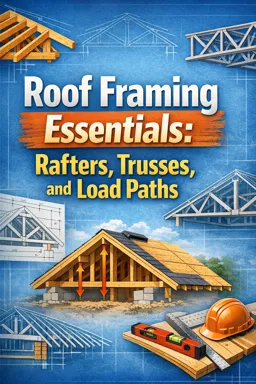
Roof framing as a structural system (what a roof is “doing”)
Roof framing is not just a shape on top of a house; it is a structural system that collects loads (weight and forces) and delivers them to the supporting structure (walls, beams, posts) and ultimately to the foundation. When you look at any roof, try to trace a “load path”: where the force starts, what members carry it, and where it ends.
Two main load types you must plan for
- Gravity loads: dead load (roof materials, sheathing, framing) + live load (snow, maintenance workers). These loads push downward.
- Wind loads: uplift (wind trying to peel the roof off), lateral pressure (wind pushing on walls and roof planes), and suction on leeward sides. These loads can pull upward and push sideways.
How loads typically travel (simple load-path thinking)
In a conventional rafter roof, gravity loads usually follow this path: roof covering → sheathing → rafters → exterior walls (or beams) → foundation. Wind uplift often follows the reverse path and relies on continuous connections: roof covering/sheathing → rafters/trusses → wall top plates → studs → sill/foundation anchors. The “how roofs work” mindset is: every member must have a job, and every connection must be continuous so forces can move without weak links.
Common residential roof shapes and how shape affects framing and load paths
Roof shape changes which framing members you need, where loads concentrate, and how you detail connections. The same basic forces exist, but the geometry changes the routes those forces take.
Gable roof
A gable roof has two sloping planes meeting at a ridge, with triangular gable ends. It is often framed with common rafters running from ridge to eave.
- Key framing members: ridge board (or ridge beam in some designs), common rafters, ceiling joists, gable end framing, sheathing.
- Load path notes: gravity loads mostly go down each rafter to the exterior walls; ceiling joists (or rafter ties) help resist outward thrust at the walls.
- Wind notes: gable ends can see high wind pressure; uplift at eaves and ridge requires strong tie-down connections.
Hip roof
A hip roof slopes down on all sides. Instead of gable ends, it has hips (external corners) running from ridge to eave.
- Listen to the audio with the screen off.
- Earn a certificate upon completion.
- Over 5000 courses for you to explore!

Download the app
- Key framing members: hip rafters, common rafters, jack rafters, ridge board/beam, sheathing.
- Load path notes: loads collect into hip rafters and distribute to corners; corners and their supporting walls/posts can become critical load points.
- Wind notes: hips generally perform well in wind because there are fewer large vertical gable end surfaces, but uplift at edges still demands continuous connections.
Shed roof
A shed roof is a single sloping plane. It is common on additions, porches, and modern designs.
- Key framing members: rafters spanning from a high wall to a low wall (or beam), sheathing, underlayment.
- Load path notes: gravity loads travel one-directionally to the supporting walls/beams; the tall wall must resist both vertical load and lateral wind effects.
- Wind notes: uplift can be significant at the low edge depending on wind direction; pay attention to rafter-to-wall connections.
Gambrel roof
A gambrel roof has two slopes on each side: a steep lower slope and a shallower upper slope. It creates more usable attic space but introduces a “knee” where forces change direction.
- Key framing members: rafters with a break in slope (often framed with multiple members and connections), ridge, collar ties/rafter ties depending on design intent, sheathing.
- Load path notes: the slope change concentrates forces at the break; connections at that joint must transfer both vertical and horizontal components.
- Wind notes: multiple planes and edges can increase uplift and suction zones; detailing and fastening patterns matter.
Essential roof terminology (what to point at on site)
Use these terms precisely. On a jobsite, clear vocabulary prevents mistakes like cutting the wrong member or placing connectors in the wrong location.
| Term | What it is (location) | What it does (structural or functional role) |
|---|---|---|
| Ridge | The top line where two roof planes meet. | Defines the roof peak; a reference line for layout and alignment. |
| Eave | The lower edge of a roof plane, usually overhanging the wall. | Sheds water away from walls; creates an edge where uplift forces can be high. |
| Fascia | The vertical board at the roof edge, attached to rafter tails. | Provides a straight edge for gutters and finishes; ties the ends of rafter tails together. |
| Soffit | The underside of the eave overhang. | Closes the overhang and often provides ventilation intake to the attic. |
| Gable end | The triangular wall area under a gable roof end. | Encloses the attic end; must resist wind pressure and transfer it into the wall framing. |
| Hip | The external angled intersection where two roof planes meet on a hip roof. | Channels loads to corners; forms a stiff edge line in the roof geometry. |
| Valley | The internal angled intersection where two roof planes meet (a “V” line). | Collects water runoff; concentrates framing loads into valley rafters and supporting structure. |
| Rafter | Sloped framing member running from ridge area to the wall/top plate. | Carries roof loads to supports; works mainly in bending under gravity loads. |
| Ridge board | A non-structural board at the ridge where rafters attach (typical conventional framing). | Provides a nailing surface and alignment; does not carry significant vertical load by itself. |
| Ceiling joist | Horizontal member spanning between walls, often parallel to rafters below. | Supports ceiling loads and can act as a rafter tie to resist wall spread (outward thrust). |
| Collar tie | Horizontal member in the upper third of opposing rafters, near the ridge. | Helps resist rafter separation under uplift and reduces ridge opening; not a substitute for rafter ties at the wall line. |
| Ridge beam | A structural beam at the ridge that supports rafter ends and carries vertical load to posts/walls. | Transfers gravity loads down through supports; reduces or eliminates outward thrust when properly supported. |
| Sheathing | Panels (often plywood/OSB) fastened to rafters/trusses. | Distributes loads to framing, stiffens the roof plane, and provides a base for roofing. |
| Underlayment | Layer installed over sheathing and under roofing (felt or synthetic). | Secondary water-shedding layer; protects sheathing during construction and minor water intrusion. |
Conceptual contrast: ridge board vs ridge beam (why the words matter)
These two are often confused, but they imply different load paths.
- Ridge board: mainly alignment and nailing. Rafters typically push outward at the walls unless restrained by ceiling joists/rafter ties. Think:
rafters share load with walls + ties. - Ridge beam: a structural member that carries vertical load. Rafters hang from it, and the beam must be supported down to the foundation. Think:
rafters → ridge beam → posts/walls → foundation.
Practical step-by-step: tracing a roof load path on a real house
Use this quick field method to understand what you are looking at before you cut, remove, or modify any member.
- Identify the roof shape (gable, hip, shed, gambrel). Note where planes meet (ridge/hips/valleys).
- Find the primary sloped members: rafters (or trusses, if present). Note their direction and where they bear.
- Locate the ridge condition: is it a ridge board (rafters opposing each other) or a ridge beam (beam with supports)? Look for posts or bearing lines under the ridge.
- Check for ties: find ceiling joists/rafter ties near the lower third and collar ties near the upper third. Ask: “What prevents the walls from spreading?”
- Follow gravity loads: start at sheathing, move to rafters, then to bearing points (top plates, beams), then down to studs/posts and foundation.
- Follow wind uplift continuity: look for a continuous connection path from rafters to walls (hurricane ties/straps), then to studs, then to foundation anchors.
- Mark concentration zones: valleys, hips, and roof intersections often concentrate loads and require special framing and support below.
“Identify it” activity: match terms to a simplified diagram
Instructions: Look at the simplified gable roof diagram. Match each letter (A–L) to the correct term from the word bank. Then write one sentence describing what that part does.
Word bank
ridge, rafter, ridge board, ceiling joist, collar tie, eave, fascia, soffit, gable end, sheathing, underlayment, valley
Simplified diagram (gable roof with an intersecting roof creating a valley)
                 A (ridge)            B (ridge board area)          A (ridge)
                    /\____________________|____________________/\
                   /  \                 E (sheathing)         /  \
                  /    \____________________________________/    \
                 /      \            F (underlayment)        /      \
                /        \__________________________________/        \
               /          \                                  \        \
              /            \                                  \        \
             /              \                                  \        \
            /                \                                  \        \
           /                  \                                  \        \
          /                    \                                  \        \
         /                      \                                  \        \
        /                        \                                  \        \
       /                          \                                  \        \
      /                            \                                  \        \
     /                              \                                  \        \
    /                                \                                  \        \
   /                                  \                                  \        \
  /____________________________________\__________________________________\______\
  C (eave)   D (fascia)   G (soffit)     H (ceiling joist)                 C (eave)
  |<-- overhang -->|                     |<-- ties walls -->|
  I (gable end wall)
                    \
                     \ J (valley line from intersecting roof)
                      \_____________________________________
                       \                                     \
                        \                                     \
                         \                                     \
                          \_____________________________________\
                                   K (rafter)      L (collar tie)
Answer format (write your responses)
- A = ________ : (one sentence: what it does)
- B = ________ : (one sentence: what it does)
- C = ________ : (one sentence: what it does)
- D = ________ : (one sentence: what it does)
- E = ________ : (one sentence: what it does)
- F = ________ : (one sentence: what it does)
- G = ________ : (one sentence: what it does)
- H = ________ : (one sentence: what it does)
- I = ________ : (one sentence: what it does)
- J = ________ : (one sentence: what it does)
- K = ________ : (one sentence: what it does)
- L = ________ : (one sentence: what it does)