What “Context” Means in Natural Korean Mini-Fictions
When you read a Korean mini-fiction that feels “natural,” you are not only decoding vocabulary and grammar. You are also interpreting context: the situation, relationship, setting, implied emotions, and what is left unsaid. In everyday Korean, context often carries meaning that English might state directly. Mini-fictions are perfect for practicing this because they are short enough to reread, but dense enough to include realistic omissions, hints, and social cues.
In this chapter, “context” includes: (1) who is speaking to whom (relationship and social distance), (2) where and when the scene happens, (3) what the speakers assume the other person already knows, (4) what is implied rather than stated, and (5) the emotional “temperature” of the scene (warm, awkward, annoyed, playful, etc.). Reading with context means you actively reconstruct these elements while you read, instead of treating sentences as isolated grammar exercises.
Why Korean Mini-Fictions Depend on Context
Korean frequently encodes social meaning through speech level (해요체, 합니다체, 반말), honorifics (-(으)시-, 드리다/주시다), and particles that signal stance (요, 네, 아, 뭐, 좀). Also, Korean conversation often drops subjects and objects when they are obvious in context. A mini-fiction may never explicitly say “I” or “you,” yet you can still follow the story if you track the situation and the relationship.
Context also helps you interpret short responses like “됐어요,” “괜찮아요,” “아니에요,” which can mean different things depending on tone and situation. In a mini-fiction, you don’t have audio tone, so you must infer it from surrounding details: punctuation, word choice, and what happened just before.
Core Tools for Reading Natural Mini-Fictions
Tool 1: Identify the Scene in One Sentence
Before you translate anything, pause after the first 2–4 lines and summarize the scene in one simple sentence in your own language: “A customer is returning something,” “Two coworkers are negotiating overtime,” “A friend is late and apologizing.” This anchors your reading and prevents you from getting lost in word-by-word decoding.
- Listen to the audio with the screen off.
- Earn a certificate upon completion.
- Over 5000 courses for you to explore!

Download the app
Practical tip: look for location words (편의점, 회사, 집, 지하철), time markers (아침에, 방금, 오늘), and role nouns (사장님, 기사님, 선배, 손님). Even if you don’t know every word, these anchors give you a frame.
Tool 2: Track Relationship and Speech Level
Speech level is not decoration; it is context. If one character uses 해요체 and the other uses 반말, that signals a relationship difference (age, closeness, hierarchy) or a shift in mood. If someone suddenly switches from 해요체 to 반말, it can signal intimacy, irritation, or a reveal (“We actually know each other”).
- 해요체 (…어요/아요): polite, common in daily life with strangers, coworkers, service situations.
- 합니다체 (…습니다): more formal, official, customer service announcements, presentations.
- 반말 (…해/…야): close friends, family, younger people, or when someone is being rude.
When reading, underline sentence endings and ask: “What does this ending tell me about who is speaking and how they feel?”
Tool 3: Notice What Is Missing (Dropped Subjects)
Korean often omits subjects: “갔어요” can mean “I went,” “you went,” “they went,” depending on context. Mini-fictions use this naturally. Your job is to reconstruct the missing pieces by tracking who is currently “in focus.”
Practical method: after each line, silently add a bracketed subject in your head: “[I] 갔어요,” “[she] 갔어요.” If later lines contradict your guess, revise. This is not failure; it is how real reading works.
Tool 4: Read Particles as Story Signals
Particles are small but powerful in mini-fictions because they show contrast, emphasis, and implication.
- 은/는: topic, contrast (“As for this…” “But…”)
- 이/가: focus/new information (“It’s this that…”)
- 도: “also/even” (often signals surprise or accumulation)
- 만: “only” (restriction; can create tension)
- 부터/까지: range (often used to show effort or exaggeration)
Instead of translating particles mechanically, ask what they do to the story. For example, “나만” often signals loneliness or unfairness; “너도” can signal solidarity or accusation depending on context.
Tool 5: Use “Emotion Words” and “Softening Words”
Natural Korean uses many small words that soften or color meaning: 좀, 그냥, 혹시, 약간, 별로, 진짜, 너무. These are context markers.
- 좀: softens requests (“좀 도와주세요”), can also show annoyance (“좀!”)
- 그냥: “just,” can hide a reason or avoid explanation
- 혹시: polite uncertainty, carefulness (“혹시 시간 있어요?”)
- 별로: “not really,” often indirect refusal
In mini-fictions, these words often reveal what a character is trying not to say directly.
Step-by-Step: How to Read a Mini-Fiction with Context
Step 1: First Pass (No Dictionary)
Read the entire mini-fiction once without stopping. Your goal is not accuracy; it is to catch the situation and emotional arc. After the first pass, write (mentally or on paper) two things: (1) Where are we? (2) What changed from the beginning to the end?
If you feel you understood “only 30%,” that is still useful. Context reading improves by repeated exposure and structured rereading.
Step 2: Mark the “Context Anchors”
On the second pass, mark:
- Place/time words
- Relationship titles (사장님, 선배, 아저씨, 언니)
- Speech level endings
- Particles that show contrast (은/는, 하지만, 근데)
- Softening words (좀, 혹시, 그냥)
This step turns the story into a map. Even if you don’t know some nouns, you can still follow the map.
Step 3: Reconstruct Dropped Subjects
Now reread line by line and add implied subjects/objects in brackets. Example technique:
갔어요. → [누가?] 갔어요. → [그 사람/제가/당신이] 갔어요.Then check the next sentence for confirmation. If the next line says “나 혼자 남았어,” you can infer the previous “갔어요” likely referred to “they left,” not “I left.”
Step 4: Translate Only the “Turning Point” Lines
Mini-fictions often have a turning point: a reveal, a misunderstanding, a small twist. Instead of translating every line, focus on the 1–3 lines where the story changes direction. Translate those carefully. This gives you maximum comprehension with minimal time.
Turning point signals include: 갑자기, 그때, 그런데, 사실, 알고 보니, 순간, 조용히, 잠깐.
Step 5: Read Aloud with Role-Play Intonation
Even without audio, you can practice natural rhythm by reading aloud. Assign roles (A/B) and read each line with the appropriate politeness and emotion. This is where context becomes speaking ability: you learn not only what to say, but how to say it to the right person.
Practical tip: exaggerate slightly at first. Make polite lines clearly polite, and casual lines clearly casual. Later you can refine.
Mini-Fiction 1: The Convenience Store Umbrella

Text
비가 갑자기 쏟아졌다. 편의점 앞에서 나는 발만 동동 굴렀다. 우산은 집에 있다. 그때 점원이 문을 열고 나왔다. “손님, 이거요.” 투명 우산 하나를 내밀었다. “아, 아니에요. 괜찮아요.” 내가 손을 흔들자 점원이 웃었다. “괜찮아요. 어차피… 하나 더 있어요.”Context Reading Walkthrough
Scene in one sentence: A customer is stuck in sudden rain; a convenience store clerk offers an umbrella.
Relationship and speech level: The clerk says “손님” and uses polite style. The narrator responds politely too. This is a stranger/service relationship.
What is missing: “우산은 집에 있다” doesn’t say “my umbrella,” but context makes it clear. “하나 더 있어요” doesn’t specify “I have one more umbrella,” but the implied object is “우산.”
Key nuance lines: “아, 아니에요. 괜찮아요.” In context, this likely means “I can’t accept it / I don’t want to trouble you,” not “I’m fine emotionally.” The clerk’s “어차피…” suggests a hidden reason: maybe it’s a store umbrella, maybe a lost-and-found, maybe the clerk planned to give it away. The ellipsis creates warmth and modesty: the clerk avoids explaining too much.
Practice: Read the dialogue aloud twice: first as very polite strangers, then as if the clerk is slightly playful and the customer is embarrassed. Notice how the same words shift meaning with context.
Mini-Fiction 2: The Group Chat “Read” Mark
Text
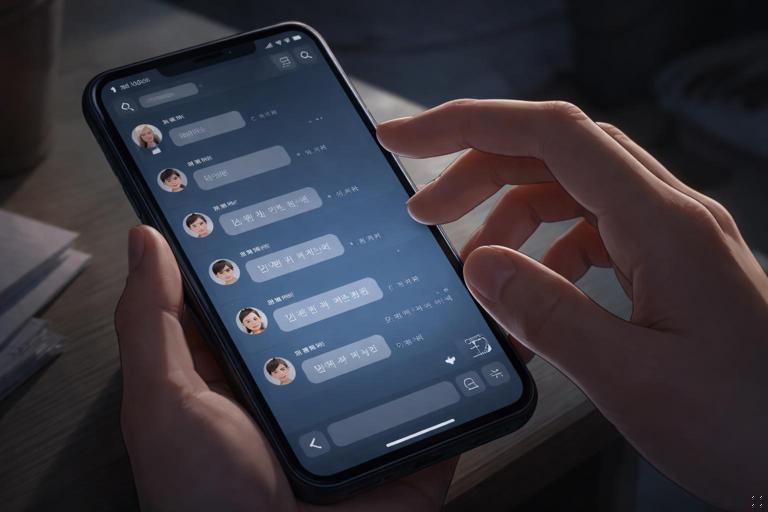
단톡방에 메시지를 보냈다. “오늘 7시에 볼래?” 바로 ‘읽음 4’가 떴다. 그런데 아무도 답이 없다. 나는 다시 썼다. “바쁘면 말해도 돼.” 그제야 한 명이 답했다. “미안… 사실 오늘은 좀.” 그리고 또 조용해졌다. 나는 휴대폰을 뒤집어 놓았다.Context Reading Walkthrough
Scene in one sentence: Someone invites friends in a group chat; everyone reads but doesn’t respond; awkwardness follows.
Anchors: 단톡방, 읽음 4, 휴대폰. These are modern daily-life anchors.
Emotion markers: “그런데” signals contrast: read receipts appear, but no replies. “바쁘면 말해도 돼” is a softening line; it gives permission to refuse, but it also reveals insecurity. “사실 오늘은 좀” is an indirect refusal. The “좀” here is not “a little” in quantity; it is a polite hedge meaning “it’s difficult to say / it’s not convenient.”
What is implied: The silence suggests the group might be avoiding the narrator, or they are unsure, or they are waiting for someone else to answer first. The story doesn’t state the reason; context invites you to infer social dynamics. “휴대폰을 뒤집어 놓았다” implies the narrator wants to stop checking, to protect feelings.
Practice: Rewrite one line to change the context. For example, replace “바쁘면 말해도 돼” with “답 좀 해” and notice how the narrator becomes more confrontational. Same situation, different social meaning.
Mini-Fiction 3: The Office Coffee That Wasn’t Mine

Text
회의 끝나고 자리에 돌아오니 커피가 한 잔 놓여 있었다. 내 이름은 없다. 옆자리 선배가 말했다. “아, 그거 네 거 아니야.” 나는 얼른 손을 뗐다. “죄송해요.” 선배는 잠깐 보더니 웃었다. “아니, 그냥 마셔. 어차피 남는 거야.” 나는 커피를 들고도 한동안 못 마셨다.Context Reading Walkthrough
Scene in one sentence: After a meeting, someone almost takes a coffee that isn’t labeled; a senior coworker reacts.
Relationship: “선배” indicates workplace hierarchy. The narrator uses polite “죄송해요,” showing respect. The senior uses casual “네 거 아니야,” which can be interpreted as senior-to-junior casualness, not necessarily rudeness.
Turning point: The senior’s “그냥 마셔” changes the mood from potential embarrassment to permission. “어차피 남는 거야” implies it would be wasted otherwise, reducing guilt. Yet the narrator “한동안 못 마셨다” shows lingering discomfort—context of workplace etiquette and fear of seeming greedy.
Particle focus: “그거 네 거 아니야” uses “그거” (that thing) to distance the object and quickly correct. “남는 거야” frames the coffee as leftover, not someone’s personal item, which justifies the permission.
Practice: Read the senior’s lines in two ways: (1) strict and cold, (2) friendly and teasing. Then decide which reading fits better with “웃었다.” This trains you to use narrative cues to choose the right emotional interpretation.
Context Exercises You Can Apply to Any Mini-Fiction
Exercise 1: The “Who/Where/Why” Grid
After reading, fill this grid (mentally or in notes):
- Who: speaker roles (customer/clerk, junior/senior, friends)
- Where: location clues
- Why now: what triggered the scene (rain, read receipt, meeting ended)
- What is unsaid: what the character avoids stating directly
This prevents you from treating the text as disconnected sentences and trains you to read like a native reader who automatically builds a situation model.
Exercise 2: Replace One Context Marker
Choose one small word and replace it to change the tone. Examples:
- 혹시 → 지금 (more direct)
- 좀 → 빨리 (more urgent)
- 괜찮아요 → 됐어요 (can sound firmer depending on context)
- 그냥 → 사실 (more explanatory, less evasive)
Then reread the mini-fiction and describe how the relationship or mood changes. This is a powerful way to learn pragmatic meaning.
Exercise 3: Add the Missing Line
Mini-fictions often end with a quiet line. Add one more line that fits the context without changing the style. For example, after “나는 휴대폰을 뒤집어 놓았다,” you might add a line that shows the narrator’s next action (making tea, going outside, opening another app). Keep it short and natural, and match the speech level if there is dialogue.
Exercise 4: Shadow Reading for Rhythm (Text-Only Version)
Even without audio, you can practice rhythm by “shadowing” the punctuation. Read aloud and pause slightly at commas and more at periods. For dialogue, raise or soften your voice based on politeness markers (요, 죄송해요, 혹시). This builds a physical sense of Korean timing, which supports more natural speaking later.
Common Context Traps (and How to Avoid Them)
Trap 1: Over-Translating “괜찮아요” and “아니에요”
These phrases can mean refusal, reassurance, modesty, or “don’t worry about it.” In mini-fictions, decide meaning by asking: “What action is happening right now?” If someone is offering something, “괜찮아요” often means “No, thank you.” If someone apologizes, it often means “It’s okay.”
Trap 2: Assuming Silence Means the Same Thing
Silence in Korean mini-fictions can mean politeness, discomfort, anger, or simply thinking. Look for nearby cues: “잠깐,” “한동안,” “조용해졌다,” “웃었다,” “시선을 피했다.” These cues tell you what kind of silence it is.
Trap 3: Missing the Social Meaning of Small Words
Words like “어차피,” “그럼,” “근데,” “일단,” “뭐” often carry attitude. “어차피” can sound practical (“since anyway”) but also resigned. “뭐” can soften (“뭐, 괜찮아”) or dismiss (“뭐야?”). When you meet these words, don’t rush past them; they are often the key to naturalness.
Trap 4: Treating Honorifics as Pure Grammar
Honorifics are context. If a character uses “주셨어요” instead of “줬어요,” it signals respect and distance. If the story suddenly drops honorifics, it can signal closeness or conflict. Track these shifts like you track plot twists.
Building Your Own Context-Rich Mini-Fictions (for Reading and Speaking)
To deepen your reading, it helps to write tiny scenes that force you to encode context. Keep them short (5–8 lines) and include at least three context signals: a location word, a relationship title, and one softening word (좀/혹시/그냥). Then read your own mini-fiction aloud, switching roles if there is dialogue.
Template you can reuse:
- Line 1: Setting + trigger (비가 왔다 / 회의가 끝났다 / 단톡방이 조용했다)
- Line 2: Your action (나는 … 했다)
- Line 3: Other person’s line (speech level shows relationship)
- Line 4: Your response (softening word)
- Line 5: Small twist (사실/그런데/알고 보니)
- Line 6: Quiet ending action (휴대폰을 내려놓았다 / 문을 닫았다)
This writing practice improves reading because you become more sensitive to how Korean naturally packages context into small choices.