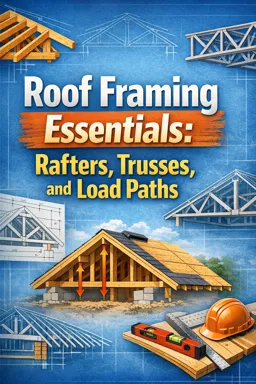
Why Connections Matter: Making the Load Path Continuous
A roof frame is only as strong as its connections. Rafters can be correctly sized and perfectly cut, but if the joints are weak or discontinuous, wind uplift and racking forces will “find” those weak points. A continuous load path means each member hands off forces to the next member through a reliable connection: rafter → top plate → wall framing → foundation. In high winds, the dominant risk is uplift: the roof wants to peel up and rotate, trying to separate rafters from plates, rafters from ridge, and ties from rafters.
This chapter focuses on four critical connection points and the hardware commonly used to keep them intact: rafter-to-plate (birdsmouth bearing), rafter-to-ridge, rafter-to-ceiling joist/rafter tie, and tie-downs for uplift continuity.
Connection Point 1: Rafter-to-Plate (Birdsmouth Bearing)
What this joint must do
- Provide solid bearing so gravity loads transfer into the wall without crushing or splitting wood.
- Resist sliding down the roof slope (especially on steeper pitches).
- Resist uplift trying to pull the rafter off the plate.
Why bearing is critical (not just fastening)
Fasteners are not a substitute for bearing. The birdsmouth seat cut creates a direct wood-to-wood bearing surface on the top plate. If the seat is too short, uneven, or not fully seated, the load concentrates at an edge, which can crush fibers, split the rafter at the notch, or allow rotation that loosens fasteners over time.
Practical verification steps on a framed roof
- Confirm full contact at the seat cut. Look for gaps between the rafter seat and the top plate. A consistent tight line is the goal; daylight is a red flag.
- Check bearing length. Ensure the seat cut provides adequate bearing area on the plate (avoid “point bearing” at a corner).
- Inspect the notch area for splitting. Splits often start at the inside corner of the birdsmouth and run along the grain.
- Verify the rafter is not rolled. A rolled rafter reduces effective bearing and can misalign connectors.
Hardware commonly used here
- Hurricane ties (rafter ties to plate): Metal connectors that wrap the rafter and attach to the top plate (and sometimes the stud). Designed primarily for uplift resistance.
- Straps: Longer connectors that can bridge from rafter to wall framing for added continuity.
Key idea: A hurricane tie does not fix poor bearing. It supplements a properly seated birdsmouth by providing a rated uplift connection.
Connection Point 2: Rafter-to-Ridge (Ridge Board Joint)
What this joint must do
- Align opposing rafters so the roof plane stays straight and loads share properly.
- Provide a fastening surface for rafter ends (typically to a ridge board).
- Resist separation and rotation at the peak under wind and unbalanced loading.
Common issues to watch for
- Shallow end contact: If the plumb cut is off, the rafter may touch only at a corner, reducing nail holding and encouraging splitting.
- Missed nails: Nails that miss the ridge board (or exit the side) provide little strength and can split the ridge.
- Rafter end gaps: Gaps can allow movement; movement loosens nails, and loosened nails accelerate movement.
Practical verification steps
- Check rafter end fit. The plumb cut should bear cleanly against the ridge board face without rocking.
- Confirm nail placement. Look for nails centered in the ridge board thickness and not overdriven.
- Confirm consistent ridge line. Sight down the ridge; misalignment can indicate poor end cuts or uneven seating at plates.
When connectors are used at the ridge
Many roofs rely on direct nailing at the ridge board, but connectors may be specified in higher wind zones or where geometry/loads demand it. Examples include ridge hangers or straps that tie opposing rafters across the ridge line. Use them when required by plans or local wind design, and ensure the connector matches the rafter size and angle.
- Listen to the audio with the screen off.
- Earn a certificate upon completion.
- Over 5000 courses for you to explore!

Download the app
Connection Point 3: Rafter-to-Ceiling Joist / Rafter Tie
What this joint must do
- Keep the lower ends of rafters from separating by tying them together across the building width.
- Transfer tension forces through a reliable connection that won’t withdraw under cyclic loading.
What good fastening looks like
This joint often uses nails, sometimes supplemented with straps. The key is that the tie is actually connected to the rafter in a way that can carry tension. A few poorly placed nails can hold parts in place during construction but fail under wind-driven movement.
Practical verification steps
- Confirm the tie is present where required. Look for missing ties, especially near ends, openings, or modified framing areas.
- Check overlap and contact. If the tie laps the rafter, the wood surfaces should be tight together, not separated by a gap.
- Inspect fastener pattern. Nails should be properly spaced, not all in a line that encourages splitting.
- Look for splitting at nail lines. Splits reduce tension capacity dramatically.
Connection Point 4: Tie-Downs for Uplift (Creating a Continuous Uplift Path)
What uplift is trying to do
Wind can create suction on the roof surface. The roof assembly wants to lift as a unit, and individual rafters can try to peel up at the plate. If the rafter-to-plate connection is strong but the plate-to-stud or stud-to-foundation connection is weak, the failure simply moves down the chain. A continuous uplift path means each link is strong enough and actually connected.
Typical components in an uplift path
- Rafter-to-plate connector (often a hurricane tie)
- Plate-to-stud connection (nailing, straps, or hold-downs depending on design)
- Stud-to-sill/foundation connection (anchor bolts/straps/hold-downs as specified)
This chapter’s focus is the roof framing portion, but when you inspect a roof, you should still look for continuity: a strong connector at the rafter is not helpful if the wall below is not tied down as required.
Connectors and Hardware: What They Do and How to Use Them Correctly
Common connector types you’ll see
- Hurricane ties: Small formed steel connectors that attach a rafter/truss to the top plate to resist uplift. Many are “handed” (left/right) or have specific orientations.
- Straps: Flat metal straps used to tie members together across a joint or to provide a longer load transfer path (useful where direct nailing is limited).
- Hangers: U-shaped or L-shaped connectors that support a member at its end (commonly for joists, but sometimes used where roof framing bears in a way that needs a rated seat).
Manufacturer-specified nailing patterns (non-negotiable)
Connectors are engineered products. Their published load ratings assume:
- Specific fastener type (often a particular nail diameter and length, sometimes structural screws).
- Specific hole usage (some holes are mandatory; some are optional for higher capacity).
- Specific orientation (flipped or rotated connectors may lose capacity).
If the required nails are missing, substituted, or placed in the wrong holes, you no longer have the rated connection. In practice, this is one of the most common inspection failures: a connector is present, but it is not installed per the schedule.
Step-by-step: How to verify a connector installation
- Identify the connector model (stamp/shape) and what joint it is intended for.
- Confirm geometry match: correct rafter size, correct angle, correct side (left/right) if applicable, and full contact to wood.
- Count fasteners and confirm they are in the correct holes (not “random holes”).
- Confirm fastener type: correct nail size/length; avoid drywall screws or undersized nails.
- Check for overdriving: nails driven so hard they crush wood fibers or deform the connector reduce performance.
- Check for splitting in the wood at fastener lines; splitting can negate the connector’s benefit.
Toenailing vs. Connectors: When Each Is Used
Toenailing (what it is good at)
Toenailing is driving nails at an angle through one member into another. It is commonly used to hold framing in position and can provide moderate resistance to movement when properly done. It is fast, inexpensive, and often used where loads are primarily gravity and where uplift demands are low.
Limitations of toenailing under uplift
- Nail withdrawal: Uplift loads pull along the nail shank; nails can slowly withdraw under cyclic wind loading.
- Wood splitting: Angled nails near the end of a member can split the rafter or plate, reducing holding power.
- Inconsistent quality: Toenailing strength depends heavily on angle, penetration, and avoiding edge distances that cause splits.
Connectors (what they are good at)
Connectors provide a more reliable, rated load transfer path, especially for uplift and lateral forces. They reduce dependence on perfect nail angles and increase resistance to cyclic loading. In many wind design situations, connectors are required because toenails alone do not provide sufficient uplift capacity.
Practical guidance: choosing between them
| Situation | Toenailing | Connector |
|---|---|---|
| Holding parts in place during framing | Common and acceptable | Optional |
| Rafter-to-plate in wind/uplift-prone areas | Often insufficient alone | Typically required (hurricane tie) |
| Where plans/specs call for rated uplift capacity | Not a substitute | Required with specified fasteners |
| Where geometry limits good toenailing (tight corners, short bearing) | Often unreliable | Preferred |
What Failures Look Like Under Wind Uplift (So You Know What You’re Preventing)
Common failure modes at roof connections
- Rafter lifts off the plate: toenails withdraw; the birdsmouth may show crushing at the seat edge and a visible gap at the plate.
- Progressive peeling: one rafter connection fails, load shifts to adjacent rafters, and failures cascade along the eave line.
- Connector present but ineffective: missing nails, wrong nails, or wrong orientation; the metal may be intact but the wood tears or fasteners pull out.
- Splitting at the birdsmouth or tie connection: splits reduce capacity and allow rotation, which accelerates fastener loosening.
- Ridge separation: rafter ends pull away or rotate, loosening ridge nails and opening gaps at the peak.
Field clues during inspection
- Shiners (nails that missed the member) at ridge or plate lines.
- Overdriven nails and bent connector flanges.
- Connectors installed on the wrong side or not seated tight to wood.
- Crushed fibers at bearing points indicating uneven seating.
Structured On-Site Checklist: Continuous Load Path at Roof Framing
1) Verify bearing
- Birdsmouth seat fully bears on the top plate with minimal gaps.
- Rafter is not rolled; seat contact is flat and consistent.
- No significant crushing or splitting at the notch.
2) Verify fastening
- Rafter-to-ridge nails are properly placed and not missed/overdriven.
- Rafter-to-plate fastening is present as required (toenails and/or connector).
- Rafter-to-tie fastening is adequate and not causing splits.
3) Verify tie continuity (uplift path)
- Each rafter has a clear uplift connection to the top plate (often a hurricane tie).
- Where straps/hold-downs are specified, they are continuous and not interrupted by missing fasteners.
- Look down the chain: connector at the rafter is not the only “strong link” in an otherwise weak path.
4) Verify connectors match the joint geometry
- Correct connector type for the joint (tie vs strap vs hanger).
- Correct orientation/handedness and tight seating to both members.
- Correct fastener type and full nailing pattern per manufacturer (no substitutions).
- No deformation, corrosion, or damage that compromises fit.