What “Ombre Brows” Means in Practical Terms
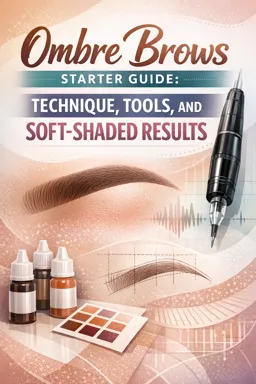
Ombre brows are a machine-shaded gradient brow: the front (head) is the lightest and most diffused, the mid-brow (body) is fuller and more even, and the tail is the most defined and slightly deeper. Instead of drawing individual hair strokes, the artist deposits pigment as tiny pixels (soft stippling/pointillism) to create a powdery, makeup-like finish that can be very subtle or more polished depending on density.
How the Gradient Is Built (Conceptual Map)
| Zone | Visual goal | Typical saturation | Common mistakes to avoid |
|---|---|---|---|
| Front (head) | Airbrushed, soft entry | Lightest | Hard “block” start; too much pressure; over-dark outline |
| Body | Even fullness, smooth shading | Medium | Patchy fill; inconsistent pixel spacing |
| Tail | Crisp direction and definition | Deepest | Over-saturating; tail too long/downturned; harsh corners |
Practical Step-by-Step: Explaining the Look to a Client
Show the gradient idea: point to the brow and describe “light at the front, fuller through the middle, defined at the tail.”
Confirm finish preference: ask whether they want “barely-there soft powder” or “more makeup-ready.”
Set the intensity plan: explain that the first session is built for a healed result; you can refine and adjust at the follow-up.
Clarify symmetry expectations: brows are sisters, not twins—ombre shading improves balance but won’t change underlying bone structure.
Continue in our app.- Listen to the audio with the screen off.
- Earn a certificate upon completion.
- Over 5000 courses for you to explore!

Download the app
How Ombre Brows Differ From Microblading and Combo Brows
All three techniques aim to enhance brow shape, but they differ in texture, healing appearance, and maintenance patterns.
Texture and Visual Finish
- Ombre (machine shading): looks like soft powder or pencil/soft makeup. Texture is made of tiny dots/pixels that blend together when healed.
- Microblading (manual strokes): looks like hair strokes. Texture is linear; the illusion depends on crisp, separated lines.
- Combo brows: a mix—strokes (usually at the front) plus shading through the body/tail for added density.
Healing Appearance (What Clients Usually Notice)
- Ombre: often heals more even because shading is distributed in pixels; the front typically softens significantly as the skin recovers.
- Microblading: strokes can heal thicker, blurrier, or partially missing depending on skin type and aftercare; crispness is more skin-dependent.
- Combo: shading tends to heal more predictably than strokes; the stroke portion may soften faster than the shaded portion.
Long-Term Maintenance Patterns
- Ombre: tends to fade as an overall soft wash; refreshes are usually about restoring depth and rebalancing the gradient.
- Microblading: strokes can gradually blur together on certain skin types, making the brow look more “filled” over time; some clients transition to shading later.
- Combo: maintenance may focus on restoring the shaded base while evaluating whether the stroke area still reads as hair-like.
Suitability Checklist: Who Ombre Brows Typically Suit
Use this checklist to match the technique to the client’s skin, brow features, lifestyle, and style preference. Ombre is often chosen because it can be soft and natural or makeup-defined without relying on hair-stroke crispness.
1) Skin Type Considerations
- Oily skin: often a strong candidate for ombre because pixels can heal more evenly than strokes. Plan for softer definition and possible faster fading; avoid over-saturating to “fight” oil.
- Porous/enlarged pores: shading is usually more forgiving than strokes. Expect more diffusion; keep the front extra airy and avoid sharp outlines.
- Mature skin: ombre can be excellent when kept soft; it avoids relying on thin, crisp lines that may blur. Use a gentle gradient and avoid heavy tails that can visually “drag” the eye down.
- Sensitive/reactive skin: suitability depends on stability and triggers. Choose conservative density, minimize passes, and prioritize patch testing policies where applicable.
2) Natural Brow Density and Hair Pattern
- Sparse brows: ombre can create the appearance of fullness without needing enough hair to “hide” strokes.
- Uneven density or gaps: shading blends gaps smoothly; ideal for clients who currently fill with pencil/powder.
- Very dense brows: ombre can still work, especially to refine shape and add a polished tail, but discuss whether they want enhancement or a noticeable makeup effect.
3) Lifestyle Factors
- Frequent sweating/fitness: ombre is popular for clients who want a consistently “done” brow. Discuss that heavy sweating during early healing can affect retention; plan timing around events/training schedules.
- Outdoor/UV exposure: UV can accelerate fading. Clients who tan or spend lots of time outside may need more frequent refreshes and strict sun protection habits.
- Skincare routines: regular use of exfoliants/acids/retinoids around the brow area can fade pigment faster; clients may need to adjust product placement.
4) Preference: Makeup-Like vs Natural
Ombre is flexible, but it is still a shaded technique. Use these questions to guide the design:
- Do you fill your brows daily? If yes, ombre often matches their routine.
- Do you want to look “done” without makeup? Choose a soft powder plan with a light front and moderate body.
- Do you want hair-stroke realism up close? Ombre may not be their first choice; discuss whether a combo approach fits better.
Contraindication Screening Essentials (and When to Postpone)
Screening is about safety, predictable healing, and legal compliance. Policies vary by region, so follow local regulations, your insurance requirements, and your studio’s medical clearance rules.
Client Intake: What to Ask and Document
- Medical conditions: immune disorders, uncontrolled diabetes, bleeding disorders, history of poor wound healing, seizure disorders (as applicable to your policy), or any condition requiring physician approval.
- Skin conditions near the brow: eczema, psoriasis, dermatitis, active acne lesions in the area, rosacea flare-ups, sunburn, open wounds, or infection.
- Allergies/sensitivities: known pigment sensitivities, topical anesthetic reactions, latex/adhesive allergies.
- Medications and treatments: anticoagulants/blood thinners (prescription or frequent use), recent steroid use, immunosuppressants, recent injectable treatments near the brow, and recent/ongoing dermatology procedures that affect the skin barrier.
- Pregnancy/breastfeeding: follow local rules and your insurer’s guidance; many studios postpone due to consent, healing variability, and risk management.
When to Postpone (Common Practical Triggers)
- Active irritation in or near the brow area (rash, broken skin, sunburn, inflamed acne).
- Recent aggressive skin treatments around the forehead/brow (chemical peels, resurfacing, strong exfoliation) until the barrier is fully recovered per provider guidance.
- Uncontrolled medical issues or lack of medical clearance when required by your policy.
- Client cannot follow aftercare due to travel, heavy sweating schedule, swimming, or unavoidable sun exposure during the initial healing window.
Practical Step-by-Step: A Simple Screening Flow
Pre-book questionnaire: collect medical/skin/medication info before confirming the appointment.
Photo review: request clear brow/forehead photos in natural light to spot irritation, sunburn, or dermatitis.
Day-of visual check: confirm no active lesions, no compromised skin barrier, and no new medications or treatments since booking.
Decision: proceed, proceed with modifications (lighter density/shorter session), or postpone with a clear rebooking timeline.
Outcome Expectations: Softness, Fading, and Why Healed Looks Lighter
Achievable Softness (What “Soft-Shaded” Really Means)
A well-executed ombre brow should read as a diffused gradient rather than a solid stamp. Softness is controlled by pixel spacing, depth consistency, and how lightly the front is built. Even when a client wants a more defined look, the front should remain the most airy area to keep the brow natural in expression.
Typical Fading Behavior
- Overall lightening: the brow generally fades as a uniform soft wash, with the front often fading the most (by design).
- Gradual diffusion: edges soften slightly over time; crispness is maintained by good design and conservative saturation rather than heavy outlining.
- Color shift risk: lifestyle (UV), skincare, and skin type can influence how quickly tone and depth change; refresh timing is individualized.
Why Healed Results Look Lighter Than Fresh Work
Fresh ombre brows look darker because pigment is sitting in freshly worked skin with temporary redness and swelling. As healing progresses, the surface skin regenerates and light reflection changes, making the pigment appear softer. In practical terms, clients should expect the healed result to look noticeably lighter and more blended than day one, which is why the initial session is planned for the final healed look—not the immediate post-procedure intensity.