Why “Loads” and “Load Paths” Matter
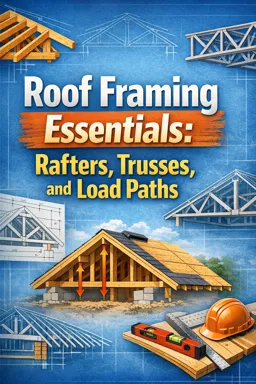
A roof frame is not just a collection of members sized to “hold weight.” It is a system that must (1) support vertical loads pushing down and (2) resist lateral forces and uplift trying to slide, rack, or pull the roof apart. A load path is the continuous chain of materials and connections that transfers forces from where they occur (roof surface) to where they are ultimately resisted (ground through the foundation). If any link in that chain is missing, weak, or poorly connected, the structure can fail even when the lumber sizes look adequate.
Types of Loads Acting on Residential Roofs
Dead Load (Permanent Weight)
Dead load is the weight of materials that are always there: roof sheathing, underlayment, shingles/metal roofing, rafters or trusses, insulation, ceiling drywall, and fixed equipment (for example, some HVAC components). Dead load is predictable and constant, so it is often the baseline load the roof must carry at all times.
Live Load (Temporary, Variable Weight)
Live load is temporary and changeable: workers during construction or maintenance, tools, stacked materials, and occasional roof access. Even if a roof is not intended as a deck, it still must tolerate limited temporary loading from people and maintenance activities.
Snow Load (Environmental Vertical Load)
Snow load is a vertical load that can be much larger than typical live load in cold climates. It is not just “snow depth × weight.” Drifting, sliding, and accumulation at valleys, lower roofs, and behind chimneys can create localized high loads. Conceptually, snow load increases the downward force on sheathing and framing and can also introduce unbalanced loading (one side of a roof more loaded than the other).
Wind Uplift (Environmental Suction and Pressure)
Wind uplift is often counterintuitive because it can pull upward on the roof. Wind flowing over a roof can create suction, especially at edges, corners, and eaves. Wind can also press laterally against walls, which indirectly affects the roof through diaphragm action and connections. Uplift demands a continuous “tie-down” path from roof framing to walls and down to the foundation.
- Listen to the audio with the screen off.
- Earn a certificate upon completion.
- Over 5000 courses for you to explore!

Download the app
Seismic Considerations (Inertial Forces, Conceptual)
During an earthquake, the building experiences rapid acceleration. The roof mass resists that motion due to inertia, creating forces that must be transferred through the structure. Conceptually, seismic forces are often treated as lateral forces that must be collected by the roof diaphragm (sheathing acting as a plate), transferred to braced/shear walls, and then into the foundation. Even though the roof is “up top,” it plays a major role in distributing lateral loads to the vertical resisting elements.
How Loads Move: The Basic Roof Load Path
A practical way to understand roof behavior is to follow the force from the surface down to the ground. For typical residential construction, the vertical load path is often:
- Roof covering and underlayment (receive snow/live/dead loads)
- Roof sheathing (spreads load to framing)
- Rafters or truss top chords (carry load to supports)
- Bearing points: exterior bearing walls, interior bearing walls, beams, ridge beams (depending on design)
- Wall framing: top plates, studs, posts (deliver load downward)
- Floor framing / beams (if loads pass through intermediate levels)
- Foundation: sill plate/anchor bolts, footings, soil (final resistance)
Two important ideas make this more than a simple list:
- Loads must be continuous through members and connections. A rafter can be strong, but if its seat cut bears poorly or its connection to the wall is weak, the load path is interrupted.
- Loads often “spread” and “collect.” Sheathing spreads point loads to multiple rafters; diaphragms collect lateral loads and deliver them to specific walls designed to resist them.
Vertical Load Support vs. Lateral Stability
Vertical Load Support (Gravity System)
Vertical support is about carrying downward forces safely: dead load, live load, and snow load. Key performance questions include:
- Is there adequate bearing where members sit on walls/beams?
- Are members sized and spaced to limit bending and deflection?
- Are loads transferred without crushing wood fibers at contact points (for example, at rafter seats or truss bearings)?
Lateral Stability (Racking Resistance and Uplift)
Lateral stability is about resisting forces that try to distort the building into a parallelogram (racking), slide it off its supports, or pull components apart. The roof contributes through:
- Roof diaphragm action: sheathing fastened to framing acts like a stiff plate that can transfer lateral forces to braced/shear walls.
- Edge and corner vulnerability: wind effects are often highest at eaves, rakes, and corners, so detailing and fastening patterns matter.
- Uplift resistance: connectors must provide a continuous tie from roof framing to wall framing to foundation anchorage.
Why Connections Matter as Much as Member Size
Members carry forces, but connections transfer forces. In residential roof framing, common “force transfers” include:
- Sheathing-to-framing fasteners: transfer gravity loads into rafters/trusses and enable diaphragm action for lateral loads.
- Rafter/truss-to-wall connections: transfer vertical reactions into the wall and resist uplift (often with straps, clips, or hurricane ties where required).
- Wall-to-foundation anchorage: anchor bolts/straps transfer uplift and lateral forces into the foundation.
Think in terms of what the connection must do:
- Gravity bearing: compression through contact (wood-to-wood or wood-to-beam).
- Shear transfer: fasteners resisting sliding between parts (for example, diaphragm shear through nailed sheathing).
- Tension tie: connectors resisting pull-apart forces (uplift straps, hold-downs).
Quick Check: “Continuous Load Path” Questions
- Can you point to a physical connector or bearing surface at every step from roof surface to foundation?
- At edges (eaves/rakes), is there a clear uplift tie from the rafter/truss into the wall and down to anchorage?
- For lateral loads, is there a clear path from roof sheathing (diaphragm) to braced/shear walls?
Guided Exercise: Trace Two Load Paths
Use this exercise to practice naming components and connections. The goal is not to compute numbers, but to identify a complete chain of load transfer. Write your answers as a sequence using arrows, like: component → connection → component → connection → ...
Exercise A: A Person Standing on the Roof (Downward Load)
Scenario: A person stands near mid-slope on a typical pitched roof. Trace the load path to the ground.
Start at the point of load: The person’s weight is applied to the roof covering and immediately into the roof sheathing.
Sheathing to framing: The sheathing transfers the load to nearby rafters or truss top chords through sheathing fasteners (nails/screws). Because the sheathing spans across multiple members, the load is shared by more than one rafter/truss.
Framing to bearing: Each loaded rafter/truss carries the force to its bearing points (commonly exterior walls; sometimes an interior bearing wall/beam depending on layout). The transfer occurs through bearing contact (for example, rafter seat on top plate, truss heel bearing on plate) and any required metal connectors that keep alignment and provide uplift resistance.
Wall system downward: The reaction enters the top plate, then travels through studs/posts (compression members) to the bottom plate.
Into the foundation: The bottom plate bears on the subfloor/floor system (if applicable) and ultimately on the foundation wall/footing. The final transfer is into the soil through the footing.
Your turn (fill in the blanks):
Person → __________ → (fasteners) → __________ → (bearing/connector) → __________ → __________ → __________ → foundation/footing → soilCheck yourself: If you skipped “fasteners” between sheathing and framing, you skipped a real force transfer. If you jumped from rafters straight to foundation, you missed the wall system that actually carries the reaction.
Exercise B: Wind Uplift at an Eave (Upward Load)
Scenario: Strong wind creates suction at the eave, trying to lift the roof edge. Trace the uplift path down to the foundation anchorage. This is a tension load path (pulling apart), not compression.
Start at the roof edge: Wind suction acts on the roof covering and sheathing near the eave, pulling upward.
Sheathing to framing (uplift transfer): The uplift force transfers from sheathing into the rafter/truss top chord through sheathing fasteners. If fasteners are insufficient or poorly installed, the sheathing can detach first, breaking the load path early.
Rafter/truss to wall (critical connector): The uplift then tries to pull the rafter/truss off the wall. Resistance typically relies on a rafter/truss-to-top-plate connector (commonly a metal tie/clip/strap where required). This connector must be properly nailed/fastened per its schedule to develop its rated capacity.
Wall to foundation (tie-down continuity): The uplift continues down through the wall framing to the bottom plate, then into the foundation through anchor bolts/straps/hold-downs (depending on the system). The foundation transfers the force to the ground through its mass and bearing on soil.
Your turn (name each connection):
Wind uplift at eave → sheathing → (__________) → rafter/truss → (__________) → top plate/wall → (__________) → foundation → soilConnection focus: In this uplift case, the “weak link” is often not the rafter size but the sequence of connectors (sheathing fasteners, rafter/truss tie, wall anchorage). A continuous uplift path is only as strong as its weakest connector.
Practical Tips for Thinking Like a Load Path
- Always ask: compression, tension, or shear? Gravity is mostly compression; uplift is tension; diaphragm action is shear.
- Edges and discontinuities deserve extra attention: eaves, rakes, roof-to-wall intersections, and changes in roof elevation concentrate wind effects and require careful detailing.
- Don’t mix systems in your mind: A roof can be strong vertically yet weak laterally if diaphragm nailing, braced/shear walls, or tie-downs are inadequate.
- Trace it with your finger: If you cannot physically point to each step and connection, you likely have a missing link in the load path.