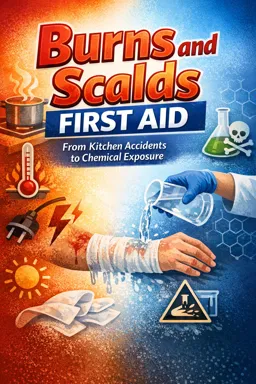
What burns and scalds are (and why recognizing the type matters)
A burn is tissue damage caused by heat, radiation, electricity, friction, or chemicals. A scald is a burn caused specifically by hot liquids or steam. First aid priorities are similar across types: keep yourself safe, stop the source, cool the injury correctly, protect the damaged skin, and decide whether emergency care is needed.
Burns can look very different depending on the cause and depth. In first aid, you do not need to “grade” the burn perfectly; you need to recognize red flags and apply a consistent sequence that prevents the burn from worsening.
1) Common causes you’ll encounter
Hot liquids and steam (scalds)
- Examples: spilled tea/coffee, boiling water, soup, microwaved liquids, pressure cooker steam, kettle steam.
- Typical pattern: irregular splash marks; steam can burn under loose clothing and may affect a larger area than expected.
- Immediate risk: heat continues to transfer from soaked clothing and trapped steam.
Flames
- Examples: stove flare-ups, candles, grills, house fires.
- Typical pattern: can include soot, singed hair, and may be associated with smoke inhalation.
- Immediate risk: ongoing burning of clothing; airway exposure if in an enclosed space.
Hot surfaces
- Examples: oven racks, pans, irons, curling irons, motorcycle exhausts, space heaters.
- Typical pattern: well-defined contact shape (e.g., a line or circle).
- Immediate risk: brief contact can still cause deep injury.
Sun (radiation)
- Examples: sunburn after prolonged exposure; can be worse with reflective surfaces (water/snow) or certain medications.
- Typical pattern: widespread redness, tenderness; blistering in more severe cases.
- Immediate risk: dehydration/heat illness can occur alongside skin injury.
Electricity
- Examples: damaged cords, outlets, appliances, industrial sources, lightning.
- Typical pattern: may have small entry/exit marks but significant internal injury; muscle pain or weakness may appear.
- Immediate risk: heart rhythm problems and deep tissue damage even when skin looks minor.
Chemicals
- Examples: drain cleaners, oven cleaners, pool chemicals, cement/wet concrete, battery acid, lab chemicals.
- Typical pattern: pain, redness, blistering; sometimes delayed symptoms; powders can keep reacting when wet.
- Immediate risk: ongoing tissue damage until the chemical is removed and thoroughly flushed.
2) Immediate actions that apply to most burns (the first-aid sequence)
Use this sequence as your default. Adjust only when a specific cause requires extra safety steps (especially electricity and chemicals).
Step A — Ensure scene safety
- Pause and scan: is there fire, smoke, live electricity, chemical fumes, hot oil, or unstable glass/metal?
- If unsafe, move yourself (and the person if possible) to a safer area before providing care.
- For chemical fumes or heavy smoke, prioritize fresh air and call emergency services.
Step B — Stop the burning process
- Remove the person from the source: turn off heat, move away from steam, extinguish flames.
- For flames on clothing: stop movement, drop to the ground, and roll to smother flames; use a blanket or coat to help smother if available.
- Remove hot/wet items: gently remove rings, watches, belts, and loose clothing near the burn before swelling starts.
- Do not pull off clothing that is stuck to the skin; cut around it.
Step C — Cool appropriately (the key step for thermal burns)
Cooling limits ongoing tissue damage and reduces pain when done correctly.
- Cool the burn with cool running water for 20 minutes as soon as possible (ideally within the first 3 hours).
- Use a sink, shower, gentle tap, or clean container of cool water changed frequently.
- Avoid overcooling: if the burn is large or the person is a child/older adult, cool the burn area while keeping the rest of the body warm (blanket, dry clothing).
- If running water isn’t available, use a cool, clean wet cloth and refresh it often.
Special note: For sunburn, cooling showers or cool compresses can help; focus on hydration and monitoring for heat illness if the person also feels faint, nauseated, or confused.
- Listen to the audio with the screen off.
- Earn a certificate upon completion.
- Over 5000 courses for you to explore!

Download the app
Step D — Protect the injury
- After cooling, cover with a clean, non-stick dressing (sterile non-adherent pad) or cling film/plastic wrap laid loosely over the burn (not wrapped tightly).
- Keep the area clean and protected from friction and contamination.
- If fingers or toes are involved, place a non-stick layer between them if possible to prevent sticking.
Step E — Decide when to seek emergency care (early, not late)
Use the decision points below. When in doubt—especially with children, older adults, pregnancy, or significant medical conditions—seek medical advice promptly.
Cause-specific safety adjustments (still following the same sequence)
Chemical burns: remove and flush
- Protect yourself: avoid touching the chemical; use gloves if available.
- Remove contaminated clothing/jewelry carefully.
- Brush off dry powders before adding water (powders can worsen when wet).
- Flush with cool running water for at least 20 minutes (longer if pain persists), ensuring runoff doesn’t spread to unaffected skin.
- Do not attempt to “neutralize” with another chemical (e.g., vinegar/baking soda); this can cause heat and worsen injury.
Electrical burns: power off first
- Do not touch the person until the power source is disconnected.
- Turn off the breaker/unplug if safe; if not, call emergency services and keep bystanders away.
- Even if the skin burn looks small, electrical injuries can be serious—seek urgent medical evaluation.
Hot oil/grease burns: cool with water, avoid splashing oil
- Move away from the pan and turn off heat.
- Cool the skin burn with cool running water; do not apply ice.
- If oil is on clothing, remove clothing if not stuck; oil retains heat and continues burning.
3) Key “do-not-do” list (prevents worsening the injury)
- Do not use ice or ice water directly on burns (can cause further tissue damage and hypothermia risk).
- Do not apply butter, oils, toothpaste, egg, flour, or home remedies (trap heat, increase infection risk, complicate medical assessment).
- Do not pop blisters (increases infection risk and delays healing).
- Do not peel off clothing or melted material stuck to the skin (can tear tissue).
- Do not apply adhesive dressings directly onto the burn surface.
- Do not wrap tightly with bandages or cling film (swelling can compromise circulation).
- Do not delay cooling while searching for creams or special products—cooling first matters most.
- Do not use “neutralizing” chemicals on chemical burns; flush with water instead.
- Do not ignore signs of inhalation injury (hoarse voice, coughing, soot around mouth/nose, facial burns)—seek emergency care.
4) Quick decision points (used throughout the course)
Use these checkpoints after you’ve made the scene safe and started cooling/flushing.
| Decision point | What to look for | Action |
|---|---|---|
| Airway/breathing concern | Burns to face/neck, singed nasal hair, soot, coughing, wheeze, hoarse voice, trouble breathing, exposure in enclosed fire | Call emergency services immediately; prioritize fresh air and monitoring |
| Electrical burn | Any electrical source involvement, even small skin marks; fainting, chest pain, irregular heartbeat, weakness | Urgent medical evaluation (call emergency services if symptoms or high-voltage/unknown) |
| Chemical burn to eye/face or ongoing pain | Eye exposure, significant pain after flushing, unknown chemical, large area | Immediate emergency care; continue flushing en route if advised |
| Depth looks severe | White/charred/leathery skin, numbness, deep blistering, skin looks waxy | Emergency care |
| Location high-risk | Face, hands, feet, genitals, major joints, circumferential (all the way around) limb | Same-day urgent assessment (often emergency care depending on severity) |
| Size is significant | Burn larger than the person’s palm (rough guide), multiple areas, or large scald in a child | Seek urgent medical care |
| Age/health increases risk | Infants/children, older adults, pregnancy, diabetes, immune suppression | Lower threshold for medical evaluation |
| Symptoms beyond the skin | Fever later, increasing redness/swelling, pus, worsening pain, dizziness, nausea, signs of shock | Medical care promptly (emergency if severe) |
Practical mini-scenarios (apply the sequence)
- Hot tea spill on forearm: move away from spill → remove bracelet/watch → cool under running water 20 minutes → cover loosely with non-stick dressing/cling film → seek care if blistering is extensive or pain is severe.
- Oven rack contact burn on hand: remove hand from source → cool under running water 20 minutes → remove rings → cover → seek care if burn crosses a joint or blisters are large.
- Drain cleaner splash on skin: protect yourself → remove contaminated clothing → brush off any dry residue → flush with running water 20+ minutes → urgent care if large area, persistent pain, or any eye/face involvement.
- Small electrical shock from appliance with a fingertip mark: ensure power is off → assess symptoms (chest pain, fainting, weakness) → cover any skin injury → seek urgent medical evaluation even if the mark is small.